


 Shkruar nga Ermal Peçi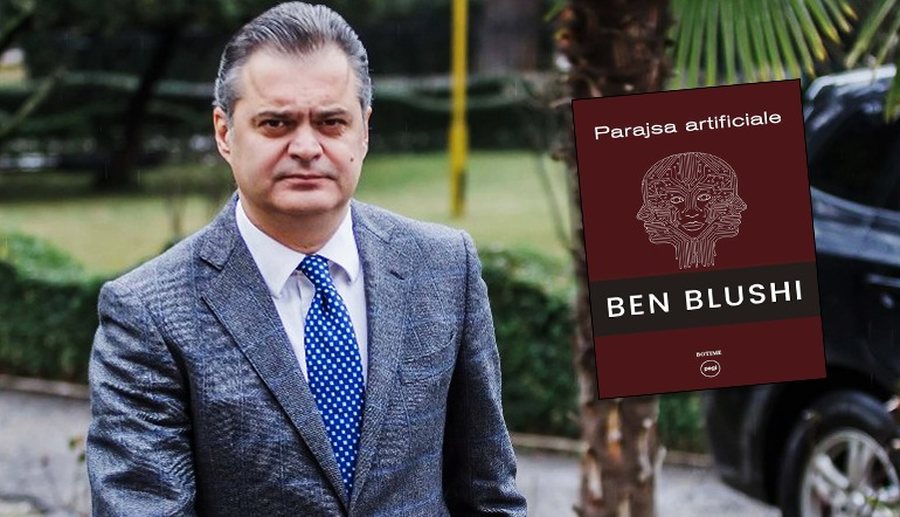
From politics to literature, Blushi has remained a man who tells things as they are, with a realism that often hurts.
What can a writer who knows power from the inside warn today, when he chooses to challenge it with literature? This is the question that comes to mind every time I hear that Ben Blushi will publish a new novel.
Blushi is among those names that leave no one indifferent.
Some see him as a politician, some as a writer, some as an innovator in the media, while others as a man who destroys journalism. There are those who love him, follow him and quote him, but also those who hate him, often without reading him but also by reading him. He is a figure who divides, but precisely in this division lies his strength: Blushi provokes thought, not to be liked, but to be heard.
In this country, for more than three decades, we have learned to think differently in appearance, but not in substance. So for years, Albanians have learned to think differently, to speak differently and to act differently. It is a culture planted in silence as a result of communism, accepted without noise, but which has brought a deep distortion to the soul of our society. We have built a reality where the truth is no longer spoken aloud, but whispered across tables. We have built a culture of silence, of fear of the truth, of whispers that replace free speech.
As a reader and follower of Ben Blushi's thoughts, I eagerly await each of his new novels, because he does not write to entertain, but to warn. And time has often proven him right. From politics to literature, Blushi has remained a man who tells things as they are, with a realism that often hurts.
The new novel, according to the author himself, seems like an alarm bell for a society that is afraid of free speech. When Blushi writes that “the first publisher can’t publish it because he won’t let her go,” he’s not talking about God. He’s talking about power, the invisible one, that controls the book, the screen, opinion, and the public spirit. This is his strongest message: censorship is no longer institutional, but mental, and when fear becomes its own guardian, then speech ceases to be free.
The choice that Blushi entrusts the manuscript to “an atheist” is not a coincidence. It is a symbolic act. The atheist in this case represents the man free from dogmas, from the fear of God and power. He is the only one who can publish without permission, because he does not pray to anyone. A figure who stands in the face of the moral and religious hypocrisy that often masks the lack of civic courage. Thus, Blushi turns the atheist into a metaphor for the free man, of the one who believes only in the truth.
Perhaps this novel will touch on territories that are usually avoided, such as conscience, religion, political and economic power, three pillars on which a society is based. When Blushi says “I don’t know if I’ll need a fourth,” the question implied is much deeper: Does a free man exist in this country anymore? One who fears neither God, nor the state, nor opinion?
In the end, this “short story” could be a long mirror of today’s Albania, a place where literature still dares to say what politics is silent about. Perhaps even though I think that through this novel, Blushi is not only warning about the power that controls, but also about the society that is silent.





Ju lutem kuptoni kete episod.Kur ne une,Blushi,Edi,PS fitum zgjedhjet 12 vjet me pare jam takuar rastesisht me Benin diten qe u shpall rezultati. Fituam i thashe gjithe ngazellim.Ai pa u menduar fare me tha:Nuk ke fiuar gje ti dhe socialistet si ju,por Edi Rama dhe miqte e tij.