


 Shkruar nga Paolo Gentiloni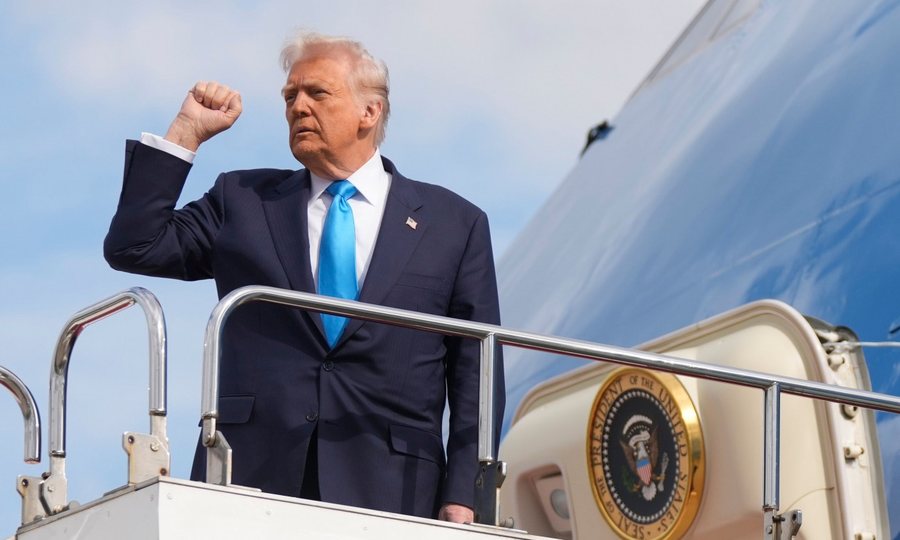
America became a superpower precisely when it stopped playing alone and placed itself at the center of a network of economic and military alliances...
The week in Southeast Asia seemed like a triumphal march, until Trump ran into the Chinese dragon. With Xi Jinping, it became clear that when flattery gives way to power relations, things can get worse, even for the president of the United States. As had happened a few weeks earlier in Alaska, with the red carpet rolled out for Vladimir Putin without getting anything in return.
The truth is that, in the face of great autocracies, America First ends up presenting itself as America Only. And this "America Only" sends dangerous signals of weakness.
In Anchorage, Putin's return to the world's greats was on display, under the banner of "pursuit of peace." The US administration itself understood this by postponing the Budapest meeting that Putin had prepared shortly before Zelensky's arrival at the White House.
In Busan, Korea, the brief summit between the US and China merely sealed a trade truce. An outcome that was undoubtedly positive but generally more favorable to Xi than to Trump, given the ultimatums issued the day before and the silence on Taiwan. In confirmation, the Chinese president indulged in praise of the American strategy: “I believe that our vision of ‘the great rejuvenation of the Chinese nation’ should go hand in hand with your vision of ‘making America great again.’”
That Maga’s vision might not bother China was also evident in relations with Southeast Asian countries. These countries are concerned about Chinese overproduction, often subsidized by the state, but where resentment towards the United States prevails, which abandoned the Trans-Pacific Partnership under Trump and now presents itself as an aggressive competitor. The immediate reaction, not unlike that of Europe, was to try to appease its powerful ally. In the background, however, a growing and alarming Chinese influence is emerging in this part of Asia. So there is something similar in the stories that Europe and Asia tell us. And that is the fact that the economic rules and alliances on which the strength of the United States has been based for decades cannot be questioned without paying a price.
Of course, competition has always existed between the two sides of the Atlantic. But never, in the last eighty years, has economic power been systematically used as a weapon against one's allies. If the economy becomes an open battlefield, it will not be easy to maintain trust in the long run, and in this world without rules, autocracies are more likely to prevail.
At its extreme, America First is, in short, an America that plays alone. In the last century, this solitude was interrupted by the outbreak of two world wars. America became a superpower precisely when it stopped playing alone and placed itself at the center of a network of economic and military alliances, cultivating its own interests, but also those of its allies, including Germany, Japan, and Italy, who had also lost the war.
Overturning this success story with a new isolationist approach is far from a given. The alarming symptoms are numerous: there is the trade war that does not distinguish between adversaries and allies, there is the National Guard stationed in Chicago and Los Angeles, there is an evolving Monroe Doctrine, now being tested by the Maduro dictatorship, there is indifference to the fundamental values of democracies in the rest of the world. All true. But the more traditional line, which sees alliances as the key to winning the confrontation with Chinese techno-nationalism and Russian imperial nostalgia, still exists, firmly embedded within the administration itself.
We Europeans must do everything we can to prevent, or at least delay, an isolationist shift. By holding high the flag of the free world and its common interests. By clinging to the importance of transatlantic relations and friendship with the US at every level. But all this without closing our eyes. And for this reason European protection, new markets, from Latin America to Indonesia and, tomorrow, India. And a reestablishment of economic and trade relations with China, which certainly cannot be benevolent, but must develop independently and not as an appendage of American decisions.
Most importantly, and woe to anyone who forgets, support for Ukraine will matter, starting with economic support, including the use of frozen Russian assets. Because only a Europe that fights for a just peace in Ukraine will have a role in the new great game that is unfolding in the world./ Adapted from “Pamphlet” by “La Repubblica”




Lini një Përgjigje