


 Shkruar nga Diplomatico | Pamfleti.net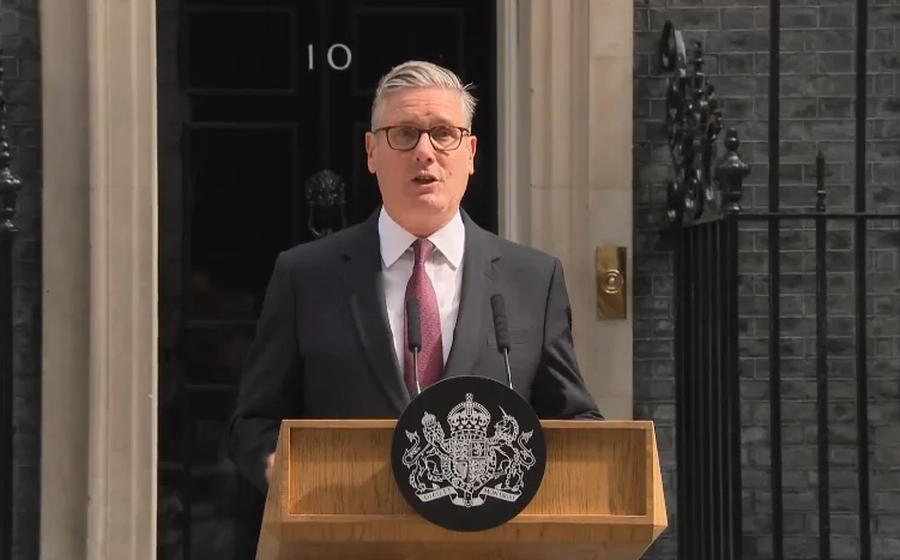
Two years after the plebiscite victory, the Labour leader leaves Downing Street. In a Europe of political crises, mandates are being shortened faster than electoral promises.
The expected resignation of British Prime Minister Keir Starmer marks the end of one of the shortest political experiments in modern British history. The man who in July 2024 won an overwhelming parliamentary majority and ended 14 years of Conservative government is leaving Downing Street after just two years in power, abandoned by MPs, ministers and a large part of his electorate.
Starmer was not brought down by the opposition. He was not brought down by a personal scandal. He was not brought down by a constitutional crisis either. He was brought down by a phenomenon far more dangerous for any political leader: the loss of trust within his own party.
In recent days, cabinet ministers and senior Labour figures have publicly and privately urged him to announce a timetable for his departure. Some have seen his stay in office as an electoral burden on the party.

The crisis did not erupt overnight. It has been building gradually over the past few months. Disappointing results in the 2026 local elections, losses of support in traditional Labour areas and the rise of alternative forces such as Reform UK and the Green Party created a belief that the government had lost touch with the electorate.
At the center of the rebellion emerged the figure of Andy Burnham, mayor of Greater Manchester and one of the most popular politicians on the British left. For months, Burnham was considered Starmer's silent rival.
Ironically, Starmer himself had helped to establish himself as a rival. In January of this year, Labour leaders blocked Burnham from returning to Parliament, a decision that sparked outrage among dozens of MPs and activists. Many interpreted it as an attempt by the leadership to eliminate its most serious rival.
But British politics has an old adage: the more you try to stop a contender, the stronger they become. Burnham’s victory in the recent by-election was a turning point. Within days, his name was being openly mentioned as Starmer’s successor. Polls showed that a majority of Britons saw Burnham as the most credible alternative to leading Labour.
Starmer’s fall is also the story of a political project that lost its identity. When he took over the leadership of the Labour Party in 2020, he promised to build a modern, pragmatic force capable of governing. He removed the party’s most radical figures, brought together the political center and won the election on a moderate platform. But once he entered government, he faced the same problem that has plagued almost all traditional European parties: a lack of a distinct vision. Many voters began to see him as an administrator of the system rather than a reformer of it.
The economy did not produce the results the public expected. Debates over immigration, energy and public services created ongoing tensions. Factions formed within the party accusing the government of having lost its ideological orientation. Even important figures such as Angela Rayner began to publicly express dissatisfaction with the course pursued by Starmer.
If the resignation is fully confirmed, Britain will have changed its seventh prime minister since the Brexit referendum in 2016. This fact speaks louder than any analysis. Once considered a symbol of European political stability, Britain today produces prime ministers at a rate that even Italy in its most unstable years would envy.
However, Starmer’s departure does not solve the main problem. The British crisis is not just about the name of the prime minister. It is about the exhaustion of the traditional model of major parties. The Conservatives lost power because citizens no longer trusted them. Labour gained power, but very quickly lost trust. This is why Nigel Farage, the Greens and other peripheral forces are gaining ground. Voters are not just looking for a new leader. They are looking for a new alternative.
Keir Starmer will be remembered as the man who returned Labour to power after a decade and a half in opposition. But history may be more ruthless. It may remember him as the leader who won a historic majority and consumed it faster than any of his predecessors. / Pamphlet



Lini një Përgjigje