


 Shkruar nga Pamfleti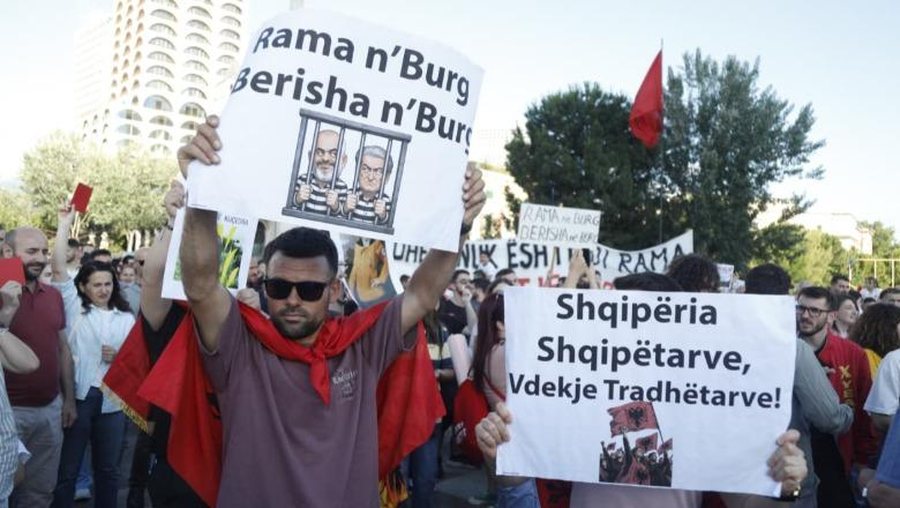
Thousands of citizens again in front of the Prime Minister's Office with the chants "Rama in prison", "Berisha in prison" and "Resign". The movement that started for Zvernec has turned into the largest citizen revolt of the last 35 years against the entire political establishment.
For the 12th day in a row, thousands of citizens have gathered in front of the Prime Minister's Office in Tirana, confirming that what began as a protest against projects in Zvernec has transformed into an unprecedented movement against the entire Albanian political class.
With chants of "Rama in prison", "Berisha in prison", "Resign" and "Albania is not your property", the protesters have marched once again towards the center of political decision-making, conveying a message that has been becoming increasingly clear for days: anger is not directed only at the government, but at the entire political model that has dominated Albania in the last three decades.
The history of Albanian pluralism has seen protests organized by parties, electoral rallies, opposition protests, and strong political clashes. But rarely, if ever, has such a civic mobilization been seen that is not led by political parties, not controlled by traditional structures, and not led by the usual names of politics.
This is precisely the element that has made the protest of recent days different from anything Albania has seen in the last 35 years.
In the square, not only calls against Edi Rama are heard. Equally strong are the calls against Sali Berisha, the Democratic Party and the traditional opposition. For many of the protesters, the problem is not only related to a government or a specific mandate, but to a political class that, according to them, has consumed the trust of citizens.
In this sense, the protest has become a double slap in the face for Albanian politics.
On the one hand, it is putting Prime Minister Edi Rama in a difficult position, who for days has tried to treat the movement with irony, minimizing its size and impact. However, the fact that the protest continues to gather citizens for days and is attracting attention even outside Albania, shows that the government is facing an unusual situation.
For the first time in his political career as prime minister, Rama is facing a movement that does not come from his traditional political opponent and that cannot be easily labeled as an opposition protest.
On the other hand, the developments of recent days also constitute a blow to the opposition. For years, the Democratic Party has organized protests, rallies, and gatherings against the government, but has rarely managed to produce a mobilization similar to the one appearing today on the streets of Tirana.
This is the paradox of the Albanian political moment: while citizens are filling the squares against the government, they simultaneously refuse to give credit or representation to the traditional opposition.
Many of the participants have openly stated that they are not protesting to hand power to another party, but to challenge the entire political establishment created after the '90s.
Therefore, after 12 days of protests, it seems that the movement has entered another phase. It is no longer just a reaction to a project in Zvernec or to a government decision. It has become an expression of the dissatisfaction accumulated over years with a political system that many citizens consider worn out.
And this is precisely the element that makes the protest special: for the first time in many years, the square is not demanding political rotation. It is demanding a change in the very way Albanian politics is structured. / Pamphlet



Lini një Përgjigje