


 Shkruar nga Pamfleti
Brent reaches $111.04 per barrel, as market remains sensitive to wars, recessions and supply disruptions
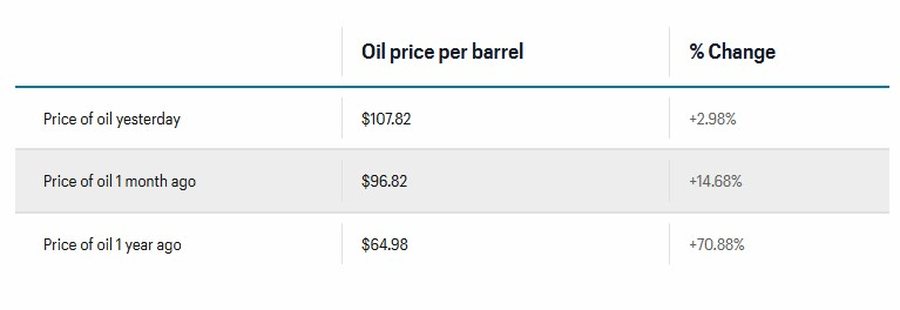
The price of Brent crude, the main international market benchmark, reached $111.04 per barrel. This represents an increase of $3.22 compared to the previous day and about $46 more than a year ago.
Experts emphasize that predicting the movement of oil prices remains difficult, as the market is influenced by many factors. Essentially, prices are determined by the relationship between supply and demand, but geopolitical developments, fears of economic recession or international conflicts can also quickly change the direction of the market.
The price that consumers pay at gas stations does not depend only on crude oil. It also includes the costs of processing, transportation, taxes and the profit margin of distribution companies.
Since crude oil accounts for the majority of the cost per liter or gallon, its increase usually also leads to higher fuel prices. However, when the price of oil falls, the reduction in fuel prices often occurs more slowly. This phenomenon is known in the market as “rockets and feathers,” where prices rise quickly but fall gradually.
The role of the US strategic reserve
The United States maintains a strategic reserve of crude oil, known as the Strategic Petroleum Reserve. Its main purpose is to guarantee energy security in emergencies, such as sanctions, major storm damage, or military conflicts.
This reserve can also be used to cushion sharp price increases during supply crises. However, it is considered a short-term measure and not a permanent solution, aimed at supporting consumers and critical sectors of the economy, including public transport and emergency services.
The connection between oil and natural gas
Oil and natural gas remain two of the world's main energy sources. For this reason, strong changes in the price of oil can also affect the gas market.
In cases where oil becomes more expensive, some industries may partially switch to using natural gas, increasing demand and potentially its price.
History of oil market fluctuations
Two main standards are commonly used to analyze the historical performance of oil:
Brent, the global oil market benchmark;
West Texas Intermediate (WTI), the leading benchmark in North America.
Brent is considered the most representative indicator for the global market, as it is used to price a large portion of internationally traded oil. The US Energy Information Administration (EIA) also now uses Brent as its main reference in long-term reports.
Historically, the oil market has gone through periods of strong fluctuations:
In the early 1970s, the embargo of Middle Eastern countries during the Yom Kippur War caused the first major oil crisis.
In the mid-1980s, prices fell due to lower demand and the entry of new producers outside OPEC.
In 2008, prices rose sharply on global demand, but then fell after the global financial crisis.
During the COVID-19 pandemic lockdowns in 2020, global demand shrank significantly and prices fell below $20 per barrel.
Analysts estimate that the oil market remains one of the most sensitive to international crises, energy policies, OPEC decisions and global economic developments. / Pamphlet /








Lini një Përgjigje