


 Shkruar nga Fadil Lepaja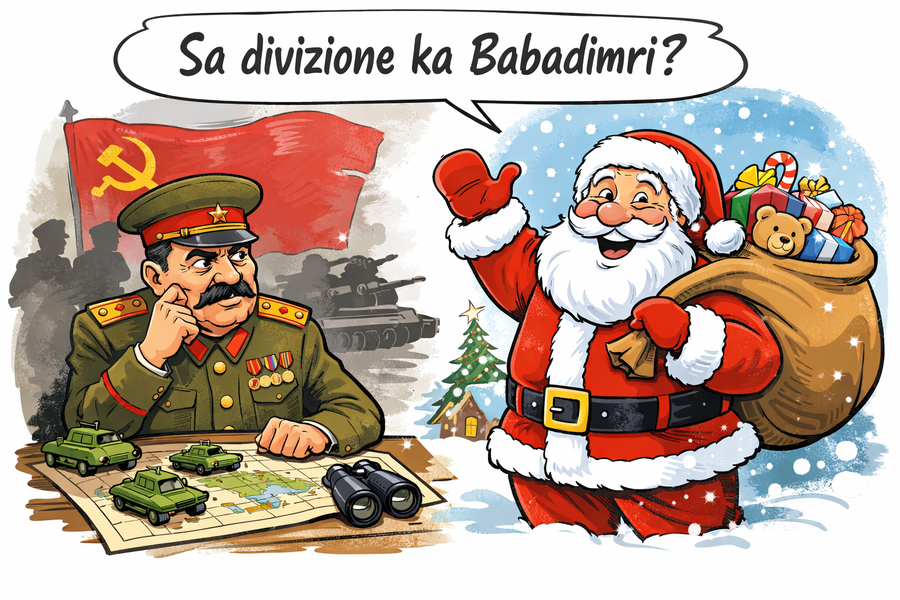
Santa Claus, the Pope and the end of ideologies: when fun defeats power...
“How many divisions does the Pope have?” – Stalin had once cynically asked, at a time when socialism was at the height of its power. The dictatorship of the proletariat was presented as the pinnacle of freedom, while the only accepted god was Stalin himself. The lack of military power and faith, the creation of socialist man and the same morality, made realism seem more reasonable than mysticism.
A few decades later, fed up with realism and insatiable with bread, the citizens of the Eastern Bloc returned to their faith. They prayed silently and hoped that God would save them from the equality imposed by force. The ideology of equality was opposed by the ideology of humanism and mercy, which triumphed with the fall of the Berlin Wall.
History returned Stalin's answer with irony: Pope Karol Wojtyła, without any division, with only a sermon and Polish solidarity, overthrew the red empire. But the collapse had occurred from within: man had defeated the system, imperfection had destroyed perfect theories.
After that time, the world entered an era of freedom and debauchery. The power of man had never been greater, but systems continued their war with the individual. This is where Santa Claus entered the picture. Santa Claus became the new spiritual leader of the planet, celebrated even by those who were not Christians.
As authoritarian ideologies clashed with humanism, people began to live for pleasure, spending more on entertainment than on necessities. On the eve of the holiday, Stalin's question is reframed: "How many divisions does Santa Claus have?"
This secular character, who comes on December 31 at midnight, dressed in red, without an army and without political power, has another power – the atmosphere. He brings joy in the face of order, fluctuation in the face of rigid walking, imperfection in the face of the system. He tells us to love life, to cultivate happiness, because this is our responsibility as humans. For the rest, we have machines, robots, artificial intelligence.
And the atmosphere, surprisingly, is stronger than ideologies. That's how we all become children.
The war between East and West ended, democracy won, but a rift remained within the individual: democracy is the power of the majority over the minority, while entertainment is man's rebellion against the system and morality.
Technology feeds us, keeps us warm, gives us knowledge. But why is all this happening? Are we going to become robots? Omniscient? Why?
Will Santa Claus also destroy the God within us – the one who tells us what to do?
The 20th century was a century of conflict: freedom against dictatorship, faith against atheism. The Cold War was not just about territory, but about minds and hearts. Today, behind the Berlin Wall, great ideologies are like dusty books: no one reads them.
Technology can do everything, except create meaning for man. Entertainment has become the new ideology. There is no longer a need for treatises and sermons. People want to feel good, to celebrate, to forget the burden of responsibilities.
And Santa Claus is the symbol of this era: there are no divisions, but there are millions of hearts that await him with joy.
In Stalin's time, power was measured by tanks. Then by money. Today it is measured by power over oneself, by the ability to create an atmosphere. Robotics, artificial intelligence, religious or ideological sermons cannot replace this. The atmosphere is human, tangible, experiential. It cannot be programmed, nor imposed by force.
Santa Claus declares war not only on ideology, but also on traditional morality. Once entertainment was seen as the opposite of order and responsibility. Today it has become the ultimate goal of life. The society that once built ideological utopias, today builds spaces of entertainment.
Pope Wojtyła overthrew an empire with morality. Santa Claus goes beyond humanism.
Stalin's question was ironic, but the question about Santa Claus is even more ironic: "How many divisions does he have?"
Entertainment as ideology has a mission: to deconstruct the concept of “common sense.” Doesn’t political thought destroy happiness? Doesn’t Santa Claus endanger the bureaucrats who promise collective happiness?
The answer is simple: have fun!
In this atmosphere, readers can run to the fir tree to see the power of Santa Claus. And the best gift for Kosovars would be a new acquaintance – the fifth this year – precisely from the state of Lapland.
The President sought recognition not from Santa Claus, but from the Vatican, where she was received with respect. But relations between the churches make it impossible for the Pope to recognize Kosovo.
But will geopolitics hinder Lapland's recognition? Will common sense defeat the "ideology" of entertainment, just as it defeated perfect justice and perfection itself?
Believe me, entertainment demands no allegiance, imposes no morals, has no “divisions.” It is an absence of ideology, a void where the individual does not need to believe, but simply to feel good.
Instead of fighting for ideals, fighting each other, let's fight for moments of joy. Fun is a rejection of common sense - it doesn't ask "why", it says "why not?".
Never mind, even Santa Claus will come to us drunk, it seems. AI and robots take care of our food, organization and security. We have captured the code of the universe and of life. But man refuses to be coded.
Mira Murati says she created machines that think, but they don't make fun, they think silently. They think about us.
Hey people, let's have some fun. The machine and the system are thinking about us.
The time for the slushies is coming.
Pssst, be quiet, you machines. Do you work for us or do we work for you?
Happy!/ Pamphlet



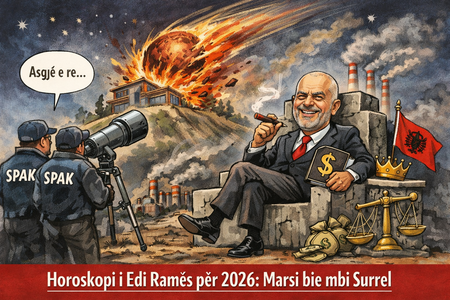

Dmth, qe zgjedhja e Papes ka lidhje "simbolike" me ndryshimin. Polaket e Vojtiles dhane sinjalin e shketerrimit te Sovjetikeve e Papa i USA eshte sinjali i dominimit global nga USA. Mire shume.