


 Shkruar nga Gjergj Zefi
Promises of a quick victory clashed with the reality of a protracted conflict, with no winners and growing global consequences...
Today, developments on the ground and international media analysis are confirming point by point what was then considered a grim warning.
Reality has debunked the “surgical strike” narrative. A state like Iran, with a complex power architecture and consolidated resistance mechanisms, is not the target of a swift military operation that produces political capitulation.
On the contrary, any external pressure tends to harden internal structures and increase cohesion around the ruling elites. This is exactly what is happening: not a regime in decline, but a system that adapts and resists.
On the other hand, the United States' strategic calculations are proving more complex than initially anticipated. The declared objectives remain unarticulated in concrete results, while the political and economic cost is progressively increasing.
The war has not produced a decisive moment; it has become a consuming process, where time works against expectations of a quick victory. This is the classic paradox of modern interventions: military superiority does not automatically translate into strategic advantage.
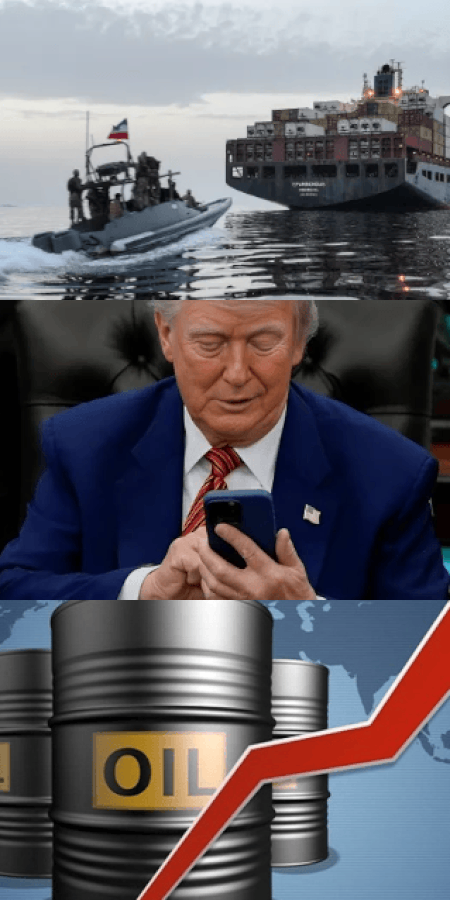
Meanwhile, the domino effect on the international system has been immediate. The Strait of Hormuz, a vital artery of global energy, has become a pressure point that goes beyond the boundaries of conflict.
Energy prices, market uncertainty, and the fragmentation of Western positions prove that this is not a regional war, but a crisis with global resonance. Europe appears ununited, while other actors take advantage of the vacuum created.
In this context, the idea of regime change once again emerges as a theoretical construct rather than a feasible objective. The history of previous interventions has shown that the overthrow of a political structure in the Middle East does not necessarily produce stability; often, it produces the opposite. Today, the lack of a clear exit strategy makes this conflict not only difficult to win, but also dangerous to end.
Essentially, what we are seeing is a clash between perception and reality. The perception of a controllable, limited, and winnable war is quickly being replaced by the reality of a prolonged, costly confrontation with no clear winner. And therein lies the crux of the original mistake: underestimating the adversary and overestimating the instruments of force.
The economic consequences and political pressures are direct, while the need for diplomatic positioning becomes more complex in an increasingly volatile international environment. Ultimately, this conflict is proving an old truth of geopolitics: the most dangerous wars are not those that break out suddenly, but those that are started with the mistaken belief that they will end quickly./ Pamphlet



Lufterat tashme nuk mbarojne shpejt, por mund te zgjasin me vite te tera, sic ka ndodhur ne Kore, ne Vietnam, ne Afganistan etj. Ky Trump-i a thua se nuk i ka pare vete keto luftera. Qenka nje byk qe do te tregohet si perandor.
Pavarësisht nga zgjatja dhe rritja e cmimit të energjisë, etj, nga kjo luftë Irani do të ndryshojë. Ai nuk do të jetë më një fuqi që synon të zhdukë Izraelin si shtet dhe as të nxisë e të drejtojë terrorizmin. Lufta do të përfundojë me forcimin e botës së lirë demokratike dhe dobësimin e pushteteve diktatoriale autokratike.
Ça thua mo me këto parrulla
Po ne "c'na duhet izraeli?
Cfar përralla po shkruan ? Qenke ndikuar nga mashtrimi i i mediave
Gabim e ke. Irani do dale me i forte se kurre, do behet fuqi regjionale e pakontestuar. Shtetet fqinje sdo jene kurre me si kane qene. Sa per terorizmin Israeli eshte shteti me terorist dhe gjenocidal ne bote.
Rroftë PPSH, rroftë Shoku Enver, rroftë kllasa punëtore. Ps. Ç'mund të presësh nga dikush qe quhet Thanë
Se harrova, rroftë Netanjahu dhe Zionizmi
po.pse nuk thoni se kjo.jet nuk esht.me e mir se kohet.kan ndryshuar..jo kohet jam njelloj jan njerezit.qe.ndryshojn