


 Shkruar nga Pamfleti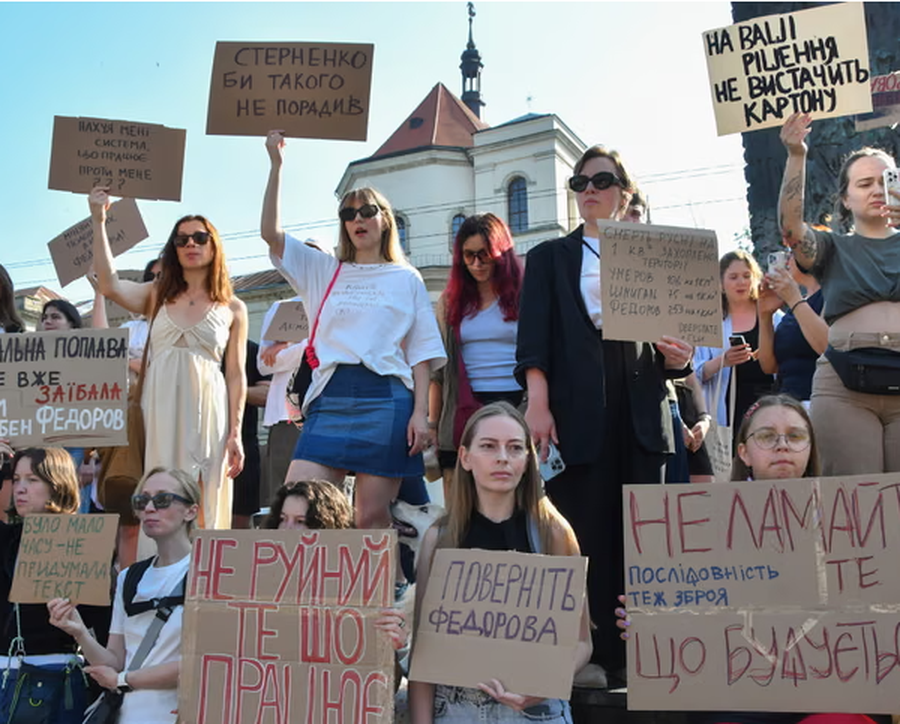
One of the most popular figures of Ukraine's new political generation has left the government, exposing for the first time publicly a deep rift at the top of power in Kiev. President Volodymyr Zelensky's decision to fire Defense Minister Mykhailo Fedorov has sparked rare wartime protests and opened a debate about the direction the Ukrainian leadership is taking.
Ukrainian President Volodymyr Zelensky has defended his decision to dismiss Defense Minister Mykhailo Fedorov, publicly acknowledging that relations between the ministry and military leaders had deteriorated to the point of open conflict. The decision has highlighted a rare political crisis in Kiev at a time when the war with Russia continues and internal unity is considered vital.
At a joint press conference with British Prime Minister Keir Starmer, Zelensky said that there had been a "difficult dialogue" between Fedorov, considered one of the government's most reformist figures, and the army's commander-in-chief, General Oleksandr Syrskyi.
" I would very much like there to be unity. The parties failed to find it. The problem is not only with them, but also with me. But the situation is what it is. At such a moment you have to choose one side or the other ," the Ukrainian president said.
With this statement, Zelensky confirmed that he had chosen to support the country's military leadership, temporarily appointing the head of the Security Service of Ukraine, Yevhenii Khmara, as head of the Ministry of Defense, and seeking Parliament's approval for his appointment.
The decision sparked strong reactions in Ukraine. More than a thousand protesters gathered outside the presidential office in Kiev, in one of the largest anti-government demonstrations since the Russian invasion began in 2022. Demonstrators held banners in support of Fedorov, while chants against Syrskyi could be heard in the crowd. It was only the second time during the war that a decision by Zelensky brought such a large number of citizens to the streets.
A few hours after his dismissal, Fedorov appeared before the media and openly accused the military leadership of blocking reforms. He said that decisions on supporting military brigades, including the deployment of drones, were made on the basis of "loyalty" and not operational data.
" It is impossible to develop the system on this basis ," he declared, adding that the General Staff had thwarted plans to modernize the army, create centers of excellence, and change the organizational structure, replacing reforms with bureaucracy and resistance to change.
Fedorov also revealed that he had proposed replacing Commander Syrskyi, a move that, according to many observers, led directly to his removal from office.
" This culture must disappear. Otherwise we will not be able to defeat an enemy that suffers from exactly the same problems. We have no other way if we want to defeat Russia with the least possible losses ," he said.
The clash comes as Ukraine has recorded some of its most significant military successes in recent months, striking Russian refineries, strategic infrastructure and targets in Crimea. However, developments on the front line are giving way to a political crisis at the heart of power.
Just a day earlier, the Ukrainian parliament also approved the resignation of Prime Minister Yulia Svyrydenko, after Zelensky declared that the government needed a "restart."
For many participants in the Kiev protests, Fedorov's departure is not only related to disagreements with the military leadership, but also to his political profile. At 35, he was considered the face of institutional modernization and was seen by some as a figure with the potential to play a greater role in Ukraine's political future.
It is not the first time Zelensky has parted ways with highly popular associates. In 2024, he also dismissed former commander-in-chief Valerii Zaluzhnyi, who was later appointed Ukraine's ambassador to London.
Fedorov's departure and the strong reaction he has provoked show that, while the war with Russia continues on the front lines, another battle is taking place in Kiev: that between the vision for reform and modernization, on the one hand, and the traditional military establishment, on the other. / Pamphlet



Lini një Përgjigje