


 Shkruar nga Pamfleti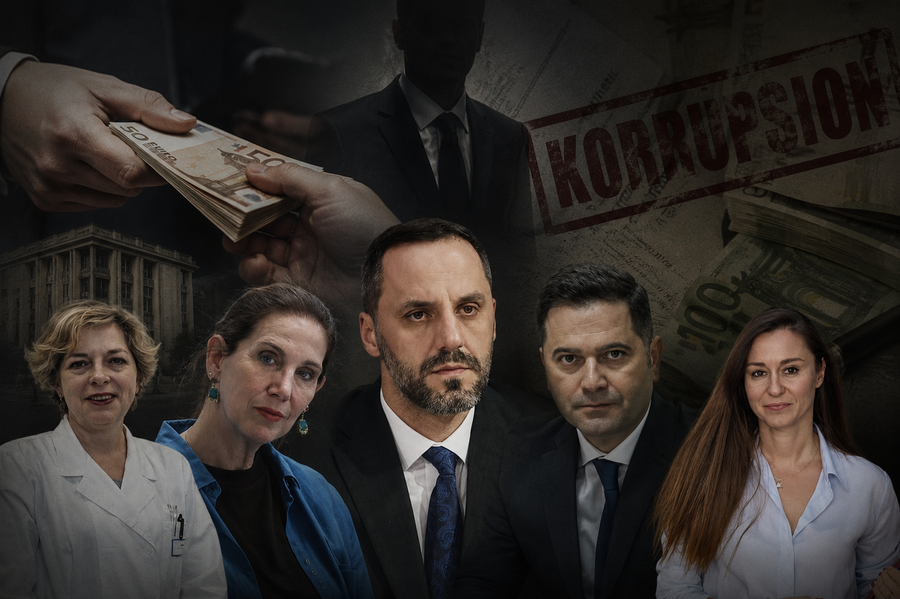
The European Union publishes a list of sectors where corruption is rife...
Healthcare, Cadastre, public procurement, public-private partnerships (PPP), education, State Police, tax administration and customs are sectors where corruption rules the law.
This is the assessment of the European Commission in the Rule of Law Report 2026, which emphasizes that, although a system has been established to identify corruption risks, other concrete measures are needed to prevent abuses in these areas.
According to the report, corruption continues to be particularly problematic in health, education, public procurement, public-private partnerships (PPP), law enforcement structures, cadastre and property administration, tax administration and customs.
The European Commission also expresses concern about state-owned or partially state-owned enterprises, which manage important public projects, including procurement in the infrastructure and digitalization sectors, as well as projects financed by European Union funds.
“ Several sectors continue to be identified as particularly vulnerable to corruption risks, notably health, education, public procurement, public-private partnerships, law enforcement, property, tax administration and customs. Business integrity remains an area that requires particular attention. Corruption risks also persist in state-owned or partly state-owned enterprises, which have taken on important public responsibilities, including public procurement in the digitalisation and infrastructure sectors, involving European Union funds. Transparency in public procurement procedures, particularly for public-private partnerships, remains limited, especially as regards the granting of strategic investor status. Political interference remains widespread and requires stronger safeguards ,” the report highlights.
Another problem identified is the lack of transparency in public procurement, especially in public-private partnership contracts and in the procedures for granting strategic investor status. The report highlights that political interference remains widespread, calling for stronger measures to protect the integrity of institutions.
Brussels underlines that the National Anti-Corruption Strategy 2024-2030 has identified public infrastructure, cadastre and property rights, customs, tax administration, education, health and public procurement as priority sectors for intervention.

The report notes that during the reporting period, corruption risk assessments were conducted or initiated in some of the sectors with the highest exposure, including public procurement, health and property management, but emphasizes that the implementation of measures must be accompanied by concrete results, continuous monitoring and stronger inter-institutional coordination.
“ The perception of experts, citizens and business leaders is that the level of corruption in the public sector remains high. In Transparency International’s Corruption Perceptions Index 2025, Albania scored 39 out of 100 and ranked 91st out of 181 countries in the world. This perception has improved over the last five years.
The 2026 Special Eurobarometer on Corruption in Albania shows that 86% of respondents consider corruption widespread in their country (EU average is 71%), while 39% feel personally affected by corruption in their daily lives (EU average is 30%) , the report highlights.
So it seems that the sectors where corruption is rife are those led by Lorena Goxhobelli of Cadastre, Evis Sala of Health, Mirela Kumbaro of Education, Petrit Malaj of Finance or Besfort Lamallari of Internal Affairs. /Pamphlet







Lini një Përgjigje