


 Shkruar nga Sebastien Maillard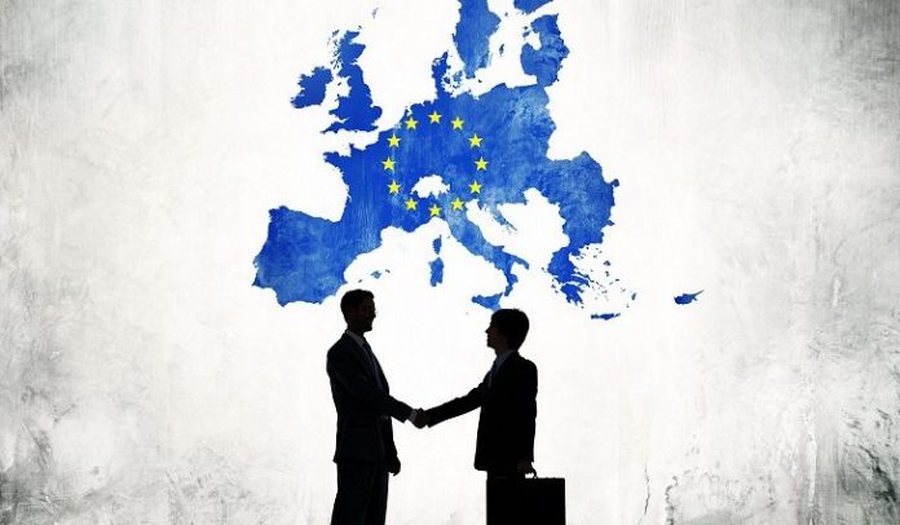
Europe is often described as slow, bureaucratic, divided and in decline. Yet never before has it aroused so much interest: nine countries are knocking on its door, the United Kingdom is getting closer again, and Iceland is considering returning to the EU. A paradox.
It has become common to lament Europe, to complain about its divisions, to highlight its marginalization, to criticize its slowness and bureaucracy. Not without reason. However, while May 9th annually commemorates the launch of European integration, in 2026 Europe has never been so attractive.
This is evidenced by the nine countries that are now knocking on its door, from Albania to Ukraine and Moldova. Or that could knock again, like Iceland, if the referendum planned for August 29 decides in favor of it. Other countries are standing by the door, like the United Kingdom.
Ten years after the referendum on leaving the European Union, which brought about a “hard Brexit”, the aim is now to align with European law and “the closest possible rapprochement” for the British economy. According to a YouGov poll last September, 53% of Britons would like to return to the EU, while a third would oppose it. The Scottish and Welsh nationalist parties, which are considered favorites in the regional elections on May 7, see their emancipation only within the European Union.
The perception of Europe has changed radically. During Brexit and the crises that hit it one after another, the financial crisis, the euro crisis, and the migration crisis, the foundations of the European project seemed shaky and the common currency was in danger of collapsing.
The very existence of the EU seemed uncertain. Jean-Claude Juncker described the European Commission in 2014 as “the Commission of last resort.” Ten years later, Emmanuel Macron focused his second speech at the Sorbonne on the idea of a “mortal Europe.”
Europe remains undoubtedly fragile. It is threatened by a “slow agony”, as Mario Draghi warned in his famous report on competitiveness in 2024. It still has major reforms to implement, as the Letta report also calls for. But in the face of the Russian threat, Trumpist statements and China’s trade aggression, Europe also appears to be the most reliable shield. Even the candidate countries for membership have understood this well.
Shelter of political stability
In the geopolitical chaos dominated by power relations and imperial logics, where transatlantic solidarity has become more precarious than ever, the 27-nation bloc is seen as a haven of political, monetary and legal stability.
"Before, people came to Europe for financial support and infrastructure. Today, it is perhaps the last peace project on Earth," summed up Montenegro's Prime Minister, Milojko Spajić, on April 9 during a pro-European event in Barcelona.
Moldovan President Maia Sandu expressed it similarly in an interview with Le Monde on April 29, describing her country’s path to the EU as “a survival strategy as a democratic state.” The possibility of a new Icelandic candidacy also demonstrates this need for European anchoring, even for wealthy and stable countries.
Even the repeated assertion that Canada would rather become the 28th EU state than the 51st US state expresses this spirit, albeit humorously. Meanwhile, populists, having lost Viktor Orbán as a central figure, are attacking Brussels less harshly. Europe today looks less like a project to be saved and more like a project to save us for the future.
Two opposing perceptions
In fact, both of these perceptions run parallel. On the one hand, a Europe seen as powerless from within and a “scapegoat” for our weaknesses; on the other, a Europe desired from without. The contrast is particularly evident in France, where the population is among the least trusting of the EU in the entire bloc, according to last autumn’s Eurobarometer.
How can the expectations of old member states, which are trying to restore industrial competitiveness and reduce their pronounced dependencies, as the energy crisis currently shows, be reconciled with those of countries facing imperial ambitions and seeking to secure their national future by joining the EU, such as Ukraine, which aims for membership as early as 2027?
Essentially, both inside and outside the EU, the same need for security is growing: military, technological, energy, economic and democratic, in the face of foreign interference. The enlargement of the European Union is inseparable from the deepening of its security dimension.
At the recent European summit held in Cyprus, the heads of state and government discussed how to make the mutual assistance clause provided for in Article 42.7 of the European Treaty operational. Ukraine is now an essential part of this strategic reflection. This large country can also contribute to making Europe more innovative.
Even if full membership is not for tomorrow or is not an objective, as in the case of the United Kingdom or Switzerland, the EU remains the central part of a new European ensemble, perceived as indispensable in an increasingly dangerous world./ Adapted from "Pamphlet", from "Les Echos"
Sébastien Maillard is a special advisor at the Jacques Delors Institute and a fellow at Chatham House (London).


Lini një Përgjigje