


 Shkruar nga Pamfleti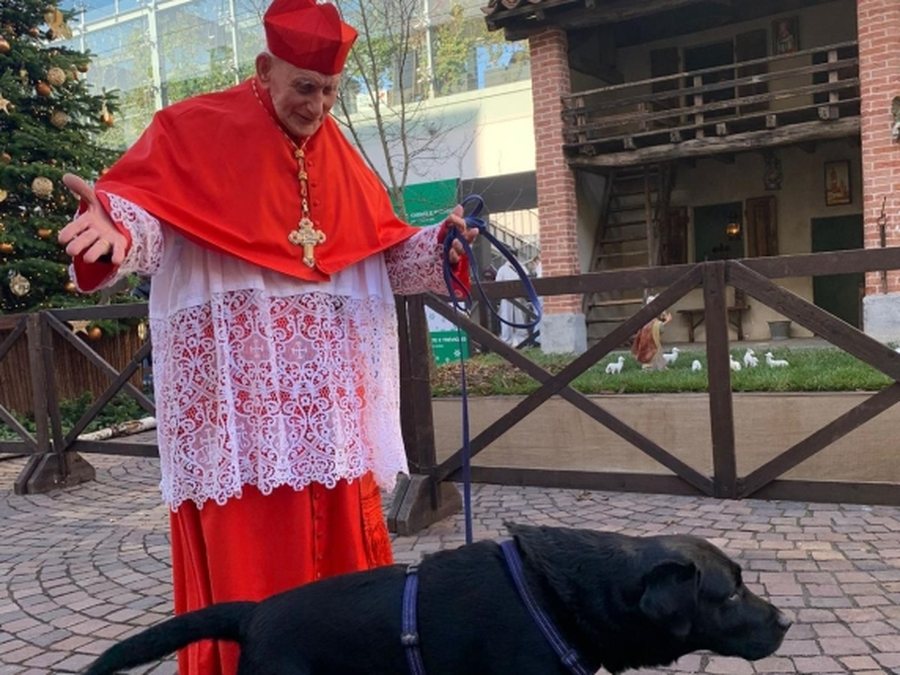
From prison to altar: The shocking story of Cardinal Simoni, a story that touched the hearts of young Italians
He is 97 years old, but his voice still carries the weight of a life spent in suffering, prayer, and forgiveness. Albanian Cardinal Ernest Simoni is not simply a witness of the times, but a living symbol of spiritual resistance in the face of dictatorship.
He brought his story to the students of the city of Treviglio in Italy. The meeting, held at the TNT theater, deeply touched over 300 young people from schools in the area.
The event was organized by the ABF center in Treviglio, as part of a joint initiative of the Caravaggio and Treviglio schools on the theme of peace. “After we invited the cardinal and he accepted, we decided to open the activity to all students,” said the director, Davide Finazzi. In his account, the cardinal was assisted by his personal secretary, Vieri Lascialfari.
Ernest Simoni, born in 1928, showed early religious inclinations. At the age of 4, his mother saw him “playing” the mass, and at the age of 10 he asked to enter the Franciscan convent in Shkodra. With the end of World War II and the coming to power of the communist regime of Enver Hoxha, religious belief was banned and atheism was established as state policy, with severe penalties for violators.
The assembly where the young Simon was was targeted. The police hid weapons under the altar to stage a mass arrest, which ended with the execution of the priests and teachers, while the novices were expelled and then recruited into the army. Simon served as a soldier from 1953 to 1955, under difficult conditions, but he never abandoned his spiritual calling and continued his theological studies in secret.
He was ordained a priest in 1956 and began his pastoral mission. But this was enough to put him on the target again. On Christmas Eve 1963, while he was celebrating mass, four soldiers entered the church, let him finish and then communicated the order for his death sentence. The reason: he had celebrated mass for the soul of American President John F. Kennedy, who had been assassinated a few months earlier. “They took off his liturgical vestments and kicked him in front of his mother who was in the front row of the church,” recalls his secretary.
The death sentence was later commuted to 25 years in prison, in a cell as small as one and a half meters. It was during this period that Simon embraced a motto that he carried throughout his life: “To love your enemies, to forgive them, to pray for them and, if necessary, to give your life for them”. In prison, he continued to celebrate mass and became a spiritual leader for the prisoners. For this reason, in 1973 he was convicted again for “inciting revolt” and was given another death sentence, which was later commuted to forced labor in the copper and pyrite mines.
After 1981, he was released from prison, but the regime still considered him an "enemy of the people" and forced him to work in the city's sewers. It was only with the fall of the dictatorship in 1991 that he was free to wear the priest's robes again and help reopen churches in the villages.
In 2014, Simoni was the only priest to survive communist persecution in Albania. When Pope Francis visited the country for the first time, he specifically asked to meet him. His testimony moved the Pope, who described him as a “living martyr” and in 2016 appointed him cardinal.
“Pray for those who persecute or insult you,” the cardinal told the students of Treviglio. “We must always be messengers of peace and friendship. For every person, whatever their color, nation or religion, we must pray without ceasing and persuade them to love one another. Because we are all God’s masterpieces.” /Adapted from “Pamphlet” by “ Corriere Della Sera ”



Lini një Përgjigje