


 Shkruar nga Pamfleti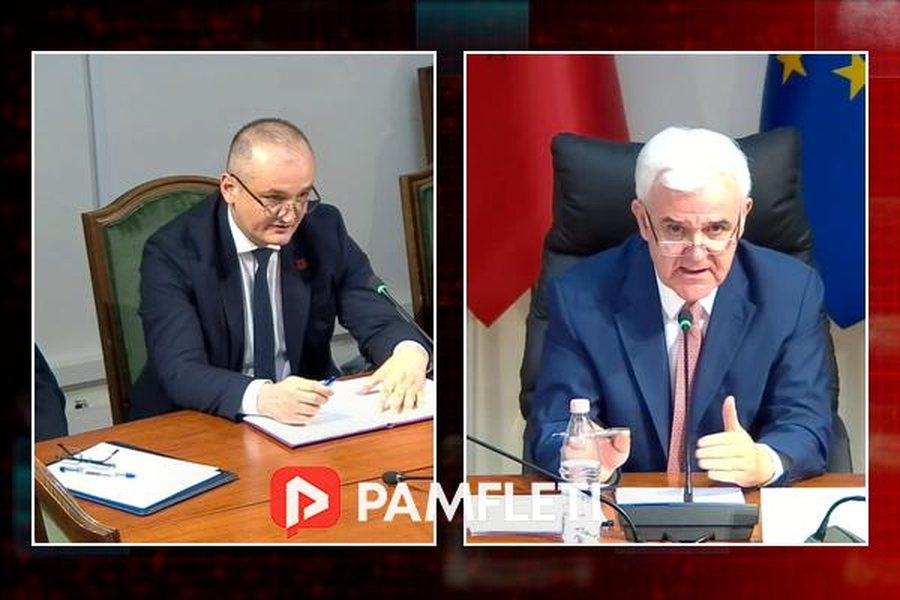
KLSH constantly uncovers violations, Xhafaj demands audits "without catching the institutions in error"...
Instead of demanding accountability for why state institutions do not implement the recommendations of the Supreme State Audit Office, Fatmir Xhafaj chose to tell the constitutional institution itself how it should do its job.
During the meeting of the Committee for Civic Initiatives, Cooperation and Institutional Oversight, where the annual report of the SAI was reviewed, Xhafaj gave a long speech, where in several cases it was implied that the institution should not focus on identifying violations, but on "helping" the administration.
" The issue here is not how to catch institutions in error. This should not be the philosophy of audit work. But how to help institutions make as few mistakes as possible. How to help institutions, to prevent them, to have as few legal violations as possible in the administration of public property ," declared Xhafaj.
At another point, he also discussed how the work of the Supreme State Audit Office should be measured.
" How should we measure the success of the Supreme State Audit Office? By the number of audits? By the number of recommendations? By the value of the identified economic damage, which is often unknown as to what the real damage is? Or by the change that the audits have brought to the way the public administration manages citizens' funds? Personally, I believe that the fundamental standard should be the latter ," he continued.
He even added that citizens are not interested in learning how many violations are found by auditors.
" The citizen does not just wait and is not interested in knowing that a problem has been identified or how many audits have been conducted, he expects that problem not to recur ," said Xhafaj.
But this is precisely where a stark contrast with reality arises.
The Law on the Supreme State Audit Office clearly states that the institution audits the administration of public funds, identifies violations, responsibilities and economic damage, and provides recommendations for their correction. The SAO is not an advisory body to the government, but the highest constitutional institution of public audit.
In practice, the problem has not been a lack of recommendations.
For years, the Supreme State Audit Office has uncovered violations with significant financial values and issued thousands of recommendations to ministries, agencies, and public institutions.
However, a good part of them have remained only on paper.
Just a few weeks ago, the head of the Financial Supervisory Authority, Denar Biba, declared in Parliament that he does not accept the audit of the SAI, openly challenging the powers of the constitutional institution.
The State Cadastre Agency has also acted along the same lines, in several cases opposing the findings and competence of the auditors.
Also, in a series of audits, the SAI has recommended the dismissal or taking disciplinary measures against the heads of institutions for violations found during the audits, but these recommendations have been rejected or ignored by the government.
So, the problem does not seem to lie in the fact that the SAI "catches" the administration in error, but in the fact that the administration and the government itself often choose not to react to its findings.
The chairman of the Albanian Supreme Audit Institution, Arben Shehu, responded to Xhafaj's approach by defending the role of the institution.
" The purpose of institutional work is not to punish an individual or institution. The purpose is the work of the SAI to raise the level of awareness and improve the work in the institutions in which we carry out audit actions ," he said.
But he also opposed the idea that the institution's success should be measured by the level of implementation of recommendations.
" The work of the institution cannot be measured on the basis of how much these recommendations are implemented, but how objective and essential these recommendations are ," declared Shehu.
The debate highlights a paradox: while the head of the parliamentary committee demands that the SAI change its auditing philosophy, the biggest challenge remains the failure to implement recommendations by state institutions themselves and the lack of will to take action against the violations found. /Pamphlet






Po pse mo z. Xhafaj, faji i KLSH është që ti e ke mbushur Administratën me patronazhistë të pa aftë dhe me diploma fallso që s'janë të zotë të lexojnë dhe të interpretojnë ligjin para se të firmosin kuturu nga padituria duke i paguar me taksat e popullit dhe duke fryrë administratën vetëm e vetëm që të të sigurojnë votat që ti të ngrohësh të ndenjurat në kolltukun haram të parlamentit për 4 vitet pasardhëse!...turp.
Ne vend qe xhafaj te ngrej problemin se cfare behet per te zhdemtuar te gjitha ato déme qe konstaton kontrolli i shtetit qe jane qindra miljona euro dème ne vit thote mos i evidentoni ato se nuk ka interes qytetari por kjo absolutisht nuk eshte e vertete se qytetari ka shume interes ti dije se jane parate e tij por Ai ka teper interes se cfare behet qe keto déme te zhdemtohen nga fajtoret te cilet pervec kesaj te mbajne dhe pergjegjesi te tjera administrative penale sipas ligjeve