


 Shkruar nga Pamfleti
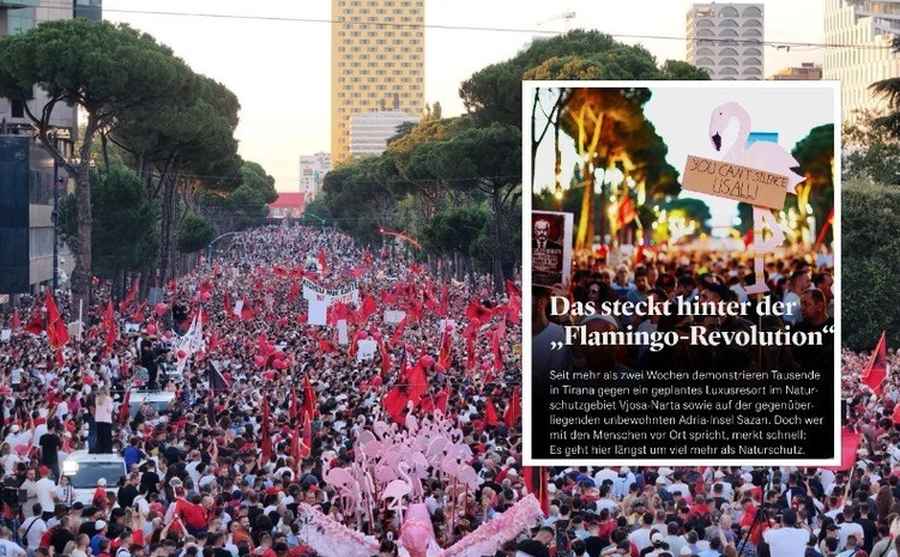
History shows that revolutions that are not institutionalized are consumed. The “Flamingos” have won the moral battle; now they must win the battle for political power...
The protest, launched furiously to oppose the Zvërnec and Sazan project, has entered its 40th day today.
This movement has brought to the surface important developments for Albanian society.
It has articulated a public opinion that demands, above all, a just republic.
An Albania without a "king in white sneakers".
A just state, without criminals and without institutions that protect them.
A fairer economy, where inequality is reduced as much as possible, according to the welfare state model of Scandinavian countries, Western Europe, or even countries like Slovenia.
There is no doubt that the revolt that this protest has brought to Albanian political life is representative.
In fact, in many respects, it represents the vast majority of Albanians.
But the problem at this stage is different.
Like a child after the first 40 days of birth, this movement must now think about how to grow as healthily and safely as possible.
The characters who have so far read the requests addressed to Edi Rama have presented five points, demanding the removal of the prime minister, the creation of a technical government, and constitutional reform, among other things.
Meanwhile, Edi Rama is preparing what he calls a "reflective response" to the protest.
According to sources, in addition to a cabinet reshuffle and a wave of dismissals in the senior administration, he is also expected to announce changes in the way public contracts are awarded, tenders and construction permits for towers, hotels and other large projects are awarded.
It is also expected to propose an online public consultation system for these processes.
Of course, if these measures are implemented, they constitute a success of the protest.
And every citizen who has been part of it has the right to consider this an achievement.
But the main question remains:
What happens next?
The solution that Edi Rama could offer is unlikely to be accepted by the protests.
And this is completely normal.
Because it is a solution that primarily serves his power.
While the protest seeks a solution that serves the citizens who support it.
The most natural path is to institutionalize it into a classic political movement.
A movement that elects its leaders through transparent procedures.
To then unite and merge all opposition factors into a large political front against the majority.
A model similar to the one built by Peter Magyar in Hungary.
The possibility is real.
Local elections are next year.
If this movement wins Tirana and the main cities, then the path to general elections becomes much easier.
But so far it seems that the situation is different.
The protest, which is mainly supported by two factors; Germany and Albin Kurti, is not showing any will to build a competitive political leadership.
In Hungary the opposite happened.
The alternative that challenged Viktor Orbán had broad support in the West, and the elections turned into a referendum between the European Union and the pro-Russian model.
Hungarians chose Europe.
In Albania, at least so far, it seems that a permanent protest is being preferred.
A permanent revolution.
A pressure valve against Edi Rama.
This strategy could weaken the prime minister.
But at the same time, it could also give him a political survival card.
As happened with Sali Berisha, who at certain moments was considered a tactical ally by various political actors.
This is precisely what has prevented the emergence of a new, clearly Western and pro-European alternative.
By creating space for flows coming from the East and supported financially and politically by Turkey.
A problem that Edi Rama manages much more easily, by negotiating directly with Ankara.
Even, as the metaphor says, carrying the "suitcase".
But this is not the solution for the European and just republic that Albanians have been demanding for 40 days in the square./ Pamphlet



Lini një Përgjigje