


 Shkruar nga Pamfleti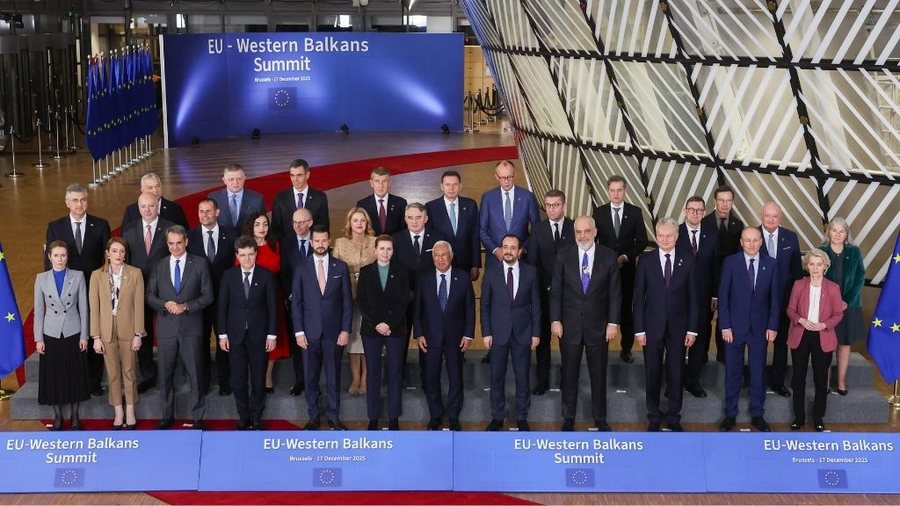
Montenegro is seen as the most advanced candidate in the Western Balkans, while the European Union seeks to strengthen the credibility of the membership process in the face of new geopolitical challenges...
The EU-Western Balkans Summit taking place in Tivat, Montenegro, is taking on a special political and symbolic significance, as it coincides with the 20th anniversary of the country’s independence. The participation of key European figures, including German Chancellor Friedrich Merz, French President Emmanuel Macron and Italian Prime Minister Giorgia Meloni, demonstrates the growing attention the European Union is paying to the Western Balkans at a time when enlargement policy is returning to the center of the European agenda.
The summit comes at a time when the European Union is trying to reinvigorate the enlargement process in the face of numerous geopolitical challenges. Montenegro is widely considered the most advanced candidate country in membership negotiations, and its progress could serve as an indicator of the credibility of the European integration process in the region.
In this context, the summit is expected to mark an important milestone in defining future relations between the European Union and the Western Balkans. Brussels aims to strengthen the credibility of the enlargement policy not only for the countries of the region, but also for other candidates such as Ukraine and Moldova.
Discussions will focus on the progress of accession negotiations, the reforms needed to align with EU legislation, and the possibilities for gradual integration of candidate countries into certain Union policies and funding mechanisms before full membership. These debates reflect the EU's efforts to keep enlargement at the top of its strategic priorities, while adapting the process to new geopolitical and economic realities.
The geopolitical dimension of the summit remains equally important. Montenegro's position on the Adriatic coast and its membership in NATO give the country a special role in the Western security architecture. For the European Union, strengthening its presence in the Western Balkans is closely linked to regional stability, institutional sustainability and maintaining its influence in an area of strategic importance for South-Eastern Europe.
The summit is also expected to be attended by Serbian President Aleksandar Vučić, who has announced a series of meetings with European leaders as part of the event. Vučić stated that he will attend at the invitation of European Commission President Ursula von der Leyen, emphasizing the importance of continuing dialogue with European institutions. Serbia's presence is considered particularly important, as the country remains a key actor in regional developments and one of the European Union's main partners in the Western Balkans.
At the same time, Brussels continues to place a strong emphasis on the rule of law, democratic governance, media freedom and the implementation of reforms, which remain fundamental criteria on the path to EU membership. These issues take on added importance at a time when public support for European integration varies across the region.
The presence of the President of the European Council, António Costa, in the Western Balkans during the same period further reinforces the message that the region continues to remain a strategic priority for the European Union.
Against this backdrop, Tivat is becoming more than just a host city for a regional summit. It is taking on the role of a reference point for the next chapter in relations between the European Union and the Western Balkans.
The main question that accompanies the summit remains whether the European Union is ready to translate its commitment to enlargement into concrete measures and clearer deadlines. In this context, Montenegro's progress is expected to serve as a benchmark for the future of European integration in the Western Balkans and could become the most important test of the EU's enlargement policy in the coming years.



Lini një Përgjigje