


 Shkruar nga Gjergj Zefi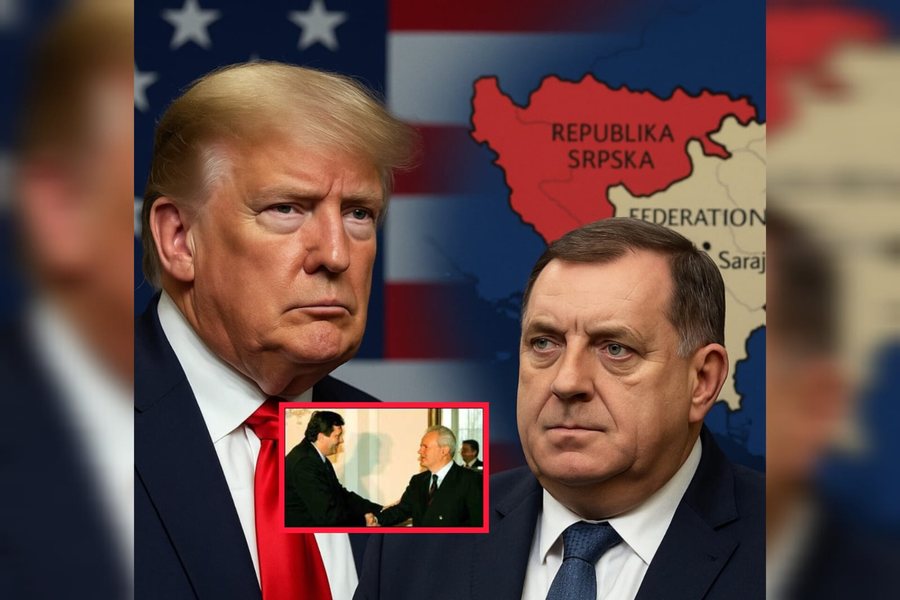
In the name of "stability," American diplomacy is amnestying Dodik's associates and reviving the logic of bargains that once divided blood and territory. Bosnia becomes the first evidence of the dark return of Trumpism in the region...
It is not simply an administrative decision. The lifting of sanctions against Milorad Dodik's closest associates by the US is a political act with long-term consequences and very dark messages.
Instead of strengthening the architecture of peace in Bosnia and the region, the Americans are reopening the doors to blackmail, bargaining, and rehabilitation of nationalists who for years have worked against the multiethnic state of Bosnia and threatened its disintegration.
This is not an act of diplomacy that seeks stability through principles, but a frightening return to the Trump style: dirty bargaining with toxic figures in exchange for momentary calm. It is the same logic that allowed Vučić to become a privileged interlocutor in the Kosovo-Serbia negotiations, while sponsoring parallel structures in the north and fueling tension with the blessing of ambassadors delegated by Casa Blanca.

Now the same hand is facilitating the return to politics of people who were blacklisted for involvement in corruption, sabotage of institutions, and ties to Russian foreign influence.
Lifting sanctions on Dodik's associates is not a tactical shift. It is an ideological shift towards an approach where everything is negotiable, including the territorial integrity of countries, justice for war victims, and the survival of the constitutional order.
It is a return of Trump's shadows in American diplomacy, a policy that knows no friends or principles; only momentary interests and agreements sold as "progress."
This move is not just about Bosnia and Herzegovina. It is a reflection of what we might call the “Trump 2.0 doctrine” in American politics: prioritizing the interests of the moment, flexibility with unstable actors, and undermining ideological engagement in favor of economic and political lobbying.
Dodik has stated that he will personally address a letter to the US administration and has expressed hope that a return of Donald Trump to the White House will change Washington's approach towards his separatist entity.
His network is built to take advantage of Republican connections, by doing intensified lobbying in Washington and through conservative organizations that see the Balkans as a terrain for the expansion of American political and religious influence. This is not diplomacy, it is strategic amnesia.
For Albania and Albanians in the region, this is a wake-up call. If the US lifts sanctions to buy peace, rather than to demand accountability, then any separatist root, any policy of ethnic division or territorial disorder may see the green light. And this means that the words “rule of law”, “territorial integrity” and “internationalization of stability” have become cards used for propaganda, not for implementation.
Instead of acting as a guarantor of constitutional order in Bosnia and Herzegovina, the US is becoming a party to the game with autocrats and corrupt networks that are using the West as a political haven. Are the lifted sanctions “prudent cooperation” or a purchase of silence? No official response is provided by OFAC, and this lack of transparency is itself a symptom of rogue diplomacy.
This is an example of how American policy, under the shadow of Trump, is adapting to lobbyist influences and pragmatic interests, sacrificing principles. For us Albanians, this should serve as a warning: stability in the Balkans is no longer guaranteed only by a foreign hand, but by our ability to defend our national interest when strategic partners change course. Because when great powers make peace with destabilizers, behind the “pact for stability” may be hidden another territorial bargain, another dark influence and another valueless policy.
In this document of today's diplomacy, 'lifting sanctions' is not the end of the story, it is the beginning of a chapter where we must ask not only "what will they do?", but "what are they not doing?". And unfortunately, the answer is becoming increasingly clear: they are no longer protecting the Balkans from the darkness they themselves helped create./ Pamphlet



Ne nuk kemi një provë që, partnerët strategjik të kenë ndërruar kurs. Dhe se ky ndërrim kursi të kërcënojnë identitetin tonë kombëtar. "Ndërkombëtarizimi i stabilitetit"ndoshta sjell ndryshime për mirë për NE.
Nuk mund te presin Shqiptaret ndonje te mire nga burri e tre grave sllave. Mbyll gojen se po fole shume te vjen ere e rende.