


 Shkruar nga Diplomatico | Pamfleti.net
The era of military improvisation: how the war in Ukraine is changing and what it warns about the wider world...
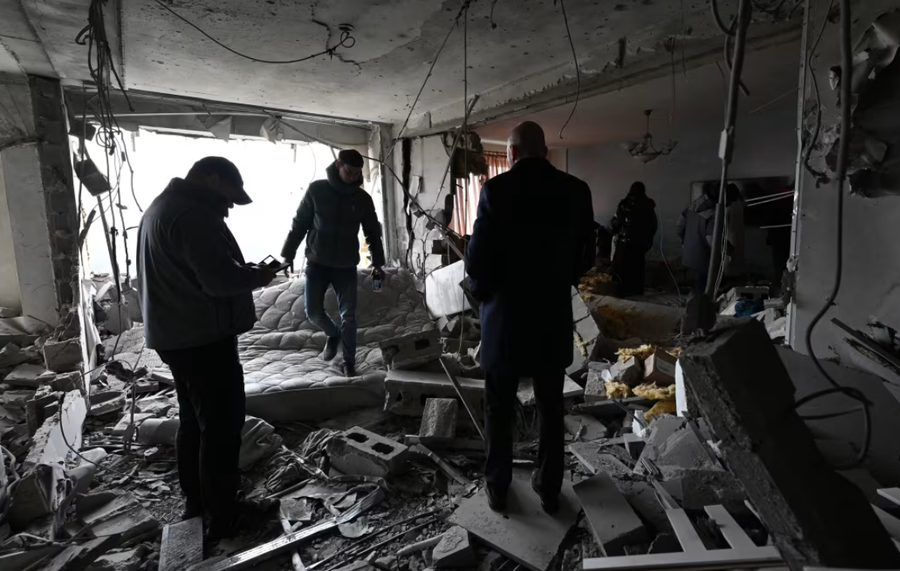
The war in Ukraine has entered a new, darker and more unpredictable phase. According to a recent CNN analysis, both the Ukrainian and Russian militaries are adapting to the realities of fatigue, supply shortages and the demand for immediate battlefield efficiency, turning every vehicle, every plane, every old missile, into a deadly improvised weapon.
This is no longer a war of F-16s or GPS-guided missiles; it is a technological race of improvisation, where creativity and necessity have taken precedence over sophistication and 21st-century military norms.
On the one hand, Ukraine is demonstrating a rare ability to adapt civilian technologies to military functions; commercial drones modified for deep-sea attacks, sports jets converted into suicide vehicles to infiltrate Russian bases, or recovered missiles giving new life to worn-out arsenals.
On the other hand, Russia, locked in the isolation of sanctions and restrictions on Western technology, is trying to revive Soviet-era weapons, adding engines, sensors or guidance modules to transform them into “poor missiles” but effective. War has become an improvisation laboratory, where any piece of iron can be transformed into a means of destruction.
This development constitutes a fundamental turning point for international security: weapons are becoming cheaper, smaller, and simpler to produce, while their effectiveness is increasing disproportionately.
In a world where artificial intelligence, 3D printing, and remote-controlled devices are accessible to almost anyone, the risk of improvised warfare spreading beyond Ukraine is becoming real. This is a warning to every small country, including Albania, that the era of “superweapons” is no longer a guarantee of security, because now all it takes is a garage, a creative engineer, and a modified drone to create a strategic threat.
Diplomatically, this shows that the war in Ukraine is no longer just a showdown between Moscow and Kiev, but a global experiment that is testing the limits of military technology and international ethics. The West, for all its support for Ukraine, is facing a new challenge: how to maintain a balance between supplying an army that is creatively improvising weapons, and maintaining control over the distribution of technologies that could slip outside the hands of the law. Russia, for its part, punished by sanctions but unabated in its aggression, is proving that restrictions do not stop the war, they only make it more savage and unstoppable.
For Albania and the region, the lesson is clear: 21st century security is no longer measured by the number of tanks or aircraft, but by the ability to adapt to technology and prevent the risks that arise from improvisation.
In a Balkans filled with frozen tensions and actors still playing the old game of geopolitical influence, the emergence of this model of warfare is a wake-up call. Because the moment military improvisation becomes the norm, the line between defense and terror, between the state and the armed group, begins to blur.
Ukraine and Russia are showing us a future where war will no longer be declared with diplomatic notes, but with the click of a button on a modified drone. And if the world fails to learn from this stage of improvisation, it will wake up to a reality where any conflict can explode at the hands of anyone with technical imagination and a little desperation. This is no longer just their war; it is a reflection of an age that is inventing weapons faster than peace./ Pamphlet




Jetojm n’fillim shekullin 21, ku imoralet t’mbasur prej pangopsis, krijuan djaj me fytyr njeriu, qe s’duan t’ja dine as per popull e as per at’dhe, perpara lekeve te pistet e pushteteve pa kufi e me c’do forme e cmim brenda tyre. S’fundi nje fund i turpshem po i pret, e ket e ka vertetuar historia n’shekuj.