


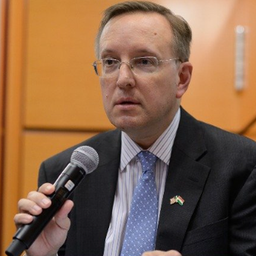
 Shkruar nga David J. Kostelancik
The Trump administration's decision to ease or lift sanctions on discredited figures in the Balkans is sending the wrong signal possible for the region: that corruption and destabilization are not punished, but tolerated, if politically expedient.
The Trump Administration's recent decision to lift financial and travel restrictions that had been imposed on Bosnian Serb leader Milorad Dodik and his family members in 2022 has brought back into focus the question of the purpose and effectiveness of sanctions specifically focused on Balkan countries.
It is worth analyzing the history and usefulness of this instrument in light of the current withdrawal of active American engagement in the region, as well as the consequences of the United States' neglect of Balkan allies and partners.
The first sanctions imposed on Balkan countries were applied by the Bush Administration in 2001 to address destabilizing violence and the undermining of 1990s peace agreements. The scope and results of these sanctions have been regularly reviewed, culminating in a broad update signed by President Biden in June 2021 with Executive Order 14033: “Blocking Assets and Denying Entry into the United States of Persons Supporting the Destabilizing Situation in the Western Balkans.”
This moment represented the culmination of a four-year, cross-agency initiative by the first Trump Administration to modernize the sanctions program against the Balkans. For the first time, Executive Order 14033 addressed endemic corruption in the governments and institutions of the Western Balkans.
This change was widely welcomed in the Balkans, where the US’s exposure of corrupt politicians was seen as key to breaking the spiral of impunity. Powerful politicians had abused their power and blocked reforms through patronage networks, supported by countries like Russia that had an interest in preserving the status quo. Executive Order 14033 added regionally focused financial sanctions to the US arsenal to combat this source of instability.
Like the corruption-based visa restrictions that have been in place for more than 20 years in the Balkans, this tool was intended to support regional leaders working for good governance, empower civil society demanding transparency, embolden investigative journalists who promote accountability, and ignite citizens’ hope for a better future. With the exception of Serbia and Bosnia, where some felt ethnic Serbs were unfairly targeted, media coverage in the region was positive. Many regional authorities fully supported the implementation of the orders and cooperated on human rights and rule of law programs.
A help even for Americans themselves
These measures also helped the United States itself, by promoting a level playing field for American businesses that had invested or intended to invest in the region. By preventing corrupt officials from laundering illicit wealth in the United States at the expense of legitimate American businesses. And by strengthening American security commitments in the region through NATO membership and support for clean democratic and economic development, to enhance stability and the ability of countries to defend themselves.
The 2021 progress was reinforced by one of President Biden's last orders, Executive Order 14140, issued on January 8, 2025. This order amended Order 14033, expanding the scope of sanctions to include "attempt" as a basis for punishment, by focusing on leaders of sanctioned entities, including ownership or control by sanctioned persons or their spouses and adult children.
Even more significant was President Trump's decision, on June 24, 2025, to extend the validity of these orders for another year, as part of a mandatory periodic review to maintain the previous conditions, in support of peace, stability, and the fight against corruption in the Balkans.
Why this matters for America today
Sanctions targeting malign actors in the region, including those seeking to destabilize the situation, have been an important and effective tool for the United States to promote the change that the Western Balkans region desperately needs. Executive Order 14033 expanded this tool to punish a broader range of malign behaviors in the region, including corruption, misuse of public assets, misappropriation of private assets for personal or political gain, and bribery, the kinds of activities that have prevented American businesses from competing fairly for markets and investments.
By championing good governance and transparency, the US and EU have worked to integrate the region into European and Euro-Atlantic structures.
The United States has long been committed to promoting transparency, accountability, and good governance in the Balkans, in pursuit of the shared goal of a Europe whole, free, and at peace. It has supported the reforms required to integrate the region into European institutions and has challenged those who would seek a weak and divided region outside the transatlantic space.
The US has wanted a prosperous region, with a legitimate economic base and internal political stability, to counter unwanted pressures from Russia, China, and Iran. The authority to impose sanctions has been a key part of this commitment.
Lifting sanctions on people like Dodik, who are not friends of America but of Russia, means that Americans, at home and abroad, will pay long-term economic costs for giving a “free pass” to those who foment instability in the Balkans for personal gain. / Pamphlet
*David J. Kostelancik was nominated as ambassador to Albania by the Biden administration, to replace Yuri Kim, but his name remained blocked in the Senate.




Lini një Përgjigje