


 Shkruar nga Gjergj Zefi
From "surgical strike" to global chaos: the easy victory over Iran is turning out to be a strategic deception...
Two weeks ago, in an editorial titled: I argued that the idea of an “easy victory” over Iran was not a military plan but a political slogan. I wrote that Ali Khamenei’s death did not guarantee the end of the system, that the Islamic Republic is not a pyramid that collapses with a beheading, and that external pressure may produce not capitulation but consolidation of the hard line. Today, events are not weakening that thesis; they are sealing it.
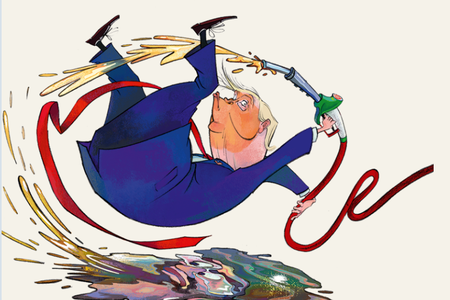
What was sold as a decisive operation to bring Iran to its knees is emerging, day by day, as a grave misreading of the nature of the Iranian state and the logic of asymmetric warfare. Tehran did not react as a regime in agony. It reacted as a state that had preserved the instruments to shift the cost of the conflict from the bombing field to the arteries of the global economy. And this is where Hormuz comes in: not as a symbol, but as the most painful lever that Iran could use against its adversaries.
This is where the narrative of quick triumph is collapsing. Reports from the US indicate that the Trump administration underestimated Iran’s willingness to use the Strait of Hormuz as a strategic weapon. This is no longer just a criticism of the US president’s opponents; it is a description of a miscalculation at the heart of the security apparatus. When your adversary cannot defeat you in air superiority, he tries to strike at your energy, at your markets, at your supply chain and at the psychological nerve of your allies. That is precisely what Iran is doing.
The data in recent days is brutal. Reuters reported that tanker traffic in the Strait of Hormuz fell from 37 to zero within days of the attacks, while oil and gas shipments came to a near-total halt. Another Reuters analysis notes that over 20% of global oil flows pass through this hub and that the market is already pricing in a prolonged crisis. Brent has passed $100 a barrel, while banks and analysts are revising energy forecasts. This is the real bill of the “easy win” adventure.
The strategic irony is bitter. On the one hand, the new leader Mojtaba Khamenei has sent his first public message demanding that Hormuz remain closed as a means of pressure and threatening American bases in the region. On the other, the Iranian ambassador to the UN has declared that Iran “will not officially close” the strait and that it respects freedom of navigation. But the reality of the war is not measured by diplomatic semantics; it is measured by what happens on the ground. And on the ground, ships are being diverted, trade is being blocked, maritime insurance is becoming more expensive, and markets are being shaken. So even without a legal declaration of closure, the practical effect is the same: Hormuz is functioning as a stranglehold on the global energy system.
This is the moment when propaganda falls and geopolitics speaks. Two weeks ago I wrote that “decapitation is not synonymous with capitulation”. Today another sentence must be added: military superiority is not synonymous with strategic control. You can strike hard, but control nothing. You can win the first blow and lose the cost architecture that it creates later. The US administration is realizing this too late, because it has already been forced to seek emergency ways to stabilize the energy market, including a temporary 30-day license for the sale of sanctioned Russian oil. This is an indirect admission that the crisis is no longer peripheral, but systemic.
Even more significant is the fact that the US has not been able to guarantee, at least for the time being, safe naval escorts for traffic in Hormuz. Reuters reported that the US Navy has informed shipping industry players that escorts are not possible “for now”. This sentence is worth more than many political statements. It shows the limits of force in a theater where the threat comes not only from a classic fleet, but also from drones, missiles, mines, attacks on tankers and the panic that an insecure corridor produces. In modern wars, it is enough to make the passage economically unacceptable; you do not need to close it with a military lock.
Here comes the biggest political mistake of Washington: the assumption that Iran would behave like a tired, isolated and paralyzed target. But the Islamic Republic, however hit, remains a state with a survival reflex, with regional networks, a security apparatus and a strategic culture that knows very well the use of weakness as a weapon. Therefore, what was sold as an offensive to weaken the regime, risks producing the opposite: strengthening the hard core, defensive nationalism inside Iran and increasing the costs for the adversary outside it. This was precisely the central point of my article of March 1. Today, it no longer seems like a hypothesis, but like a diagnosis.
For Europe, and especially for small, exposed countries like Albania, this crisis is not a television spectacle. Any shock in Hormuz affects energy prices, inflation, transport costs, market uncertainty and the political climate of the Euro-Atlantic alliance. Reuters reports that the blockade of trade routes in the Middle East has led to a sharp increase in air transport tariffs and disruptions in supply chains. So the consequences do not remain in the Persian Gulf; they travel to Europe along with the bills.
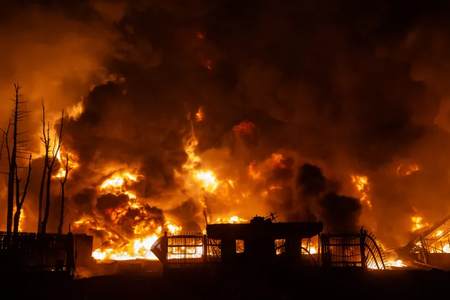
In the end, the problem is not just that Iran was underestimated. The problem is that the very nature of the international order today was underestimated: an order in which a naval node, a few coordinated attacks, and a few days of uncertainty are enough to shake the stock markets, energy, diplomacy, and reputation of the superpowers. This is why “easy victory” was an illusion when the war began and is now being paid for. In the Middle East, the slogan wins the headlines of the day; but strategic reality sends the bill the following week. And it usually comes more heavily than those who started the fire had calculated. /Pamphlet


Bytheshiturit te ruset e serbet ferkojne duart per cdo haber kunder Amerikaneve. Amerika nuk eshte Trapi, por produkt i Britanise Inteligjente e vazhdon te jete. Mos harroni se mbrapa veshit e keni te tere. Kjo qe ka nisur eshte strategji gjigande e Perendimit me Ameriken ne krye. Se ku i del fund ata qe e nisin vallen ia dine fundin. Ne fillim filluan produktet, cheap labour, made in China e pasi e rriti pordhen China, filluan produkte, made in Indfia, made in indonezia,made in Bangladesh, made in Vietnam e kur ta nrrisin pordhen keta jane krijuar kushtet, ne Irak, Loibi, Lebanon, Palestine, Iran, etc. Pse nuk i fusin ne Europe zhulsat e Ballkanit? Sepse jane nje burim fitimi per cheap labour per Eurokurven por jo Europen. Analiste e gazetare profesionale jane ata qe kur flasin per politike industriale, politike ekonomike, bujqesite, drejtesie,etj, jane me kualifikime perkatese e jo tallagjere me 6 muaj kurse te Kampi i Pioniereve e itetisrevinU Kristal. Shkenca e sakteson te verteten. Per te krijuar majane e bukes shkencetaret dalin e thithin ajrin neper pyll e krijojne maja (yeast) per buken. Dmth. buka jone qe hame eshte me pluhurat ne atmosfere nga frymemarrjet e te dhjerat e te gjitha qenieve e kalbjet e te vdekurve e te ngordhurve. Cfare mund te presim nga Shqiptaret qe kur ushqehen thone, te hajme buke e jo mengjes, dreke ose darke. Dheti me mut, kur thone Dibranet. E hu a!
Analiza juaj rezultoi diagnozë. Gabimi u bë sepse llogaritë u bënë pa hanxhinë. Zvarritja dhe rikthimi te pika nga u nisën, është rikthimi në vëndin e krimit. Shpresoj që Presidenti Donald Tramp të vendos përfundimin e luftës. Netanjahu le ta vazhdoi vetëm luftën, nëse populli izraelit e toleron. Populli Izraelit është në ekstazë, njëjtë si populli Gjerman në kohën e Hitlerit. Pasojat dihen , i paguajnë popujt.