


 Shkruar nga Diplomatico | Pamfleti.net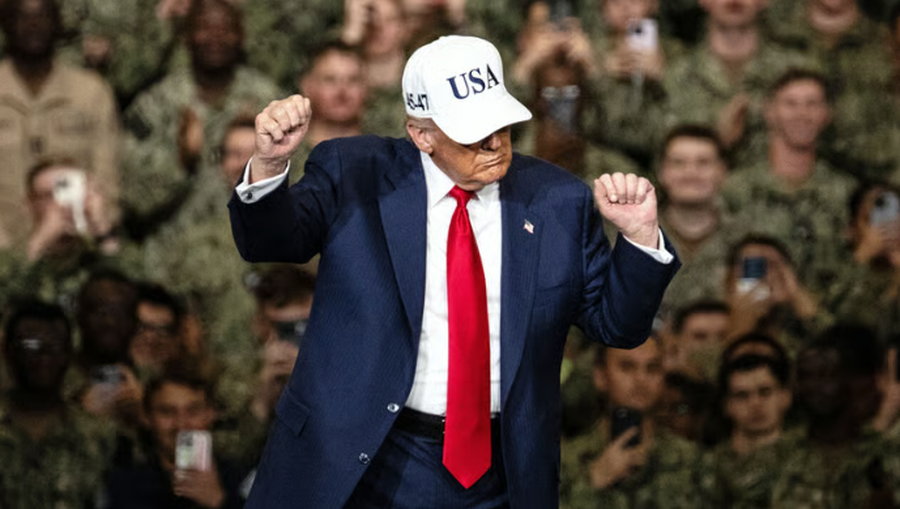
In the morning he announces the end of the war, at noon he talks about 40 days of conflict and in the evening he promises strikes 20 times stronger...
There is an unwritten rule in international diplomacy: when a country enters war, the political message must be clear, consistent, and predictable.
Not for diplomatic elegance, but because armies, financial markets, and global balances are at stake. But in the case of US President Donald Trump, this rule seems to work differently.
Within a day, the narrative of the war with Iran has changed several times, as if it were a statement being tested in real time before the public.
In the morning, the American president announces that the conflict could end very quickly. A little later he talks about a war that could last about 40 days. While then he warns that if Iran does not withdraw, the United States is ready to strike "20 times harder."
In theory, these could be interpreted as part of a strategy of maximum pressure on the adversary. In practice, to the rest of the world they sound more like a series of messages that change with the rhythm of the news cycle.
The problem is that in such a conflict, every sentence from the White House carries strategic weight.
Allies are trying to understand whether a short military operation or a longer escalation is being prepared.
Markets react immediately to every nuance in statements. While in Tehran, every contradiction is carefully analyzed to understand how determined Washington really is to go all the way.
The irony is that amidst all this noise of declarations, the essential question still remains without a clear answer: what is the ultimate objective of this war.
Does Washington only aim to weaken Iran's military capabilities?
Does it seek to impose itself in a new strategic agreement?
Does he seek to change the balance of power in Tehran?
For now, the answers seem as variable as the statements of the American president. Meanwhile, in the Middle East, another rule has long been known: wars rarely end as quickly as politicians predict in press conferences. And in this context, what may seem like political flexibility to some may be simply strategic ambiguity to others.
Ultimately, the history of international conflicts shows that adversaries pay less attention to the tone of the moment than to the consistency of the message. And when the message changes several times in a day, the risk is that the war itself will begin to be perceived no longer as a well-calculated strategy, but as a process that evolves more quickly in declarations than in the reality of the battlefield./ Pamphlet


Ore n.q.s "komandanti" eshte I cmendur ta cojne ne cmendine dhe Jo ta kene president,dhe te vendoset ai per fatin e nje shteti,nuk eshte I afte,dhe kjo nuk eshte Hera e pare qe nuk di SE c'i behet!
Po kur mbi gjysma e popullit qe e votoi eshte per cmendine si i behet!?
Donald Tramp ka folur qartë. Kur mbaron lufta, e vendos Bibi(Netanjahu). Donald Tramp po thotë: luftën e nisi Ai ,pa na pyetur Ne , ndaj Ai e di, se kur e përfundon luftën. Atë që i bëri Amerikës dhe botës Netanjahu, nuk do ja bënte as Kina, se nuk do ja mbante.
Luftrat i hapin borxhet ndaj Bankave e Bankat i kane cifutet. Hitleri i ndoqi cifutet se kur u kerkoi kredi Bankave te fuqizonte makinen ushtarake t'i binte Ruseve, cifutet i terhoqet parate nga Bankat e i transferuan jashte Gjermanise. Keshtu Gjermanet mbeten duart bosh e i ndoqen cifutet. Kjo qe e verteta, pa pallavrat e tjera raciste e terr verr verr. Ne Gjqermani ne ate kohe ishin 28 mije Afrikane e Hitleri nuk preku nje por ata iken nga frika duke pare se c'po u ndodhte cifuteve. Paraja ngre lart dynjane, paraja ben hatane.