


 Shkruar nga Gjergj Zefi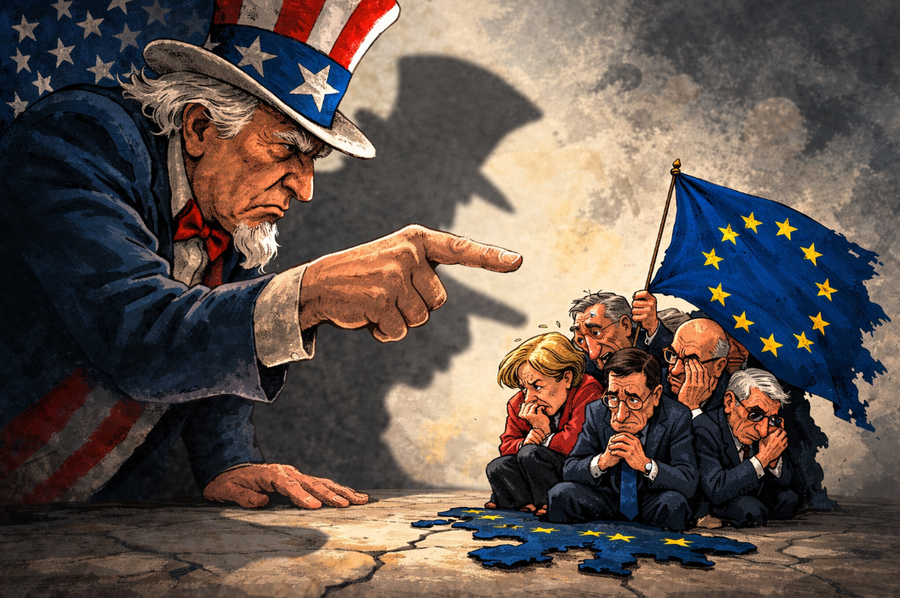
Between rhetoric about strategic autonomy and fear of clashing with Washington, European leaders always seem to choose pragmatism over political courage...
In international politics, there is always a brief moment when leaders are tempted to tell the truth. A minute when diplomacy falls apart and the masks fall off. A moment when a European prime minister can tell an American president that “the world is not a casino where great powers roll the dice with the fate of other nations.” But this moment lasts very little. Because immediately after it comes reality: the markets, the economy, NATO, strategic pressure and the fear of what happens if the relationship with Washington deteriorates.
This is the real drama of Europe today. In public, many European leaders talk about strategic autonomy, a more independent foreign policy, and the need for the continent to be more than just an extension of American decisions. Behind the scenes, they know that the global system still operates according to a brutal rule: without the military and financial umbrella of the United States, Europe is far more fragile than it publicly acknowledges.
In this uncomfortable reality, the contrast between symbolic courage and brutal pragmatism also arises. A leader could imagine telling the American president openly what many Europeans think: that power politics is pushing the world into a dangerous spiral, that Europe cannot always be a passenger on a plane that someone else is piloting, and that the use of violence remains a problem even when justified by good intentions.
But then comes the next hour. And in that hour, there is no longer any talk of morality. There is talk of German exports, of energy, of military bases, of financial markets, and of the simple fact that the European security architecture still depends on the Pentagon.
This is why many European leaders, even when they have strong criticisms of Washington in mind, choose a soft and measured language. Not because they are convinced. But because they know that foreign policy is not a moral tribune, but a chessboard where every move has a cost.
Europe, in essence, lives in a strategic paradox. It wants to appear as an independent global power, but at critical moments it is forced back into the reality of its dependence on the transatlantic alliance. This dependence is not just military. It is technological, financial and political.
And for this very reason, many grand European declarations of strategic autonomy often end up as rhetoric for domestic consumption.
In the end, international politics is not driven by moments of courage, but by the survival instinct of states. Europe may have a minute to say what it thinks. But the global system forces it to do what it is forced to do the rest of the time./ Pamphlet



Europa po kerkon kohe! Duhen 10-15 vite qe ndryshimet qe kane filluar te kthehen ne strukturore..Tani per tani kane nevoje per mbeshtetje..
Pyetja eshte a ka burra shqiperia, mos shko kaq larg ne europe.
Burrë me bole katrore është vetëm Trampi!! Të tjerët kanë futur duart nëpër xhepa dhe po kontrollojnë ku i kanë....
Per deri sa eshte mbushur Shqiperia me LGBT sa te duash, c'pyet per Europen te kete burra.