


 Shkruar nga Gjergj Zefi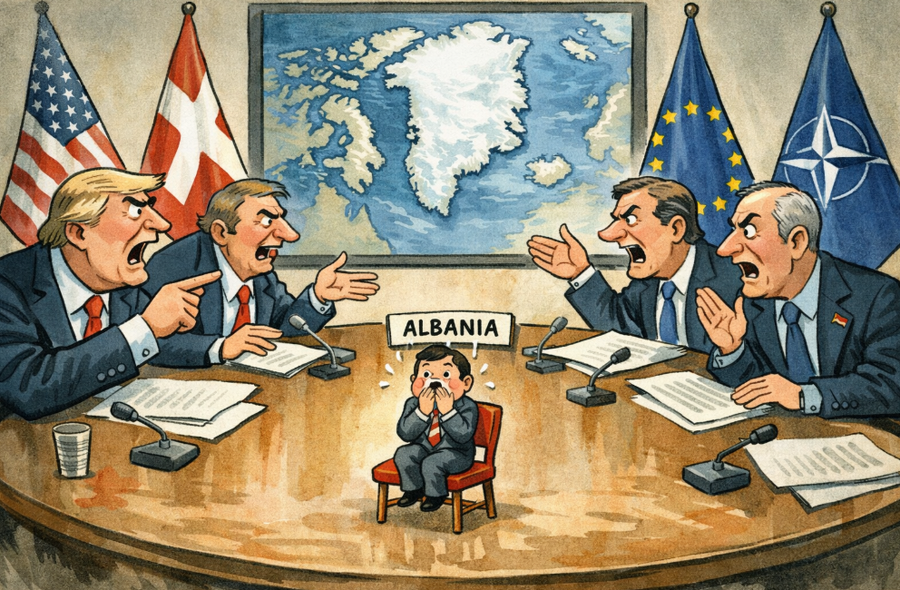
Loyalty to alliances requires principles and strategic clarity, not conformist silence disguised as diplomacy...
The question may sound peripheral for a country like Albania, but it is fundamentally deeply diplomatic. Because Greenland is not a distant geographical issue; it is a symbol of a larger crisis within the Euro-Atlantic world, where alliances, principles, and interests no longer automatically align. And it is precisely in these moments that true diplomacy is tested. Not the one that recites formulas, but the one that knows how to articulate principles without falling into servility.
The crisis over Greenland has exposed real tensions within NATO, a clash between American national interest and European sensitivities, and an open debate about respect for sovereignty, international law, and allied cohesion. In this context, the silence of small countries is neither neutral nor wise. It is simply a lack of positioning, wrapped in diplomatic language.
Albania, as a NATO member state and a serious aspirant for Euro-Atlantic consolidation, does not need to choose between allies. It needs to choose between two approaches: diplomacy as a principle and diplomacy as servility. Because support for alliances does not exclude the clear articulation of the norms that keep those alliances functional: respect for sovereignty, international law, and collective decision-making.
In practice, Albanian foreign policy is often confused with an automatic reflex to say nothing until the big guys say it. But this is not responsible diplomacy. Serious countries are not measured by their geographical weight, but by the coherence of their positions. A measured, balanced and principled statement does not offend anyone; on the contrary, it increases the credibility of the country that articulates it.
Diplomatic servility, no matter how camouflaged with technical phrases and “in line with partners” statements, does not build respect. It builds the perception of a state without a strategic compass, waiting for instructions instead of contributing to the debate. And at a time when NATO itself is facing internal dilemmas, this is a luxury that Albania cannot afford.
In the end, Greenland is not the test. The test is whether Albanian diplomacy is able to understand that loyalty to alliances does not require silence, but clarity; not submission, but positioning; not imitation, but articulate thought. Because diplomacy is not always saying “yes”, but knowing when and how to say something with dignity. And this is precisely where serious partners are separated from obedient followers. / Pamphlet





Natyrisht qe ka. Zelli me te cilin priti ftesen per ne bord eshte miratim me gjithe pasojat qe ai do sjelle. Personalisht ky bord mua me gjen kunder, por s'mund te harroj angazhimin amerikan ne ceshtjen kombetare, per te cilen Evropa vazhdimisht ka mbajtur qendrim te ftohte e indiferent. Besnikeri klasike ndaj Evropes s'ka perse te kete, aq me pak mund te kete pakenaqesi ndaj Amerikes pse na shpalli boterisht kriminelin Sali non grata, per te gjitha te zezat qe ai beri. Perkundrazi duhet ti jemi mirenjohes