


 Shkruar nga Pamfleti
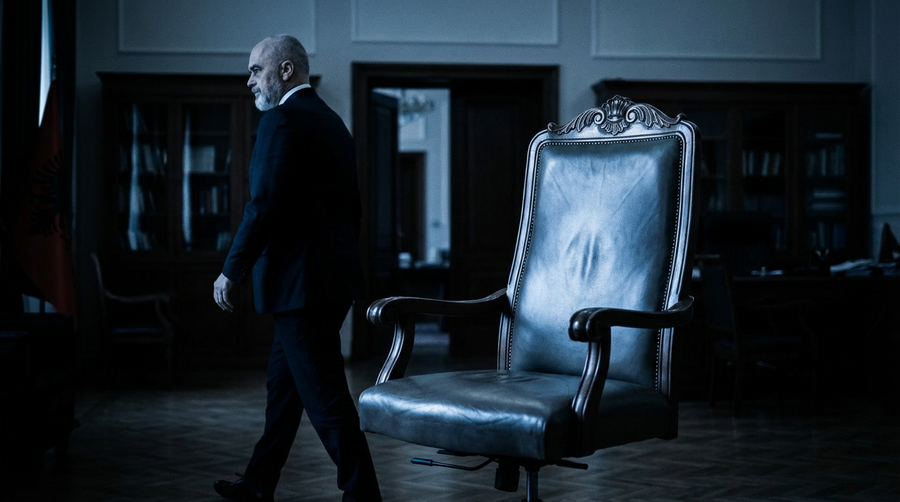
The political debate is focused on the departure of Edi Rama, while no one is talking about the successor and how he will be elected. The risk is not the change of power, but the arrival of a random prime minister, produced by circumstances and not by the will of the citizens.
Albania is entering a phase where the problem is no longer Edi Rama, but what might happen after him. The public debate continues to revolve around the stay, fall or exhaustion of a long-term government, while no one is seriously talking about the successor, how he will be chosen and the risk that he will come not from the will of the citizens, but from circumstances.
When a government weakens and society is not positioned, the transition does not produce elections, but appointments. It does not produce direction, but quick solutions. This is where the danger of the accidental prime minister arises, a figure who does not emerge from a political process, but from the need to close a crisis as quickly as possible.
Such a prime minister does not come because the people demand it, but because no one opposes it. He does not come with a program, but with acceptance. He does not come to make decisions, but to avoid opening up problems. And a country that accepts this kind of direction does not choose the future, but leaves it in the hands of the moment.
The history of transitions shows that when societies do not speak up in time, decisions are made outside of public attention. They are not made in elections, but in negotiations. They are not made by citizens, but by actors who seek stability above all else. Stability, when it does not stem from domestic politics, produces leaders without roots and without obligation to vote.
America does not appoint prime ministers or announce names, but it always prefers order and continuity. When a country does not produce its own successor through a clear political process, the successor emerges from compromise. And compromise usually produces figures who do not disrupt, but do not lead either.
The danger for Albania is not the change of power. The danger is the transition from a strong prime minister to a random prime minister. From a government that decides wrongly, to a government that does not decide at all. From a figure who bears responsibility, to a figure who simply occupies the chair.
Therefore, the moment to speak is not after the fall, but now. Not to overthrow someone, but to determine who should not govern us. Because democracy is not lost only when the vote is manipulated, but also when society accepts that its direction comes from chance.
If Albania does not open this debate today, it risks waking up tomorrow with a prime minister that no one has chosen, but that everyone has accepted due to the lack of an alternative. And this is the most silent form of losing control.
As for Edi Rama? He already belongs to the past... /Pamphlet


Hahah ju ka djeg Rama me ftesen nga Trump. Nuk po mund ta zhvleresoni me asnje gje. Do ta demtoni dhe helmoni vetem shendetin dhe shpirtin tuaj.
O kol palla, rama ka vdek, po shif ku do shkosh si patronazhist pas tij
Dëshira me largu Ramën nuk është vetëm e PDsë. Ky editorial me shumë drejtë shpalos pyetjen se kush do të jetë pasardhësi. Që qartësisht nënkupton stilin autoritar të një njeriu në krye të një shteti me themele të dobëta e me një nënbotë të fuqishme dhe mungesën e një apo disa kandidatëve të aftë. Zotëri Rama duhet të provojë pasuesit e tij, ndërsa Salih Berisha duhet ti hapë rrugën të rinjve shumë të aftë që rrinë në opozitë jo për besnikëri ndaj bajraktarit, por se janë anti-socialistë të bindur dhe nuk i kanë burimet dhe mbështetjen e organizuar për një alternativë që tërheq një shumicë votuese.