


 Shkruar nga Gjergj Zefi
The American president entered the logic of escalation, but exiting without political and military costs is becoming increasingly difficult...
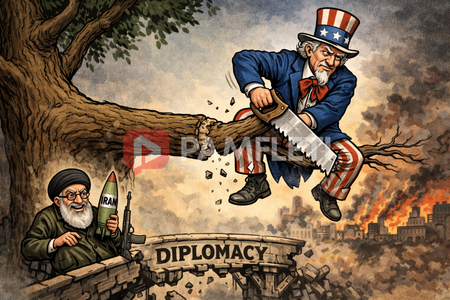
The President of the United States is today faced with a paradox that American history knows well, but that every administration acts as if it is discovering for the first time: America can open a front with shocking speed, but it cannot close it with the same ease.
In the case of Iran, Donald Trump is facing precisely this classic trap of great power: he demonstrated strength, activated the logic of maximum pressure, but is now discovering that escalation has its own law and that getting out of it without costs no longer depends solely on his will.
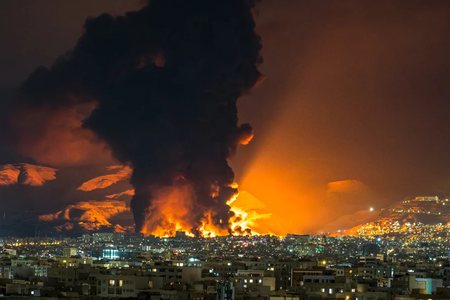
Today, the conflict has entered its fourth week, the rhetoric has intensified, and mutual threats have shifted towards energy infrastructure and the Strait of Hormuz, a vital nerve center for the global economy.
This is where propaganda ends and cold geopolitics begins. Trump can speak to his electorate in the language of triumph, he can present the strikes as proof of American resolve, he can even claim that military objectives have almost been achieved. But a president is not judged by how he enters a crisis; he is judged by how he emerges from it.
And this is precisely where the weakness of the current moment lies: the US administration has sent ambiguous signals, speaking at once of easing engagement, of limited relief in the oil market, but also of increasing forces and new threats against Iran. This is not a strategy; it is an attempt to buy time in a crisis that is dictating its own pace.
Diplomatically, Trump's biggest problem isn't just Iran. The problem is that a global power cannot simultaneously reflect fear, persuasion, and limited burdens.
The US wants to maintain its authority as a guarantor of order, but without paying the full cost of this role. This is the essence of the current crisis.
When Washington threatens Tehran to open Hormuz within 48 hours, while Western allies and the G7 talk about protecting global supplies and maritime security, it becomes clear that America is not only managing a regional conflict, but also the international system's fear of an energy shock with dire consequences.
Precisely for this reason, Trump is at an impasse.
If it escalates further, it risks entering a deeper conflict, with political, military, and economic costs that could hit not only the Middle East, but also the American consumer itself through oil and inflation.
If he backs down without a tangible outcome, he risks being perceived as a threatening leader, but he backs down when the crisis demands strategic coherence. And if he chooses the middle path, maximum pressure, without all-out war and without a real deal, he will only prolong an unstable conflict, turning the White House into a temporary administrator of chaos. Analysts have reported that energy markets are already reacting with great concern and that this is becoming a political burden for Trump in the run-up to the midterm elections.
In this picture, Iran is not just the adversary. It is also the mirror that exposes the limits of American power. Tehran knows it cannot defeat the United States in the classical military sense. But it also knows that it can increase the cost, it can destabilize the region, it can use Hormuz as an instrument of pressure, and it can hit Washington's allies where it hurts most: in energy, trade, and perceived security.
Iran's threats to completely close the Strait of Hormuz in the event of American attacks on energy infrastructure, as well as the expansion of the threat to the infrastructure of countries hosting American bases, show that Tehran is playing not for military victory, but for strategic consumption of the opponent.
This situation makes even clearer a truth that serious diplomacy should not hide with euphemisms: power without a political project is only chaos.
Bombing can destroy targets; but it cannot build order.
Threats can impose temporary fear; but they cannot produce long-term stability.
And a president who enters a crisis without a clear exit architecture risks becoming a hostage to his own image. This is Trump's real drama at this moment: he cannot appear weak, but any attempt not to appear weak can plunge him deeper into crisis./ Pamphlet


A është Presidenti Trump në qorrsokak me Iranin?????Portal provokator.Nxhitës??????????Kujt i shërben??????
Po mire c'u duhet qe beni artikuj acarues per Perandorine!? Bota nuk ndihet sa e si ne Shqiptaret por rrine syhapur e vezhgojne. Ne barinjte e malit terr e verr bejme pa e mbushur zorren mire. Mire nje individ mund te jape opinione personale por mos shkoni me lart se nuk e gdhendim boten ne.