


 Shkruar nga Gjergj Zefi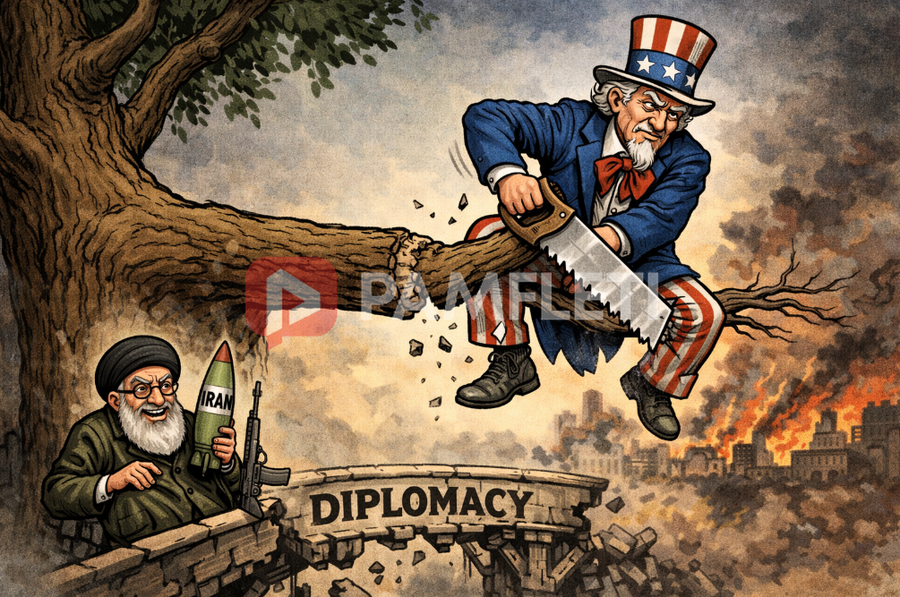
Ali Larijani was part of the heart of the Iranian regime, but also one of the few who could keep a real channel of communication open; his departure could make the crisis not smaller, but more uncontrollable...
The assassination of Ali Larijani is not simply the elimination of an enemy. It is something more serious and dangerous: it is the disappearance of one of the few people within the Iranian regime with whom one could still talk, negotiate, push for a compromise, and keep a door, however narrow, open for diplomacy.
At a time when the Middle East is on fire like never before and when any rash decision can send shockwaves across the region, striking a figure like Larijani is not a sign of strategic strength. It is the act of someone who thinks they can completely destroy their adversary without realizing that they are destroying their last point of contact with them.
Ali Larijani was not a peacemaker, nor a reformer, nor a soft-spoken man. He was a pure product of the Islamic Republic, one of its architects, and a figure closely tied to the security apparatus, to internal repression, and to the regime's hardline.
Reuters and AP describe him as one of the most powerful people in the system, with influence on nuclear issues, national security, and crisis management in the Iranian state.
That's precisely why he had weight. Because in such regimes, one does not negotiate with poets or decorative figures, but with those who hold the keys to the vault of power.
And therein lies the fatal irony of this moment. Those who thought that by killing Larijan they were striking the heart of the regime may have struck the last nerve through which a political solution could flow.
The Guardian writes that he was perhaps an even more serious loss than Khamenei himself in an operational sense, because he was a figure who connected conservatives, pragmatists, the military apparatus and diplomats. When such a figure falls, the regime becomes more nervous, more fragmented, less predictable and more prone to replacing calculation with survival instinct.
This is why his assassination could result in a tactical victory and a strategic defeat. Because yes, a key figure in the regime could be removed from the game. The chain of command could be weakened. The elite in Tehran could be shaken. But at the same time, the man who knew how to talk to the world without throwing the system into chaos is also gone. In his place, it is usually not the moderates who emerge. It is the harshest, the most paranoid, the most impulsive, the less political and the more military. And when a regime enters that phase, the risk does not decrease. On the contrary, it increases.
Reuters notes that Larijan's death symbolizes the fading of the traditional political elite and the relative strengthening of the military core in Iran.
In this sense, eliminating Larijan is like cutting off the branch you are sitting on. Because if the real objective is to avoid a wider war, to contain a regional clash and to keep a minimal channel of rationality open with Tehran, then you do not kill the man who had the weight to talk on behalf of the system. You can hate him, you can fight him, you can sanction him, you can isolate him, but in the end, diplomacy is not built with friends. It is built with enemies who still have the authority to provide a valuable response.
The biggest problem is that this type of action arises from a very dangerous illusion: the belief that the more you eliminate the strong figures of the opponent, the closer you are to peace. History usually shows the opposite. When figures who understand the balance of power are killed, the space is filled by figures who understand only the language of revenge. And in the Middle East, where every major assassination produces a series of open scores, this means that after each “decapitating” blow may come not the end of the crisis, but the entry into an even darker phase of it.
For this reason, the assassination of Ali Larijani should be read not only as a blow to Iran, but as a blow to the very last possibility for a political exit from the spiral of escalation. Removing the last person who could speak from the table means leaving the table in the hands of those who only want to overthrow it. And this is not intelligence. It is strategic hubris dressed up as triumph./ Pamphlet


Lini një Përgjigje