


 Shkruar nga Gjergj Zefi
From Merz's four fingers in Tirana to Rama's increased nervousness towards Berlin, the relationship with Germany no longer seems like a protocol misunderstanding, but as a sign of a political cooling that could bring consequences.
Germany is not a country that anyone in the Balkans can easily mock. Much less a prime minister who for years has built his international legitimacy on the idea that he is readable, acceptable and useful to the West. When Berlin smiles, many take it as support. When Berlin is silent, the costs begin to be calculated. And when Berlin shows signs of skepticism, then the political game enters a new phase.
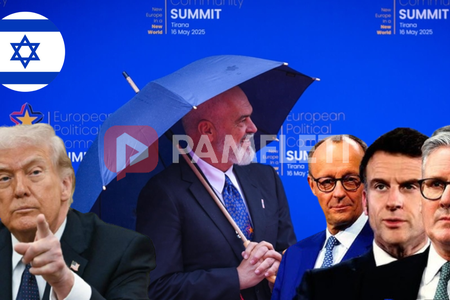
Precisely for this reason, Friedrich Merz's moment in Tirana, with four fingers raised in front of Edi Rama, was not read as a random gesture. It was seen as a snapshot of a question that seems to be circulating more and more frequently in European circles: has power concentrated in a single hand become too normalized in Albania?
Even when diplomats don't speak in big sentences, they often speak with symbols. And sometimes, a gesture is worth more than an entire statement.
On paper, the relationship between Berlin and Tirana remains correct. This is the formal truth. We do not have an official rupture, nor a declared clash. But real politics is not read only in standard statements, in protocol congratulations or in the careful language of diplomacy. It is read in tone, in distance, in reserve, in the way the parties avoid each other, or in the way they begin to weigh each other more coldly.
And here begins the real problem for Edi Rama. Because he is accustomed to dominating the domestic terrain, to controlling the narrative, to relativizing every accusation and turning every critic into material for political consumption. This has worked for him more than once within Albania. But Germany is neither the Albanian opposition, nor a television studio, nor a voice that can be neutralized with irony, jokes or public nervousness. Germany is the heavyweight of Europe. And when it doubts, its doubt is reflected more broadly, in the climate, in perception and, sooner or later, also in decision-making.
The more Rama tries to present any criticism from the outside as political prejudice against him, the more he risks revealing the true nerve of his government. Because the center of the issue is no longer just integration as a slogan. The issue is the standard. It is the rule of law. It is the quality of democracy. It is the concentration of power. It is the relationship with institutions. It is the use of Europe as a strategic objective, or as propaganda decor for domestic needs.
If Berlin may once have viewed Tirana with more patience, today it seems to be viewing it with more caution. And that is a big difference. Political patience is comfort. Caution is suspicion. When Germany moves from comfort to suspicion, a more difficult period begins for every government in the Balkans.
It is against this background that we must also read Edi Rama's increased irritation towards the German government, sometimes expressed with subtext, sometimes with more direct language in press conferences and public appearances. He is no longer hiding his annoyance towards a climate that, in all likelihood, no longer seems as friendly to him as before. But herein lies his strategic mistake: when a leader begins to openly argue with an important European center, treating it as an internal opponent, he risks confusing his own public with the real gravity of that clash.
As for sensitive regional issues, such as the case of Hashim Thaçi, it is true that beliefs and perceptions have long been circulating in the Balkans that without the approval, or at least without a silent push from important Western centers, including influential factors in Germany, some processes would not have taken that trajectory. But this must be said with caution: these remain political perceptions circulating in diplomatic channels and not publicly proven facts. It is precisely this distinction that is necessary for anyone who seeks to analyze seriously, without falling into the trap of reckless theses.
However, in our region, perception has its weight. And the perception that is strengthening today is this: Berlin no longer sees Tirana with the same comfort as before. There is more skepticism. More coldness. Less patience with the model of overextended leadership and with the tendency to present any criticism of the government as an attack on Albania.
This is why jokes, irony and the anger of the moment are not enough. You can joke about internal opponents. You can attack analysts, media, institutions, investigations or political opponents. You can produce noise for daily consumption. But there is no joking with the “flour” of Germany. Because Germany does not react with noise. It reacts with memory, with weight, with coolness and with attitudes that give effect not in one day, but in the entire period that follows.
Rama's problem, after all, is not a gesture by Merz in Tirana. His problem is the possibility that a deeper conviction has begun to mature in Berlin: that Albania cannot seriously move towards Europe by normalizing the concentration of power, relativizing criticism, and using integration as a political facade. If this conviction is strengthening, then a more complicated phase is beginning for official Tirana.
You can have disagreements with Germany. You can negotiate. You can even clash politically. But you can't act as if its weight in Europe is a protocol detail. And this is where Edi Rama's biggest miscalculation seems to begin./ Pamphlet




Analia me e mire e bere ndonjehere prej teje, z. Zefi!!! Kudos!!!
Ia paske bere mire komentin Analia. Bravo!
Mirë Sh analiza, por me letyra qe kane gllabrruar cdo gje è me nje multi agjent Ferid Hoxha Minister , do vazhdoje qeveria deri Kur të vdes sulltani