


 Shkruar nga Pamfleti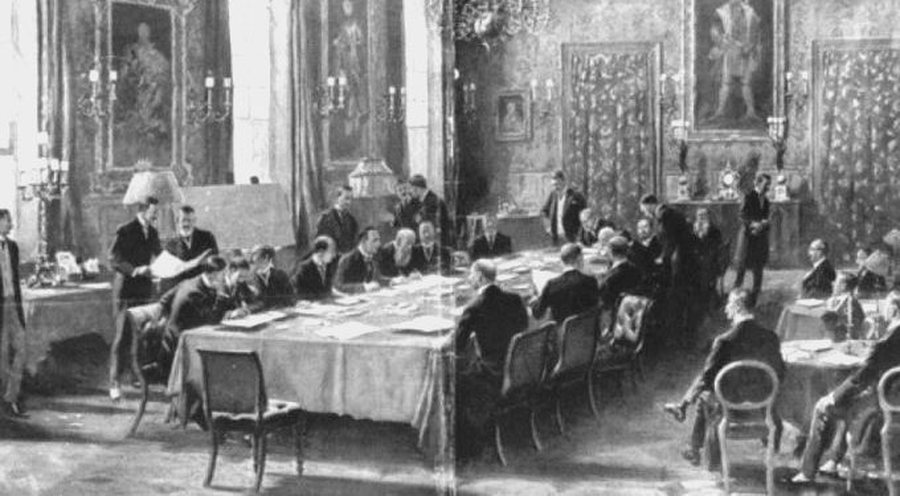
On July 29, 1913, the decision of the Conference of Ambassadors in London resulted in the “de jure” recognition of the Albanian state. This act constitutes the fundamental international document of the creation of the Albanian state and the recognition of the supervised independence of Albania by the six Great Powers of the time: Austria-Hungary, Italy, Great Britain, France, Russia and Germany. This act was attached to the internal act of independence of Albania, proclaimed on November 28, 1912. With this decision, the Conference of Ambassadors in London changed its decision of December 17, 1912, where Albania was recognized as “Autonomy guaranteed and controlled exclusively by the six Powers under the sovereignty or suzerainty of the Sultan” and decided to form Albania “as an autonomous, sovereign principality… under the guarantee of the six Powers”.
In jurisprudence, de jure recognition means a stable, complete and final recognition. Although this decision of this conference did not recognize the independent Albanian state proclaimed in the Vlora Assembly by the Fathers of the modern Albanian nation, but a state reduced to almost half of its territories, it is still important because it opened the first path towards the recognition of the rights of the Albanian nation.
The Great Powers had reservations regarding the future status of the Albanian state. They recognized it as a subject of international law, admitted it into the community of states of the time and established diplomatic relations, but imposed on it a series of obligations and conditions not only to ensure its ability to move towards a political future, but also to keep it under international legal institutional control and supervision.
The newly formed Albanian state was placed under the rule of a prince selected by the Great Powers and it was these powers, through the International Control Commission, that would direct, supervise, and care for the new state for a period of ten years. This international institution, in cooperation with the power given to the prince, as head of state and at the same time the embodiment of executive power (which he exercised through the prime minister), would constitute the highest political decision-making authority in the Principality of Albania.
There were six Great Powers, those who guaranteed the status, integrity and neutrality of the new state, a task that they in fact failed to fulfill, due to a series of international circumstances and internal Albanian reasons. Also, the Great Powers reserved for themselves the right to establish state structures and organize life, political, economic, social activity, domestic and foreign policy, the construction of the army, gendarmerie, the drafting and approval of the constitution, Provisional Statute, etc., of independent Albania, turning its independence into a fictitious one.
These restrictions were asphyxiating for the sovereign attributes, specific and necessary for an independent state and subject to international law. The de jure recognition of the Albanian state coincided with the efforts of the Great Powers of the time to find a compromise between the participating states and to geopolitically stabilize the Balkans, troubled by wars. The Conference of Ambassadors needed more than eight months of discussions, to decide on the projects and to make the necessary adjustments! The difficulty was that the basic projects were very far from each other and compromise was quite difficult.
This conference was so difficult that to this day we remember as special what all the historical figures who would deal with the administration of Albania did. Even the European powers themselves had a very difficult time. Among them, we remember the Swedes who immediately withdrew from the administration to leave the burden of administration to the Dutch gendarmerie. The American minister in Greece at the time would call this plan “a miracle of incompetence”, “an absolutely incompatible scheme”, “a tangle of unstable things”.
Faced with these difficulties, the London Conference postponed the final decision on the status of Albania from one meeting to another, without reaching a final decision. The evolution of events on the ground affected the changes and shifts of the initial positions and especially in the spring of 1913, the problem of status took on new perspectives. On May 30, 1913, at the Conference of Ambassadors in London, the Peace Treaty was signed, which for the Albanian issue is the second important act after the decision of December 17, 1912.
With this treaty, the Ottoman Empire was forced to give up its sovereign rights over Albania, the Balkan states were discouraged from continuing further divisive activity over Albanian lands, since now it would be the six Great Powers that would decide on all issues related to the status of Albania, its internal organization and the definition of borders. This treaty was the first international act that expressed the idea of a separate Albanian state, although in a still undefined form.
Çështja shqiptare u përcaktua nën prizmin e shmangies së një ballafaqimi mes Austro-Hungarisë dhe Rusisë. Austro-Hungaria u gjend përballë faktit të kryer të ndryshimit të status quo-së ballkanike në dëm të saj dhe në të mirë të Serbisë, Malit të Zi, Greqisë, prapa të cilave qëndronte, në fund të fundit, Rusia. Për të kompensuar këtë, perandoria dualiste me mbështetjen e pasigurt të Italisë, vendosi të vinte tanimë në jetë planin e kahershëm për krijimin e shtetit të Shqipërisë autonome (më vonë të pavarur), që do të duhej të kishte kufij sa “më të mëdhenj që të ishte e mundur”.
Trajtimi i problemit të kufirit të shtetit të ri shqiptar nuk u mbështet në konsiderata etnografike, historike, ekonomike etj., por u bë nga Fuqitë e Mëdha nën prizmin e mos prishjes së “Koncertit Evropian”. E drejta e Serbisë mbi Kosovën (e pretenduar edhe sot kur Kosova është shkëputur juridikisht dhe faktikisht nga Serbia) dhe e Greqisë mbi Çamërinë dhe territoret e tjera shqiptare në juglindje, ishin rezultat i fitimit të këtyre territoreve si plaçkë lufte dhe të sanksionuar ndërkombëtarisht nga një institucion, i cili në thelbin e punës së vet asokohe nuk kishte parimet e sotme bazë demokratike që rregullojnë marrëdhëniet ndërkombëtare.
Veprimtaria e shteteve ballkanike dhe e Fuqive të Mëdha në realizimin e këtij vendimi u ndihmua nga gjendja në të cilën ndodhej shoqëria shqiptare e asaj kohe. Pushtimi pesëshekullor otoman kishte konservuar konservatorizmin mesjetar dhe ruralizimin e shoqërisë. Shqipëria vuante nga mospasja e një grupimi shoqëror të emancipuar, vuante nga ekzistenca e një klase bejlerësh që e kishte pak të zhvilluar ndjenjën e përgjegjësisë kombëtare dhe rendte ende me fantazmat e ruajtjes së çifligjeve personale të dhuruara.
Forcat e emancipuara liberale e pro-evropiane të shoqërisë shqiptare ishin minorancë gati të pafuqishme për të ndërmarrë nisma që thyenin tabutë konservative të një shoqërie të sapodalë në liri. Kjo liri e brishtë, e shoqëruar me cungime të rëndësishme territoriale, të sanksionuara edhe me marrëveshje ndërkombëtare, e ndjekur hap pas hapi nga etja e shfrenuar e fqinjëve grabitqarë, e kishte çorientuar kahun e drejtimit përparimtar të kësaj shoqërie, e kishte lënë atë preh dhe të pambrojtur nga aventurierët që në atë kohë (pse jo, edhe më pas), ishin me shumicë.
Çështja e Shqipërisë u zgjidh pa respektin më të vogël ndaj shqiptarëve dhe kufiri i shtetit të ri shqiptar u përcaktua vetëm nën prizmin e shmangies së një ballafaqimi mes Austro-Hungarisë dhe Rusisë, për të cilin shqiptarët nuk ishin fajtorë dhe nuk kishin të bënin fare me të. Ishte kriminal qëndrimi i Fuqive të Mëdha të asaj kohe, që në vend t’i hapnin poret jetësore një kombi në rrugën e tij për ripërtëritje qytetare e kombëtare, e cunguan atë territorialisht, i këputën arteriet jetësore dhe ushqyen faktorët që bëjnë lehtësisht të manipulueshëm dhe të kontrollueshëm një popull të penguar historikisht në rrugën e tij të zhvillimit.
It was these historical injustices, which would bring conflicts, blood, resentment, violence and tears until the beginning of the 21st century, that forced Bishop Gjergj Fishta to accuse: “Ugh! Europe, you whore of the weather!/ That you deny the new, the faith of God!/ Yes, is this the saint of citizenship?/ With the land of Albania/ among the clichés of Russia”. But as a proverb says “righteousness delays, but it does not forget”. It was the end of the 20th century that had to come, when the geopolitical situation of Southeast Europe changed.
The democratization of this part of Europe enabled not only the liberation of Albania from the communist dictatorship, but also the creation of a new entity in the Balkans, the “Republic of Kosovo”, as a sovereign, free and democratized country, which the Albanians were left out of in London in 1913. This new republic in the Balkans (despite the many problems it has with the Serbs and among the Jews) is trying to progress in freedom, democratization and Europeanization. Likewise, the Cham problem, from “taboo”, has become the topic of the day in international talks and parliamentary resolutions.
Today, after 113 years of division, Albanians are an accepted factor in Europe's process of recognizing Western values of Freedom, democratization, and Westernization. Our nation has been given the opportunity to seize this opportunity to unite their homeland in a Europe of the same values. By doing so, the West has generally corrected not only the principles on the basis of which the peoples were divided at the beginning of the 20th century, but has also specifically corrected an injustice done to one of the oldest and most suffering peoples of the Western Balkans, the Albanians.
It is the duty of the Albanian political class in Albania, Kosovo, Macedonia, Montenegro, Presevo, Medveđa and Bujanovac to take advantage of this luck, to repay the debt that the poet says "I owe to the year 13, for not closing the wounds", by drafting common integration policies in all areas. But, this first of all requires agreement among ourselves, since it is shameful, not to say anti-national, the hatred, accusations, disagreements and resentment that political leaders have towards each other. Today is the time for unity through integration, tomorrow will be too late./ Memorie.al






Lini një Përgjigje