


 Shkruar nga Pamfleti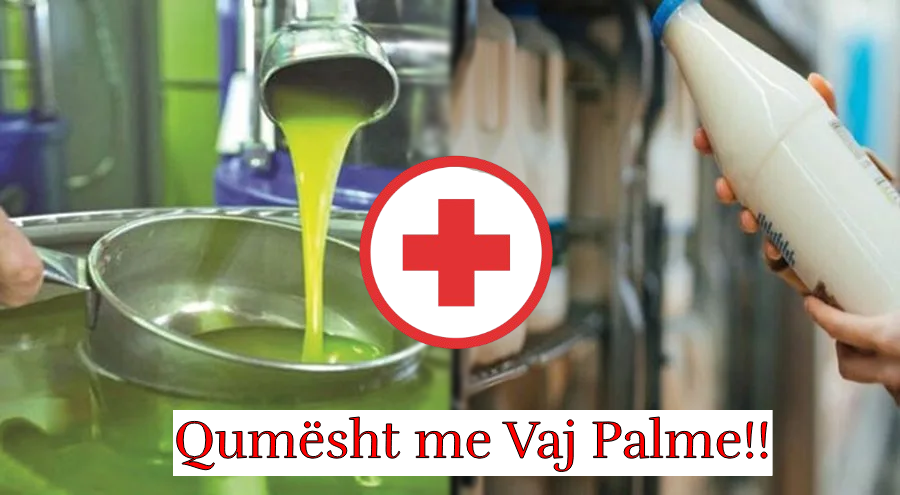
Natural fat is removed and replaced with palm oil, products are sold as traditional food, and the lack of control turns supermarket shelves into a direct risk to consumers' health.
Food safety in Albania poses a direct risk to the health of citizens because part of the dairy processing industry has built a production model that no longer relies on natural milk, but on its complete skimming and the replacement of basic ingredients with industrial raw materials such as palm oil and powdered milk obtained from whey.
This process does not happen by chance and is not related to technical difficulties, but to concrete economic decisions made by well-known factories on the market such as Lufra, Erzeni, Fast, Balkan Bio, Gjirofarm, Zepa Natyral and other milk processing entities, which receive fresh milk from farmers, extract the natural fat through technical skimming, use the cream to produce butter that is sold separately at a higher price, and in products intended for mass consumption add palm oil to artificially recreate the fat content and powdered milk to increase the volume.
This is why products labeled as cottage cheese, kaçkavall or dairy products circulate on the market that no longer contain animal fat in the percentages required by law and food practice, but instead contain vegetable fat that has nothing to do with milk, while the labeling does not truly reflect the composition and the consumer pays for something other than what he receives.
The National Food Authority was aware of this practice, as the NFA itself has conducted inspections and publicly admitted that palm oil and starch were found in certain products, but the actions have been limited to administrative fines and formal interventions on labels, without being accompanied by in-depth laboratory analyses to confirm the real extent of the phenomenon.
The question is straightforward and does not require technical justification. Why has the AKU not systematically sent samples of dairy products for full chemical analysis to the Institute of Food and Veterinary Safety, an institution that has the capacity to distinguish animal fat from vegetable fat and to determine whether a product contains palm oil?
ISUV functions as a state reference laboratory and has the legal obligation to conduct such analyses, but to date there is no detailed public report showing how many products have been analyzed, which factories have been involved, what results have been obtained, and what measures have been taken based on these results.
Meanwhile, palm oil imports to Albania have increased significantly in recent years, while domestic milk production has declined due to the decrease in the number of dairy cows, a fact that shows that the dairy industry is increasingly relying on industrial substitutes rather than the real raw material.
This situation creates a chain of fraud where producers increase profits, institutions are limited to formal measures, and consumers are fed products that release oil when cooked in heat and do not have the nutritional value of a dairy product.
At this point, the issue is no longer just a food safety problem, but takes on a criminal dimension and requires the involvement of the Special Prosecution Office, because when an economic entity falsifies the composition of food and sells it as another product, it commits fraud with consequences for public health, and when a state institution has knowledge and does not act in essence, suspicion of abuse of office arises.
SPAK should investigate this scheme by following the full chain of actions, verifying palm oil imports, quantities used by milk processing factories, AKU inspection reports, decisions on administrative fines, the lack of criminal referrals, and the reasons why samples were not sent for full analysis to ISUV.
If SPAK verifies that AKU officials had full knowledge of the real composition of the products and chose not to act beyond formal fines, then the issue moves from administrative negligence to favoring economic entities and collaboration in organized food fraud.
Food safety is not protected by press releases or sporadic inspections, but by laboratory analysis, transparency, and a clear ban on practices that transform food into an artificial product, while citizens continue to buy with the belief that they are consuming milk.
The involvement of SPAK is not a political demand nor a media alarm, but a legal need to determine criminal liability in a scheme that affects every family and every table, because food is not an ordinary commodity, but a basic element of public health. /Pamphlet






Eshte ashtu e keshtu, e bejne ashtu e keshtu, pa nje prove e pa nje analize..Tani te merret Spaku..Shpresoj te kuptoni qe po ja fusni kot..
Krim