


 Shkruar nga Pamfleti
Donald Trump confirms that the United States will conduct new nuclear tests, "if others will," while CNN reveals that the Pentagon has given the green light to send Tomahawk missiles to Ukraine, although the final decision will be made only by the president. It is difficult to predict now which of these moves will actually be implemented in the near future, but everything seems to be aimed at increasing pressure on Washington's rivals, first Russia and then China, so that they give up both the arms race and the plans to take control of Ukraine and Taiwan.
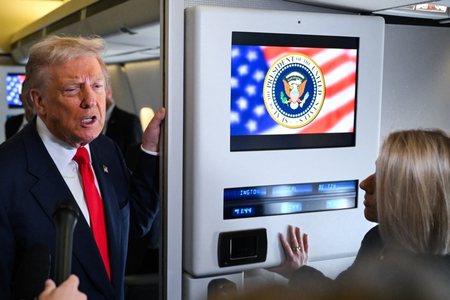
After the surprise announcement on social media ahead of a summit with Xi Jinping in South Korea, many have implied that the head of the White House had confused the nuclear-powered missiles launched in recent days by the Kremlin's rival with nuclear explosion tests. So yesterday, during the flight to Mar-a-Lago, Trump clarified: "We will do tests, yes, and other countries are doing them. If they do, we will do them too." When reporters later asked him if he intended to cause real explosions, he was vague: "You'll see."
The secretary of the Russian Security Council, Sergei Shoigu, responded that “nuclear weapons are tested regularly, but mathematical models are used, not physical experiments.” However, if Washington continues with real explosions, Moscow will follow suit. Presented this way, it looks like a mutual game in which each side beats its chest to reaffirm strength and threaten, without necessarily moving to concrete action. But with Trump, you can never be sure. Some advisers, such as those at the Heritage Foundation, urge him to conduct the tests partly to verify the effectiveness of the arsenal, partly because, in their opinion, others are already conducting them secretly, and partly to send a political signal.
Experts in the field argue that there is no need for them, since the arsenal is controlled through non-physical verifications and the construction of new nuclear warheads had already been started by Biden, without the need to detonate them. Even if it were true that Russia and China had conducted secret tests, they were not major operations, as they would have been noticed, while the political message of an explosion carried out by the Americans would be harmful to the US, because it would justify and encourage everyone else to imitate them, losing the technological advantage they enjoy today.
Then there are the practical problems, starting with the fact that the Nevada National Security Agency hasn't been used for this purpose since September 1992, and the structures are depreciated. It would take at least six months to reactivate them, possibly a year, according to nuclear physicist and former Energy Secretary Ernest Moniz.
And the cost would be over $100 million.
Adding to this are legal hurdles. Last May, the Nevada Legislature unanimously passed AJR 13 to maintain the state's testing moratorium, and Rep. Dina Titus introduced legislation to block the use of federal funds for the purpose. It won't be a major obstacle for Trump, but it promises to trigger lawsuits that could further delay the timelines.
Meanwhile, the Financial Times has revealed that the Budapest summit originally scheduled for last week has collapsed due to Vladimir Putin's excessive demands, contained in a preparatory memorandum sent from Moscow to Washington.
All this, combined with the threat to supply Ukraine with Tomahawks, may have as its primary goal to push the "tsar" towards negotiations./ La Repubblica


Lini një Përgjigje