


 Shkruar nga Pamfleti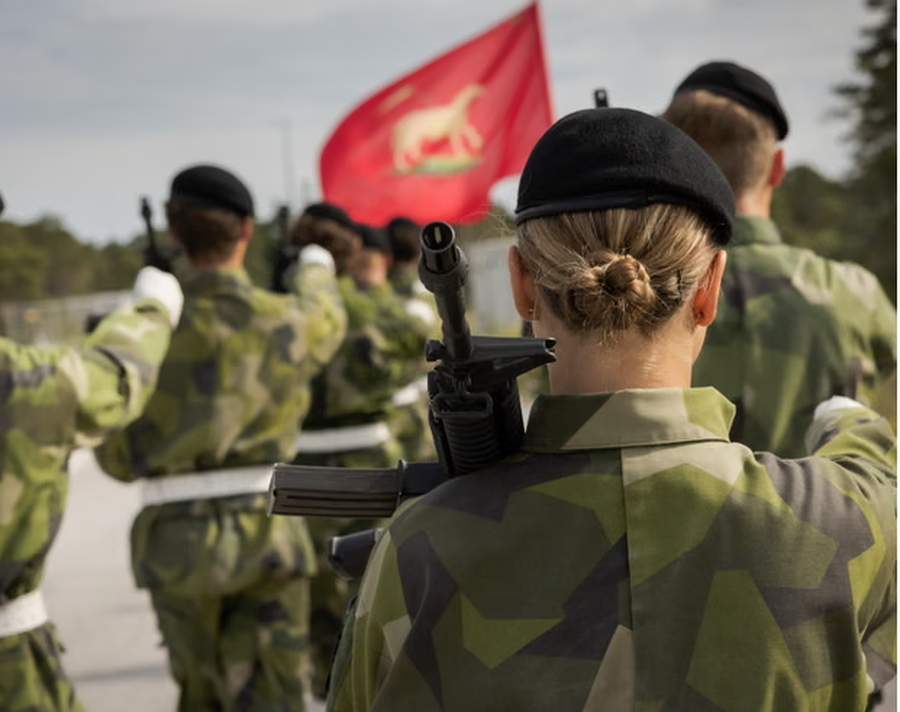
The Swedish island of Gotland, considered one of the most strategic points in the Baltic Sea, is becoming one of the main pillars of Sweden's and NATO's defense. In addition to increasing military forces, the authorities are also investing in increasing the readiness of the civilian population to face any potential crisis.
Just four months ago, 19-year-old Ella Adman had finished school and had never held a gun in her hand. Today she is doing her mandatory military service at the P18 base on Gotland and in a few days will take part in her first official mission in Stockholm, where she will be engaged in protecting the royal family.
Initially, Adman found the 15-month military service and training days lasting up to 16 hours difficult. However, she says the experience has made her stronger as an individual and as part of a team.
She is one of hundreds of conscripts who have been stationed on Gotland, part of Sweden's rearmament process. During the Cold War, the island had four regiments and up to 25,000 soldiers in the event of full mobilization. In 2005, the last regiment was closed, and only in 2018 was the military presence restored due to growing concerns about regional security.
Gotland is located about 275 kilometers from the Russian Kaliningrad and only 87 kilometers from the Swedish coast. Because of its position, military experts consider the island crucial for controlling naval and air operations in the Baltic Sea.
The commander of Swedish forces on Gotland, Colonel Andreas Gustafsson, emphasizes that control over the island is essential not only for Sweden, but also for NATO.
"If you control Gotland, you control the Baltic Sea. That's why we must defend this island, for Sweden and for NATO," he declared.
Following the Russian invasion of Ukraine and Sweden's accession to NATO, the pace of military buildup has accelerated significantly. The island regularly hosts Alliance exercises, while Stockholm has increased defense spending to 2.8 percent of GDP by 2026 and aims to raise it to 3.1 percent by 2028.
However, according to Gustafsson, the expansion of military capabilities faces difficulties due to the high global demand for artillery equipment and systems.
He estimates that there is currently no immediate threat of a conventional attack on Gotland, but the risk of espionage and sabotage remains real. According to him, a ceasefire or peace agreement in Ukraine could allow Russia to quickly redeploy forces to the Baltic region.
"The risk is that Russia will become desperate. The more pressure there is on it, the more unpredictable its actions can be ," he said.
In the event of aggression, Sweden plans to defend the island by keeping the civilian population in place and preventing any attempts to establish a Russian base on Gotland.
Preparations are not limited to the military. The island's residents are organizing themselves to deal with emergency situations.
Doctor Eva Rinblad has created a local preparedness group in her neighborhood. Residents have inventoried water, energy, and communication sources, and are also mapping alternative water reserves. On her property, she grows vegetables, raises poultry, uses solar panels, and collects rainwater, with the goal of increasing self-sufficiency.
She also plans to set up a community center where residents can get information, warm up, cook, charge their phones, or spend the night in case of an emergency.
"Society should continue as normally as possible. Kindergartens, schools and workplaces should remain functional whenever possible," says Rinblad.
This year, Swedish authorities will also conduct an evacuation drill for several hundred island residents.
The Director of the Swedish Civil Protection and Resilience Agency (MSB), Mikael Frisell, states that the security situation in the Baltic region is serious and that Gotland could be isolated in the event of conflict, experiencing supply disruptions.
According to him, the objective is for the island to become as self-sustaining as possible, while the experience gained from the war in Ukraine is being used to improve emergency services, the treatment of mass casualties, the management of unexploded ordnance, and search and rescue operations.
Stockholm University professor Emil Edenborg, who studies developments on the Baltic islands, notes that most residents support the return of the army, although the process has also sparked debates over urban development and wind energy projects.
Meanwhile, Gotland's preparedness strategist, Per Wikberg, describes the port of Visby as the island's "highway", stressing that, despite the progress made, much work remains to make Gotland fully prepared for any situation.




Lini një Përgjigje