


 Shkruar nga Pamfleti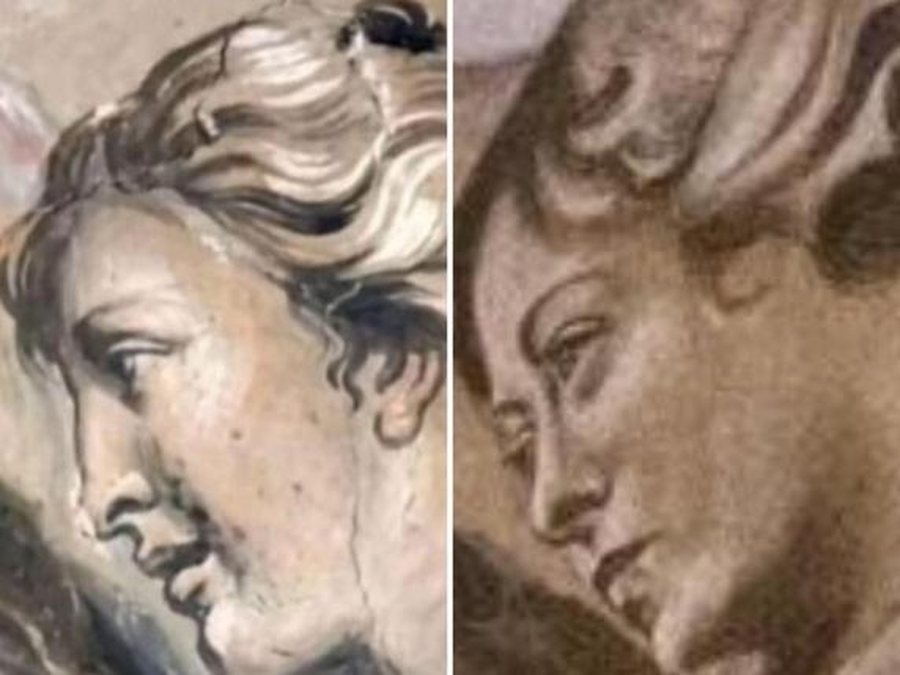
The original image of the fresco in the Romanesque basilica of San Lorenzo in Lucina was published today, reactivating the debate that has been engulfing art, politics and religious institutions in Italy for days. A comparison between the old photograph and the restored version shows a noticeable change in the features of the angel's figure, which, according to critics, after the intervention appears to resemble Italian Prime Minister Giorgia Meloni.
The original image was re-released on social media by architect Cino Zucchi, who explained that the photo was taken from the “Roma Aeterna” Instagram profile. His ironic post sparked strong controversy, as it suggested that the restoration had transformed a sacred art figure into a portrait with political references. Zucchi himself stated that it was “an ironic game,” but there was no shortage of reactions.
After the publication of the original image, the Sovrintendenza has launched verifications to understand what the fresco really looked like before the restoration and whether the intervention respected the scientific criteria for the preservation of cultural heritage. For days, archival documentation has been sought to verify whether the distributed photograph fully corresponds to the previous state of the work.
Meanwhile, restorer Bruno Valentinetti, who carried out the intervention on the fresco after it was damaged by moisture, has covered up the face that caused controversy, stating that the action was done “at the request of the Vatican.” Valentinetti insisted that during the restoration he limited himself only to “rereading what existed before,” denying any symbolic or political purpose.
The issue has also brought strong reactions from the Vicariate of Rome. Cardinal Baldo Reina has distanced himself from the ironic statements of the vicar of the basilica, Msgr. Micheletti, and has announced verifications to determine responsibilities. The official statement emphasizes that sacred art cannot be used or instrumentalized for inappropriate purposes and that it must remain at the service of liturgical and spiritual life.






Lini një Përgjigje