


 Shkruar nga Pamfleti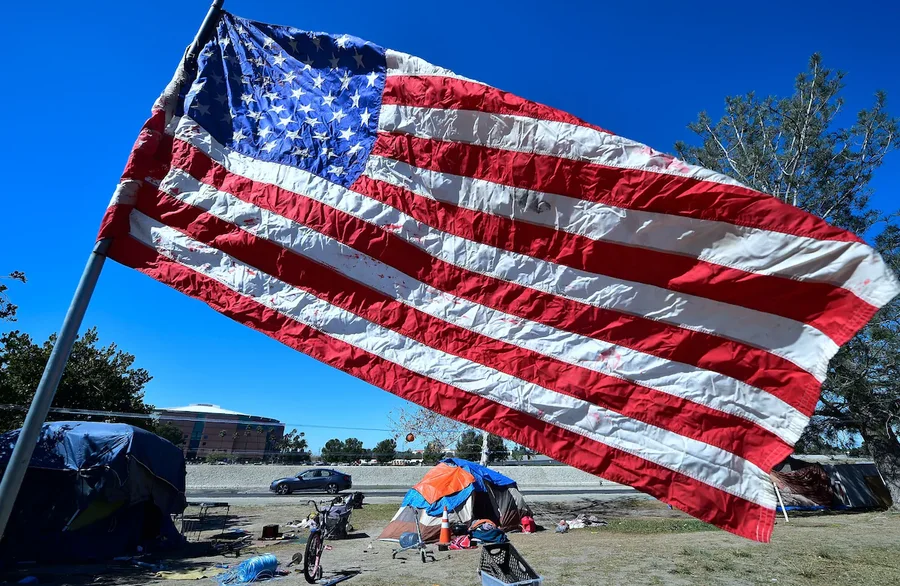
How the "new misery" hit America...
The 250th anniversary of the American experiment would be reason enough for deep reflection. But the historical developments of recent years make this moment even more charged with significance. Today, international attention is focused on the United States, amid uncertainty and concern about the direction of the American project, both at home and abroad.
Domestically, trust in political and civic institutions has suffered a long and deep decline. Internationally, the US’s reputation is rapidly eroding, as foreign governments and global markets increasingly see Washington as an unpredictable actor, even a source of instability.
This unpredictability stems from American society itself: from citizens' dissatisfaction with their country and its role in the world. This disillusionment is pushing Americans to reconsider their traditional commitment to the international order built after World War II, the Pax Americana, that has underpinned global security, trade, and finance for decades.
The historical irony is profound. It was precisely as the United States emerged from the Cold War as the sole and undisputed global superpower, with greater influence than any previous empire, that an internal unrest began to emerge that is now being reflected on the world stage.
This internal doubt emerges in a society of extraordinary wealth. No country in history has generated as much wealth as the United States today, with a private net worth exceeding $180 trillion. The fundamental question is why the richest and most powerful country in history is so fraught with insecurity and discontent.
Important answers lie in America’s “human arithmetic.” It is possible to be both prosperous and impoverished in human terms. Alongside material progress and social achievements, including the eradication of legal racial discrimination, have emerged unexpected consequences of public policy and increased spending power. These consequences have produced what has been described as the “New Misery.”
The Great Depression generation would not have imagined an America so wealthy, but with more welfare dependency, family breakdown, crime, and perhaps even more loneliness and despair. One of the most underappreciated problems is the long-term decline in employment for working-age men.
Although official unemployment figures look relatively positive, the employment rate for men aged 25 to 54 has been, on average, lower in the 21st century than at the end of the Great Depression. Today, about 7 million men in this age group are neither working nor looking for work. Many of them are socially isolated, dependent on welfare, with health problems and often suffering from what are called “deaths of despair.”
The consequences extend beyond individuals: slower economic growth, greater inequality, more fragile families, and a weaker civil society. The failure of political, academic, and media elites to seriously address this reality has deepened the gap in trust and empathy between governments and citizens.
At the same time, American political leadership after the Cold War is portrayed as weak and short-sighted, both in foreign and domestic policy. The increase in public debt, the abandonment of budgetary discipline, and the financing of current consumption through the burden on future generations are presented as unsustainable and unjustifiable practices.
Today, the United States remains a great but vulnerable nation. However, the most serious threats come largely from within. The author emphasizes that America's foundations are still strong: constitutional order, the ability to create prosperity, and the historic role of Pax Americana in protecting freedoms and reducing global poverty.
What is missing, according to this assessment, is the confidence to let these foundations work and a return to the characteristic American optimism that, historically, has been a source of strength and renewal. / Adapted from "Washington Post"






Lini një Përgjigje