


 Shkruar nga Pamfleti
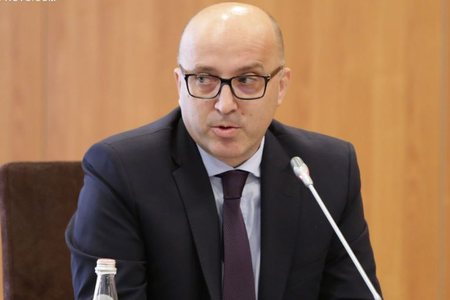
Colonel Dritan Demiraj has stated that the appointment of Eric Wendt as the new United States ambassador to Albania will bring a tougher approach to high-level corruption and election manipulation in the country.
Demiraj described Wendt as one of the most prominent American military and diplomatic profiles, citing his experience in leading NATO special forces, international missions, and Indo-Pacific strategic structures.
According to him, the selection of such a figure shows that Washington is considering the situation in Albania not simply as an internal political issue, but as a national security problem.
"Corruption at high levels in Albania, the connection of a significant part of government structures with organized crime, and the manipulation of elections will no longer be treated by the US as internal issues, but as national security issues," Demiraj said on SYRI TV.
Demiraj: From the Green Beret group commander to the leadership of NATO Special Operations Forces Command, that is, the special forces of all of NATO, including the Special Forces Command in Europe. It clearly speaks of a... of an extraordinary experience.
Not only in terms of knowledge of geopolitical situations and issues in the region and beyond, but also on the other hand, his career as a representative of the United States of America in negotiations between the Palestinians and the Israelis, and his command in one of the most important points of geographical importance in the Indo-Pacific as commander of Special Forces and deputy commander of the Indo-Pacific Command, one of the regions in which a conflict is expected in the future.
It clearly shows that his profile is one of the most extraordinary profiles and Albania is fortunate in this case to be addressed by the American embassy, but also by American foreign policy, to have such a representative standard. So the representative of the United States of America to be represented by a person with such status.
Based on the facts, I believe that one of, both Albania and other countries, I believe that are in the procedures. You know that the selection of an ambassador requires not only his election, but also the nomination and approval by Congress and the Senate. And in this perspective, that's why I said, seen or said even in the political context in which the Albanian political situation is going, this takes on extraordinary importance.
It has an extraordinary significance. This is because corruption at high levels in Albania, the connection of a significant part of all government structures with organized crime, the theft of elections... but not only that, will begin to be treated by the United States of America no longer as internal issues, but as issues of national security.
And I believe that for a long time, the messages of the US Department of State and the Secretary of State have also been important, considering the rampant corruption in Albania as a destabilizing factor and not as a political compromise.
And precisely, I believe that the manipulation of elections for 14 years will be the focus of the new ambassador's work, who I do not believe will accept democratic facades, but will demand real standards in terms of concrete results from Albanian politics.
Because the capture of a large part of justice, and its failure to function properly, certainly a large part of the justice system we have supported and continue to support, but they continue to be the foundation of the illegal survival of the current government.
And here I mean, you have seen that despite the opposition's constant statements, some, such as the former deputy prime minister, and other ministers, are being protected in all illegal ways by the justice system through the direct intervention of Prime Minister Rama.
I think that, also because of the 30 years of experience in special forces and another five years before that in conventional American army units.
The arrival of a new ambassador will aim to emphasize the acceleration of military procedures or reforms, for which, for the sake of truth, Albania has been struggling in recent years, both due to the geopolitical situation, but also due to the leadership of the General Staff of the Armed Forces by a colleague from the special forces, who, quite differently from the three or four previous chiefs of staff who have done no work, is creating a momentum that, in particular, in the last three or four years has created a qualitative procedure and reforms in the Armed Forces, which have been felt both in terms of the modernization and strengthening of these structures, but also in terms of improving salaries, training and working conditions.



Lini një Përgjigje