


 Shkruar nga Pamfleti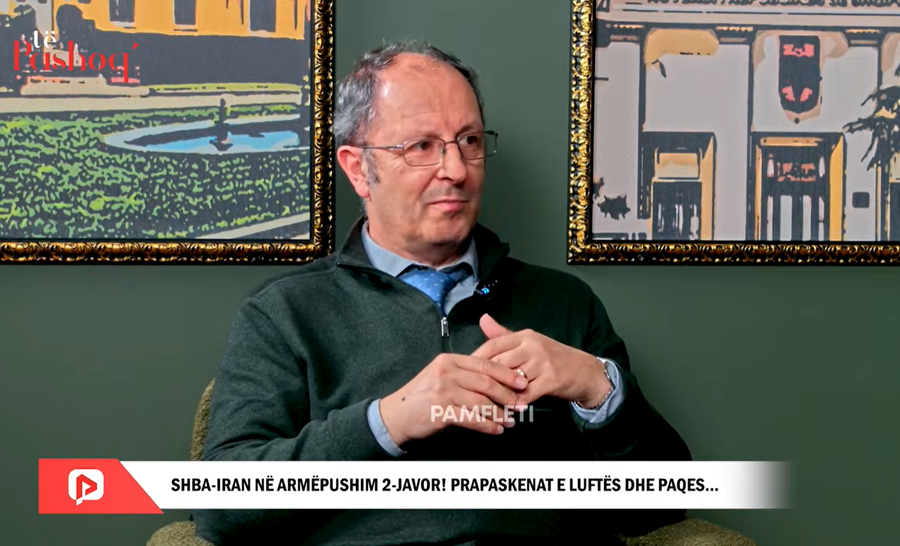
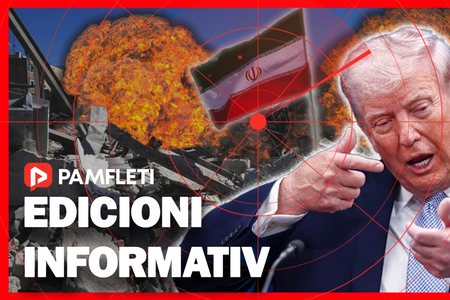
After weeks of heightened tension and bellicose rhetoric that kept the world on edge, a two-week ceasefire between the United States and Iran has brought some calm to the Middle East. The development comes after a period of harsh rhetoric and repeated threats from the White House, opening the way for a potential 10-point deal that could end the conflict.
International affairs analyst Geron Kamberi, in an interview for the show "Të Pashoq" on Pamflet's YouTube channel, said that this ceasefire serves to relieve global anxiety, especially after President Donald Trump's statements threatening Iran with "apocalypse."
According to him, the most immediate effect of this ceasefire is a liberation for the global energy market, which was under great pressure.
Regarding President Trump’s seemingly inconsistent strategy, which alternates threats with sudden withdrawals, analyst Kamberi defines it as part of “Trumpist diplomacy.” According to him, this style is characterized by very strong and seemingly irreversible initial statements, which are used to exert maximum pressure. Once this pressure produces a desired result, a quick withdrawal and a change of course follows.
Excerpt from the interview:
-Now I mentioned it a little earlier. We have been facing, I can safely say, three weeks of madness from US President Donald Trump, with statements that changed from day to night and vice versa. But fortunately, we are in the phase of a two-week ceasefire that could pave the way for an agreement, which so far is said to consist of 10 points for the definitive end of the war, perhaps. Where are we at the moment?
Geron Kamberi: We are currently at the moment when we should enjoy the ceasefire. If I were to use a term, it would be to release the anxiety that President Trump's statement a few days ago, which threatened Iran with almost an apocalypse due to its insistence on not withdrawing from the nuclear program and especially from Iran's entire policy in the Middle East, had. Currently, at this moment that we are talking about, the two-week break or two-week ceasefire will more than likely provide a release to the global energy market, which for the sake of truth had time, at least since the beginning of the conflict, but especially after the statements of the Iranian government and Iranian officials to block the Strait of Hormuz, which turned into a global political deadlock and was often compared to the famous Suez Canal crisis of 1956, when the nationalization of the Suez Canal at that time by the Egyptian government of Nasser created a conflict at a global level with the intervention and involvement of England and France initially and then the United States of America and the Soviet Union. A conflict that, set against the backdrop of the Cold War, also brought to attention the role and importance that such straits, i.e. such geographical spaces, have in international relations and gave rise to and created the term that is now known as the revenge of geography.
-Now, how do you view the incoherence of US President Donald Trump's statements, or the several times he has threatened, retreated, taken a step back, and it seems as if victory has somehow gone to Iran against a superpower like the US, for example.
Geron Kamberi: In this case, I do not believe that we can simplify the reasoning or analysis only between those who lose and those who win, especially in conflicts of this nature. We must take into account the nature, also what is called Trumpist diplomacy, or the individual style with which President Trump exercises his political power. He always tries to always switch to very strong statements initially, which often seem irreversible, but he can easily then reverse the course when, thanks to those statements, he has produced a result, such as the case of the ceasefire brokered by Pakistan, which also involved Egypt and Turkey. It is enough to remember a case when, in his first term as president of the United States of America, he did the same thing with Kim Jong-un, the president of North Korea, whom no American president had been able to meet until that moment. The statement immediately after he took power in 2016 was a direct threat to North Korea's nuclear program and the way North Korea was behaving in the Asian region, where the United States of America had not only a very large military presence since the Cold War, but also direct geostrategic interests with South Korea, with Japan and with many other countries. And that apparent threat, which surprised everyone, perhaps kept the world in suspense, perhaps in the flames of a possible nuclear conflict, uh, was followed by a meeting between the American president and the North Korean president in Singapore. So, uh, I wanted to emphasize that President Trump's model and style in the way he exercises diplomacy and politics, starting from an experience as a style of his that comes from the business field, but also a book that he wrote, The Art of the Deal, there he clearly explains that he conceives of agreements in a completely different style from what is called traditional diplomacy.





Lini një Përgjigje