


 Shkruar nga Pamfleti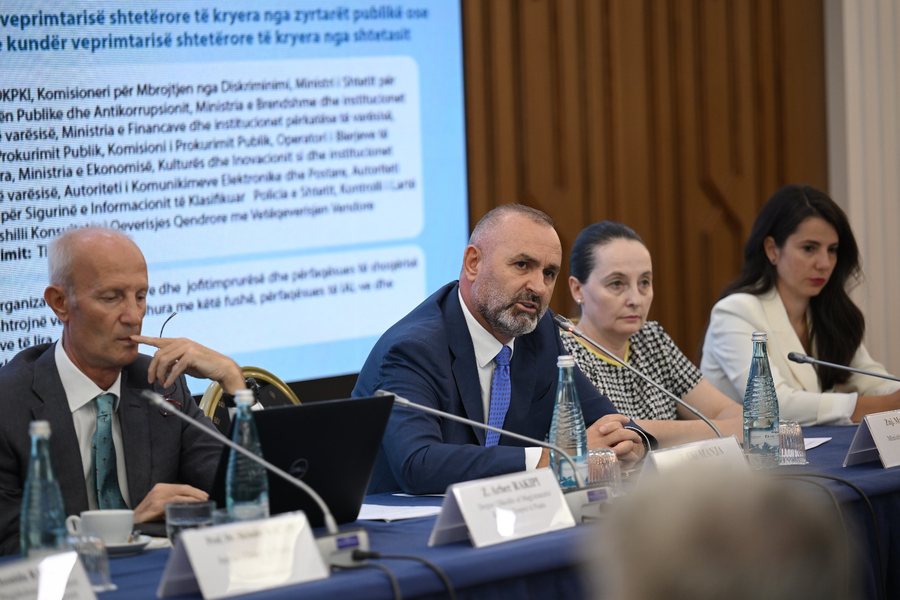
The Director of the Magistrates' School, Arben Rakipi, defended the controversial draft for the new Penal Code and suggested that critics had not read it properly. He insisted that defamation should be criminalized and that the articles do not affect journalists. Meanwhile, Justice Minister Ulsi Manja said that the changes would only be adopted after they were approved by the European Union.
In a hall filled with Ministry of Justice employees and journalists, Minister Ulsi Manja and the director of the School of Magistrates, Arben Rakipi, once again defended the contested articles of the draft Criminal Code, but promised public consultation on them.
The meeting that took place on Thursday was announced as a meeting with journalists, but was limited to long speeches by Manja and Rakipi, who promised that the draft would go through a long public consultation and that criticism would be heard.
However, the criticisms of the draft so far were ignored at the meeting. Rakipi, who focused on this part for the longest time, hinted several times that the critics had not read the draft or did not understand it. Rakipi was at the meeting in his capacity as the head of the group of experts who worked on the legal amendments.
"From the level of criticism and suggestions, it was easy to understand the depth of opinion. The question is whether the draft was studied and read, or whether it was simply known that such a draft existed. However, we did not pay attention to this," Rakipi said, among other things.
At the same time, he rejected criticism regarding the articles on defamation, insult or Article 536 of the draft on “impact on the independence of the judiciary”. Regarding the latter, Rakipi insisted that this was not aimed at journalists. “I want to assure the entire public and journalists: there is no such tendency,” he said, despite the fact that the article is quite broad and, according to media freedom organizations, openly violates by risking the criminalization of reporting from judicial processes.
Meanwhile, Rakipi insisted that defamation should be criminalized and presented this as the unanimous position of the expert group. In a lengthy explanation, he stressed that the article—criticized by media freedom organizations as broadly worded and potentially leading to arbitrary prosecution of journalists—is necessary. Rakipi said that journalists could not be exempted from the article, as this would create the prejudice that they are “licensed” to defam.
However, he hinted that, as long as there is a request from the European Union to change this part of the law, it could be reviewed. “If the political gain in relation to this issue is great, let it be decided politically,” he said, among other things, adding: “Albania does not suffer—it should not suffer—from the provision or non-provision of defamation in the Criminal Code.” After the meeting, Rakipi refused to answer questions on the matter.
Earlier, the Minister of Justice, Manja, noted that the articles providing for defamation in the Criminal Code and another list of criminal offenses would be amended faster than the time for the adoption of the new Code. Manja said that these changes are a request from the EU and that they will be made by the end of October, due to negotiations and to comply with EU directives in this area. The changes will be made in a separate process and this block of changes, according to him, will then be attached to the new Code.
Manja said the changes would only be adopted if they received approval in Brussels. “Albania will have a new Criminal Code only after it receives the stamp in Brussels,” he said, among other things.
The unchanged stances regarding criticism of the draft, especially regarding the part on media freedom, immediately brought reactions. The Chairwoman of the Media Committee, opposition MP Ina Zhupa, said that the drafters had not reflected and were threatening journalists with prison.
"Today's re-presentation, camouflaged as a hearing where no one from civil society was heard, did not change the Criminal Code's approach to media freedom at all. The problematic articles that directly violate freedom of expression, freedom of journalists to practice their profession, and free speech continue to be defended with absurdities, as in the attached video," Zhupa wrote.
Meanwhile, during the meeting, Rakipi made some comparisons with other EU countries and insisted that the draft was not repressive. / BIRN



Lini një Përgjigje