


 Shkruar nga Pamfleti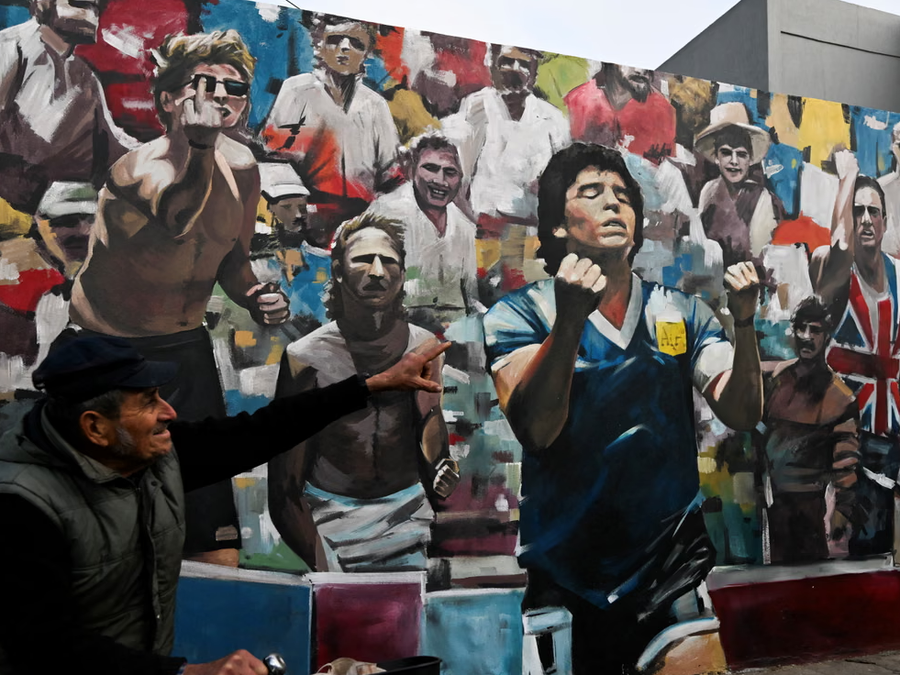
While names like Lionel Messi, Harry Kane, Julian Alvarez and Jude Bellingham will lead the way on the field, four decades ago the British and Argentines faced off in a real war, where hundreds of soldiers from both sides lost their lives...
England and Argentina face off tonight in the semi-finals of the World Cup, which is being held in the United States, Canada and Mexico, but this challenge is much more than a football match. Behind the sporting rivalry lies a history filled with conflict, war and unhealed wounds between the two countries.
While names like Lionel Messi, Harry Kane, Julian Alvarez and Jude Bellingham will lead the way on the field, four decades ago the British and Argentines faced off in a real war, where hundreds of soldiers on both sides lost their lives.
-How did the conflict start?
The dispute concerns the Falkland Islands (known in Argentina as the Malvinas Islands), an archipelago in the South Atlantic, about 13,000 kilometers from Great Britain, but administered by London.
In the 1960s, the United Nations sought to resolve the islands' status. The British Foreign Office had considered transferring control to Argentina, seeing the issue as an obstacle to trade relations with South America.
However, no agreement was reached. The islanders insisted on remaining under British sovereignty, while Buenos Aires did not give up its territorial claims. As the years passed, negotiations remained fruitless and tensions only increased.
-The Falklands War
In 1976, a military junta came to power in Argentina. On April 2, 1982, under the leadership of General Leopoldo Galtieri and at the instigation of Admiral Jorge Anaya, Argentina invaded the Falkland Islands, believing that Britain would not respond militarily.
But British Prime Minister Margaret Thatcher immediately ordered the dispatch of a large naval and military force to retake the islands.
After a naval blockade and intense fighting on land, air and sea, British troops landed on East Falkland in May and advanced towards the capital Stanley. On 14 June 1982, the Argentine commander signed the surrender, ending the war with a British victory. The toll was heavy: 649 Argentine soldiers, 255 British servicemen and three civilians were killed.
-The war continued in football too
Although the military conflict ended, tensions did not subside. They also transferred to the football field. Four years later, at the 1986 World Cup in Mexico, Argentina and England faced each other in the quarterfinals. Before the match, there were clashes between fans, and the challenge went down in history thanks to Diego Maradona.
In the 51st minute, Maradona scored the famous handball goal, later dubbed the “Hand of God”. Tunisian referee Ali Bin Nasser did not see the handball and allowed the goal, despite the English protests. Just four minutes later, Maradona scored another legendary goal, dribbling past several English players, a goal that is still known today as the “Goal of the Century”. After the match, the Argentine legend linked the victory to the 1982 war.
"Even though we said that football had nothing to do with the war, we knew that many young Argentines had been killed there. They killed them like little birds. Consider this revenge ," Maradona declared. Argentina won that World Cup.
-Relationships remain sensitive
In 1989, Argentina and Great Britain restored diplomatic relations with the Madrid Agreement, but the dispute over the Falkland Islands remained unresolved.
In a 2013 referendum, over 99 percent of the islands' residents voted to remain under British administration. Argentina did not recognize the results and continues to claim sovereignty over the territory.
-A match of historic importance
When Argentina and England take to the field, it's not just two teams with glorious footballing histories that face off. Every duel between them brings back memories of the Falklands War, political rivalry and one of the most sensitive chapters in the modern history of both countries.
For Messi, Kane and their teammates, the goal is the World Cup final. But for many fans, this challenge remains a showdown that goes far beyond football.




Lini një Përgjigje