


 Shkruar nga Gjergj Zefi
Snezhana Paunovic's horror statement was no coincidence...
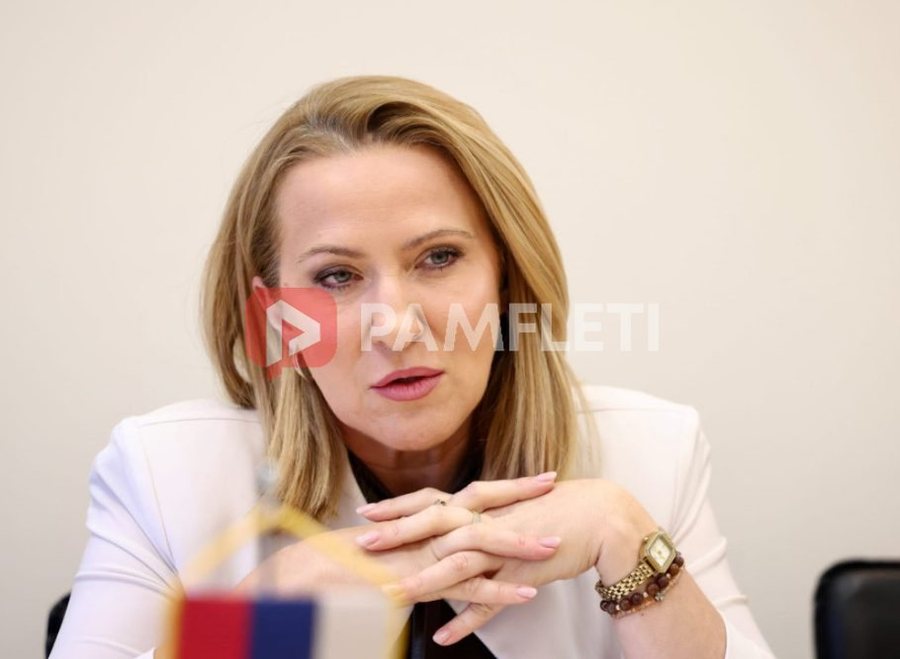
The Serbian minister did not speak only in her own name. Her message seems to be part of a broader political strategy to return Kosovo to the center of the upcoming diplomatic battle, so Albanians should be prepared for a new phase of negotiations…
Snezhana Paunovic, who stirred Albanian opinion with her shocking statement in the pro-government Serbian media outlet Kurir, is not at all a victim of Albanian governance in the Republic of Kosovo.
On the contrary.
She is one of the biggest beneficiaries of the reality created after the liberation of Kosovo and the removal of the regime of her political idol, Slobodan Milosevic, in whose party she continues to serve today.
Paunovic ran a large pharmaceutical company, which after the declaration of Kosovo's independence became one of the most important operators in the Peja region market.
The company she led, behind which stand well-known names of the Serbian financial oligarchy, remains today one of the most powerful economic actors in Kosovo.
She was not placed in that position by chance.
He was part of the political and economic network of Ivica Dačić, the leader of the Socialist Party of Serbia and one of Aleksandar Vučić's most important allies.
It was Dačić who promoted Snezhana Paunović, a young economist at the time, to the board of one of Serbia's most profitable public enterprises.
An appointment that came as a result of political loyalty.
Subsequently, Snezhana Paunovic was appointed supervisor of the Board of Belgrade's Nikola Tesla Airport, the institution that until a few years ago was considered the most important airport in the Western Balkans.
Today it has been surpassed by Tirana International Airport.
Snezhana Paunovic, who comes from the Kosovo Serb community, is none other than one of Ivica Dacic's closest figures.
Dacic himself comes from Kosovo Serb families that supported the political rise of Slobodan Milosevic in 1989, helping to eliminate his political rivals within the Serbian Communist League.
The Socialist Party of Serbia still carries one of the country's darkest political legacies today.
It fails to gain significant support even in the traditionally more nationalist areas of Serbia, not even in Pozarevac, the birthplace of Slobodan Milosevic.
For this reason, its political and economic focus has long shifted towards Kosovo.
And towards the networks that keep Serbia's strategic interest in that territory alive.
Among them are Russia, its political satellites, the Serbian Orthodox Church, and the deep structures of the Serbian state.
Snezhana Paunovic's statement is not simply a personal opinion.
It reflects a way of thinking that continues to exist in part of the Serbian political elite.
Essentially, its message was that Serbia aimed to ethnically cleanse Kosovo, but was prevented from doing so.
A statement with serious content, which would be expected to cause immediate reactions in Belgrade.
But this did not happen.
Paunovic may be an extremist figure.
However, her statement does not seem to be solely a product of personal beliefs or the influence of Ivica Dacic.
It seems more like a tested message for Serbian public opinion.
An attempt to return the Kosovo issue to the center of the political debate ahead of the upcoming electoral processes.
Snezhana Paunovic, Ivica Dacic, Aleksandar Vucic and a large part of the Serbian political class continue to treat Kosovo through the myth of the defeat of 1389.
Meanwhile, for many Kosovo Serbs, Belgrade has become a political and financial ATM, while Kosovo itself is used as an instrument of pressure in international negotiations.
Beyond the rhetoric, Serbia remains a state with expansionist aspirations.
And, according to this interpretation, it will not recognize Kosovo in its current borders and reality.
If recognition were ever to occur, it would only be linked to a new political agreement that would change the existing status, beyond Rambouillet, the 2008 declaration of independence, or Security Council Resolution 1244.
This is precisely where the real weight of the Serbian minister's statement lies.
It appears to have been put into circulation as part of a political preparation for possible developments to come.
Therefore, the most important question is not what Snezhana Paunovic thinks.
But how prepared are the Albanians, and especially the institutions of Kosovo, for a new phase of international negotiations?
A national plan for the red lines, strategic interests, and future of the state of Kosovo becomes increasingly necessary.
The history of 1913 shows that major divisions do not always occur at the will of small nations.
But with the decisions of the great powers.
And for this very reason, Albanians must be prepared.
Because, as history has shown, Serbia failed to achieve what it aimed for through force.
And this remains a fact, despite today's rhetoric./ Pamphlet



Nuk e di pse merreni me serbet halera. Akoma duhen prova se c'muter jane!? Kemi troje te mrekullueshme, me toka pjellore, me ujera te kristalta, me minerale te nevojeshme e te cmuara, ku buken e gojes mmund ta sigurojme vete, e me mendjen e mprehte behemi zoter te tokes sone. Po nuk filluam t'i bejme kukurec e tu hidhen peshkaqeneve keta halerat tane nuk ka e do te kete qetesi ne trojet e Ilireve.