


 Shkruar nga Pamfleti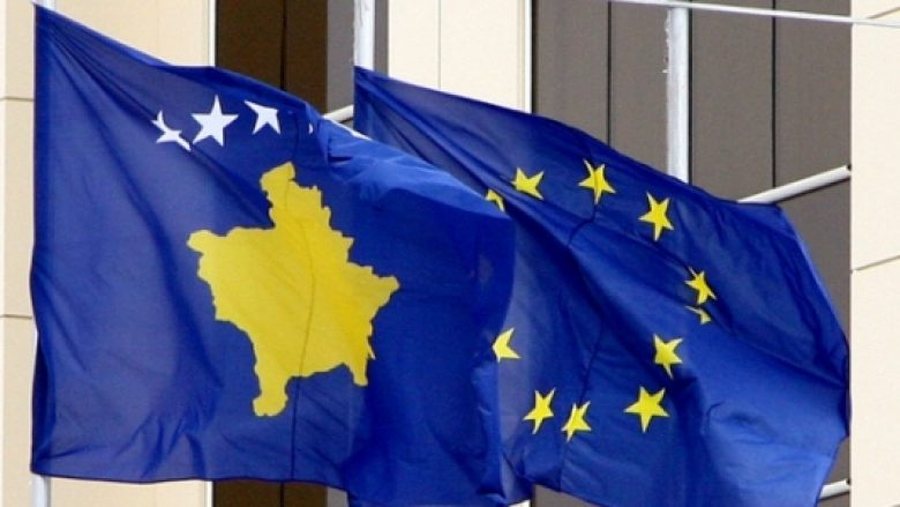
In many countries, Europe Day is treated as a symbolic day that marks the beginning of European cooperation, while Kosovo still has this date on the official holiday calendar, remaining the only country in the Western Balkans that maintains this practice.
However, beyond the symbolism of this date, Kosovo's path towards the European Union (EU) and European standards continues to show that, although there is progress in documents and laws, major challenges persist in practice.
In this context, researcher at the Group for Legal and Political Studies (GLPS), Arbresha Loxha, assesses that Kosovo's progress cannot be defined in a general way, but varies significantly from one field to another.
In Radio Free Europe's 5 Questions podcast, Loxha said that Kosovo's two most substantial achievements in relation to the EU remain the Stabilization and Association Agreement and visa liberalization.
" In Kosovo, the implementation of laws is stagnating, and at the same time, the supervision of implementation," Loxha emphasizes, adding that the institutional focus often remains on approval and not on concrete results.
Kosovo-Serbia dialogue: key conditionality for integration
One of the main obstacles on Kosovo's European path remains the dialogue with Serbia and the lack of recognition by the five EU states that do not recognize its independence.
"Without the completion of the dialogue with Serbia and without recognition from the five non-recognizing countries, Kosovo cannot be considered a country moving towards full EU membership," she tells REL.
According to her, the process remains largely political and dependent on geopolitical developments, more than on the technical fulfillment of the criteria.
However, Loxha cites the lack of political stability in the country as a major obstacle both to the European Union membership process, but also to the fulfillment of reforms according to European standards, which initially require approval in the Assembly and then implementation by executive institutions.
Well-being in Kosovo compared to European countries
In economic terms, she assesses that Kosovo has marked fiscal stability and sustainable economic growth, but with visible limitations in public investments.
"Kosovo has only 20 to 30% of the level of well-being compared to EU countries," says Loxha.
She adds that, despite perceptions of similar living costs, the difference in income and services remains large.
"Salaries and the standard of living in Kosovo are much lower compared to European Union countries ," she emphasizes.
Loxha takes Bulgaria as an example as the poorest country in the European Union, but even compared to it, according to her, Kosovo has about two times less welfare./ REL




Lini një Përgjigje