


 Shkruar nga Pamfleti
Polls in some of the main EU countries show that there is no support for enlargement to the Western Balkan countries, while Norway and Iceland are welcomed into the Union...
It closes the gates to the Balkans, but opens them to the North. This is what can be said after the results of the Barometer that shows the support that enlargement has among the populations of the main EU countries and which countries enjoy the highest support for membership.
The Eurobarometer surveys include Germany, Austria, France, the Czech Republic, where the results are disappointing for almost all Western Balkan countries, but not only, but also for Ukraine and Moldova.
Despite the fact that EU membership has become a strong card in electoral campaigns in some countries, especially in Albania, but also as a strong stone that Brussels has used to keep governments afloat away from Russian influence, the latest results of the Eurobarometer published by the German media FAZ show that citizens of the Union countries do not support enlargement towards countries that have economic problems.
In Germany and Austria, a possible enlargement of the European Union is generally rejected by a majority. Eurobarometer surveys, the EU's instrument for measuring public opinion, regularly show this. One survey showed that at EU level there is a majority of 56% in favour of admitting new members. However, in Germany and Austria supporters are in the minority, at 49% and 45% respectively.
Support is even lower in the Czech Republic and France, where only 43% of respondents support the idea of EU enlargement. The rejection is also linked to the poor reputation of the candidate countries. With the exception of Turkey, which has remained only a formal candidate and no longer plays a real role in the enlargement debate, all the countries aiming for membership are from Eastern Europe: six from the Western Balkans, as well as Moldova, Ukraine and Georgia, the latter of which is currently no longer considered a serious candidate.
In all these countries, the level of economic development remains below the average of the current member states. This creates little enthusiasm, not least in Austria and Germany. The candidates are often perceived as net beneficiaries, as “receiving countries” that do not contribute. This perception is debatable, but it remains a reality in public opinion.
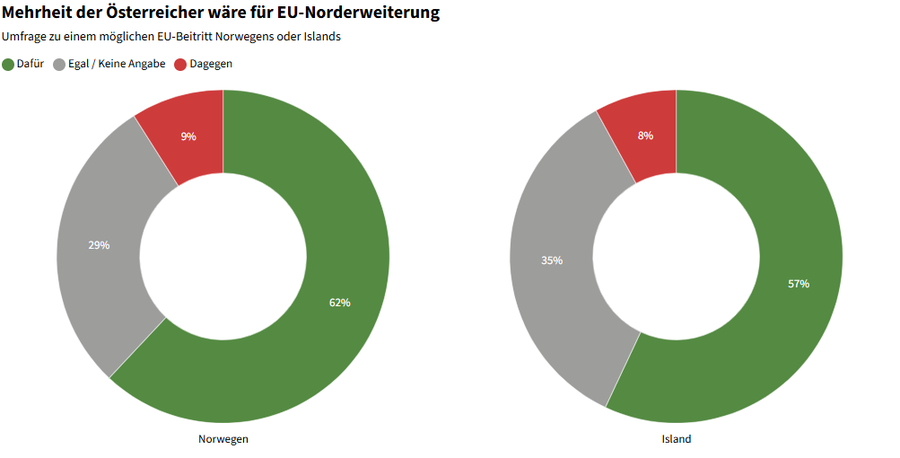
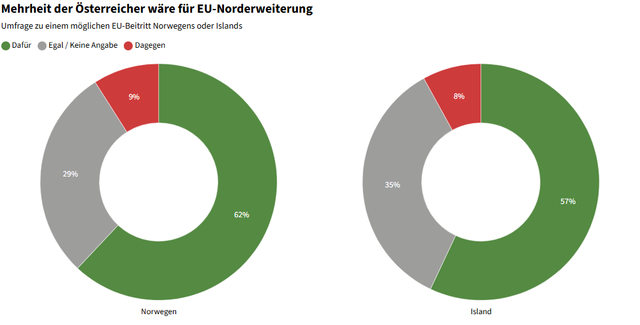
However, even in skeptical Austria there is support for EU enlargement in certain cases. A survey recently published by the Austrian Association for European Politics shows very high results for two countries: 62% of respondents support Norway's membership, while 57% are in favor of Iceland's admission. In Germany, similar results are expected.
Neither Norway nor Iceland is perceived as a problem. Both countries are considered a potential enrichment for the EU. For Norway, the issue is not currently on the table, but for Iceland it could become concrete soon, if the Icelandic population decides in a referendum planned for the end of August to resume negotiations for EU membership that were interrupted in 2015.
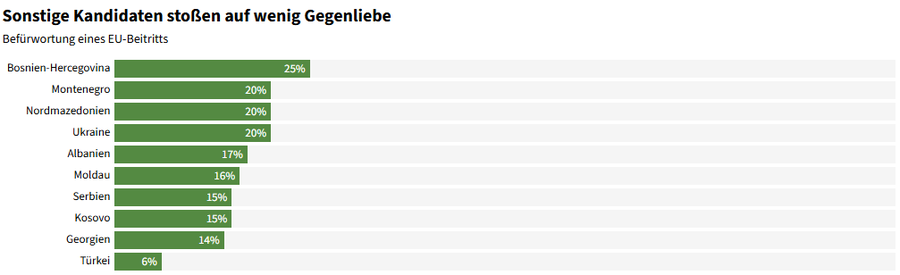
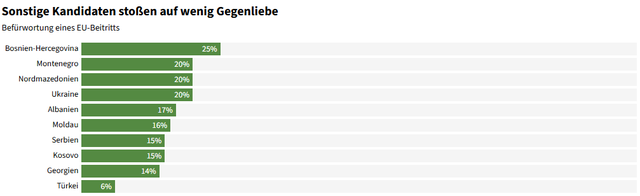
While these two Nordic countries would be welcome, the vast majority in Austria rejects the membership of Eastern European countries. Only 25% of respondents are positive about Bosnia and Herzegovina, which tops the list with low support. Montenegro, North Macedonia and Ukraine reach only 20%, Albania 17%, Moldova 16%, while Serbia and Kosovo only 15%.
These figures are particularly disappointing for Montenegro, which the European Commission considers to be the most advanced country in the accession negotiations process. Commission President Ursula von der Leyen regularly assesses the country's progress. Montenegro has opened all 33 negotiation chapters and closed 14 of them, more than any other candidate. The country aims for membership by 2028.
However, the government in Podgorica is aware of the reservations towards the Balkan countries. For this reason, the idea has arisen that Montenegro should try to benefit from a joint process with a less contested country. If the referendum in Iceland results in favor of resuming negotiations, the aim is to reach a joint solution, where Montenegro and Iceland would join together as the 28th and 29th EU countries.
From a numerical point of view, this would not be a challenge for the EU, as the two countries together have a little over one million inhabitants.
The idea is widely discussed in Montenegro and is also supported by political figures. The Montenegrin newspaper “Pobjeda” interviewed the Icelandic Foreign Minister, Katrín Gunnarsdóttir, on this issue. She, while supporting her country’s EU membership, cautiously stated that in an increasingly complex world, small states benefit from participating in strong institutions like the EU.
Regarding the issue of whether new countries should be admitted without veto power to avoid deadlocks in decision-making, the minister stressed that Iceland supports cooperation on equal terms. This is also the official position of Montenegro, although it remains to be seen whether such an approach is realistic. /Pamphlet/



kete njoftim e jep dhe gazeta ruse
So mundet Europa t’i pranoje viruset Russo-Sllave?
Të ben pershtypje qe më të krromosurit pozicionohen ne qender ekapardisen si gjeli ne maje të plehut e zonja e zoterinjte e vertete janë të thjeshte e kokeulur.
Pse vertete i besojne shqiptariket pallavrat e mashtrimet e te gjatit Edvin Rama per hyrjen e shqiprise ne BE? Nese i besojne jane ca injorante te vertete e te paditur. Edvini i ka per me shty vitet e qeverisjes mizerabile.
Persh lutem te pune germany