


 Shkruar nga Maurizio Ferraris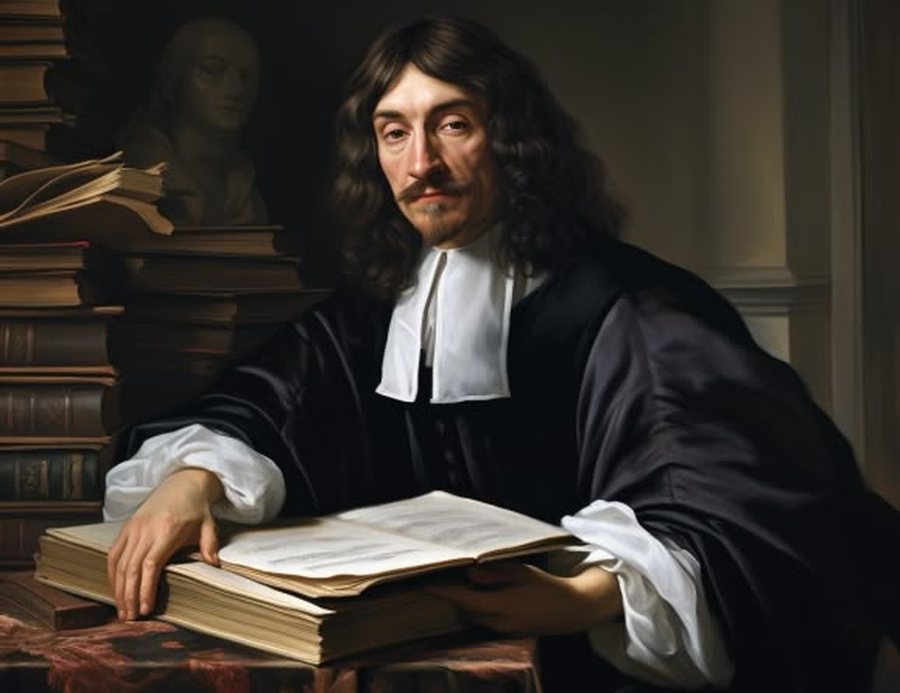
"Ego cogito ergo sum sive existo" - I think, therefore I am, that is, I exist...
René Descartes, known in Italy as "Cartesio", was born in 1596 in La Haye, France, into an aristocratic family, which allowed him to live without working and devote himself exclusively to thought. He studied at the Jesuit college of La Flèche, where he learned scholastic philosophy, Latin and Greek, but where only mathematics gave him the satisfaction of security. Everything else, including theology, metaphysics and logic, seemed like a castle built on sand. After graduating in law, out of boredom and curiosity, he enlisted in the army of Maurice of Nassau and then Maximilian of Bavaria, which did not prevent him from sleeping and therefore dreaming as much as he wanted, he needed a lot of sleep and at the college he was given special permission to wake up at 11 in the morning.
Situated in a well-heated room, since in addition to being a person who slept a lot, he was also cold, Descartes invented in the book 'Metaphysical Meditations', a doubt that is not skepticism or despair, but a method for achieving truth.
The starting point, sound logic, is not comforting, because there is no certainty. Everything can be questioned. The senses? They deceive. Dreams? Impossible to distinguish from real life. And then we could deceive ourselves like the madmen who believe they are made of glass, or in fire. Even mathematics could be a trap, if an evil and omnipotent genius had decided to manipulate our minds into believing that two plus two equals four when in reality it equals five. Cartesian doubt is not psychological, but metaphysical: it serves to eliminate all certainty, traditional but more fragile than we think, to discover whether there is something left that cannot be destroyed, or, to return to an example that Descartes gives in a letter, to find in a basket an apple that has no flaws. Cartesian doubt is not psychological, but metaphysical: it serves to eliminate all certainty.
From doubt to certainty
After destroying every belief derived from tradition and custom, one certainty remains: thought. To doubt is to think, and to think is to exist. “Ego cogito ergo sum sive existo” – I think, therefore I am, therefore I exist – is the cornerstone of his entire philosophical edifice, the only truth that resists even the evil genius, because he thinks so. This is not a mystical enlightenment, but rather a logical proof: to think that one does not exist, one must nevertheless exist. On this small and invincible certainty, Descartes rebuilds the world. We necessarily think because we feel limited, and in fact we doubt; therefore, there must be an unlimited God, who, being omnipotent, is also omniscient, good and true. And it is that God who guarantees clear and distinct ideas, those that impose themselves on reason with the same clarity as numbers on a sheet of paper. The result is a geometric system, elegant and coherent, but with an aftertaste of solipsism: the world, for Descartes, begins with itself and risks remaining there forever: this is the great break with the tradition that we will find in Kant and the idealists of two centuries later.
Limitations of the Cartesian method
Now, no one is perfect, and this also applies to philosophers. As for the proof of God's existence, it is circular: God guarantees the truth of ideas, but the proof of his existence depends precisely on those ideas. It is like asking the innkeeper if the wine is good. However, from this circularity arises modernity: the subject as the foundation, reason as the criterion, certainty as a regulating ideal. Above all, the Cartesian system separates soul and body, thought and matter, mind and world. A problematic distinction, and one that, once made, is difficult to overcome: what unites the mind with the body and the body with the world? Descartes hypothesized, with laborious arguments, that it is the pineal gland. Putting aside, after many failed attempts, this quest, science, returning precisely to the scholastic and Aristotelian tradition with which Descartes had broken away, has shown that the mind does not exist without the body. And this reason, to function, needs emotions, dark and uncertain matter in the Cartesian perspective, since they occur in the soul but manifest in the body, as when, for example, our hearts break. The Cartesian system separates the soul from the body, thought from matter, mind from the world.
Passions of the soul
Descartes doubted the world experimentally, but in his life he never doubted for a moment its existence, nor the fact that our happiness or unhappiness depends on that world. In 1640, the death of his daughter Francine from scarlet fever at the age of five was heartbreaking. Perhaps for this reason, his last book is entitled The Passions of the Soul. He reveals a deep and participatory understanding of the human soul and its ambivalence, as when he gives us the example of a devoted husband mourning his dead wife, "whom he would nevertheless be sorry to see resurrected."/ Adapted from "Pamphlet" by "Corriere della Sera"



Ne mendojmë domosdoshmërisht sepse ndihemi të kufizuar, dhe në fakt dyshojmë; prandaj, duhet të ekzistojë një Zot i pakufizuar, i cili, duke qenë i gjithëpushtetshëm, është gjithashtu i gjithëdijshëm, i mirë dhe i vërtetë. Dhe është ai Zot që garanton ide të qarta dhe të dallueshme, ato që i imponohen arsyes me të njëjtën qartësi si numrat në një fletë letre. (–THOSHTE DEKARTI, por këto quhen filozofira dhe jo prova të egzistencës së Zotit. Kurse sa për idetë e qarta dhe të dallueshme: Fakti që të krishterët dhe myslimanët prentendojnë që Bibla dhe Kurani janë libra që kanë zbritur nga lart dhe janë fjala e Zotit, por Bibla thotë që Krishti është biri i Perëndisë , pra e vërteta, dhe pjesë e Trinisë së shenjtë, kurse sipas Kuranit, nuk ka Trini, dhe Jezusi (Jezusi i Nazaretit, i quajtur Isa) ishte profet dhe jo Biri i Zotit, dhe thonë që nuk u kryqëzua dhe nuk u vra, kjo tregon që këto libra nuk janë zbritur nga lart, sepse Zoti s'mund të mohojë birin e vet, s'mund t'iu thotë tjetër gjë të Krishterëve e tjetër gjë myslimanëve. Plus që Jezusi nuk u martua kurse Muhamedi mori 13 gra (nga ku njëra minorene). Pra ka sistem të ndryshëm vlerash, parimesh, besimesh, edhe pse flasin për të njëjtin Zot që thuhet se është një dhe i vetëm, sepse e vërteta është një dhe vetëm një. _______________________________________ Ç'THOSHTE EPIKURI? : A është Zoti i gatshëm të parandalojë të keqen, por jo i aftë? Atëherë ai nuk është i gjithëpushtetshëm. A është i aftë, por jo i gatshëm? Atëherë ai është keqdashës. A është ai edhe i aftë edhe i gatshëm? Atëherë nga vjen e keqja? A nuk është as i aftë dhe as i gatshëm? Atëherë pse ta quajmë Zot? (EPIKUR)__________ Pse duhet të kem frikë nga vdekja? Nëse jam, atëherë vdekja nuk egziston. Nëse Vdekja egziston, atëherë unë nuk jam. Pse duhet të kem frikë nga ajo që mundtë egzistojë vetëm kur unë nuk egzistoj? Në kohën e Epikurit, shumë njerëz kishin frikë nga ndëshkimi pas vdekjes ose gjykimi hyjnor. Filozofia e tij synonte të çlironte njerëzit nga ky ankth, duke argumentuar: Nuk ka jetë të përtejme për të vuajtur. Shpirti tretet me trupin. Prandaj, vdekja nuk duhet të na shqetësojë. Kjo është arsyeja pse ai e quan atë një lloj "lirie". Feja (ose të paktën disa forma të saj) sundonte mbi njerëzit duke ngjallur frikë, veçanërisht frikën nga perënditë, ndëshkimi dhe jeta e përtejme. Ai argumentoi se njerëzit mund të jenë të lirë- të lirë nga bestytnitë, frika nga ndëshkimi hyjnor dhe frika nga vdekja. ____________ Nëse perënditë do t’i dëgjonin lutjet e njerëzve, i gjithë njerëzimi do të vdiste shpejt, pasi ata vazhdimisht luten për shumë të këqija kundër njëri-tjetrit. (EPIKUR)
qenia njerzore eshte qenia me e mprapsht qe ka krijuar zoti ,kjo eshte e verteta sublime dhe mbi kte fakt real qenia njerzore nuk e ka cilesine te trajtoje e rilevoje ekzistencen e zotit,....
Respekt për sa ke shkruajtur por shpirti nuk tretet bashkë me trupin - shpirti nuk ka se si të tretet - ai i përket dikujt tjetër. Një gjë nuk e kuptova kurrë - shpirti i mirë dhe shpirti i keq - si dhe zemren e thyer që nuk rreh kurrë si më parë.