


 Shkruar nga Diplomatico | Pamfleti.net
While the war is increasing the price of oil on international stock exchanges, the fiscal structure and dependence on imports could make Albania one of the countries that feels the new energy crisis the most...
The possible increase in the price of oil in Albania is not only related to geopolitical developments in the Middle East or to fluctuations in international energy exchanges. In reality, the structure of fuel prices in Albania is such that any small increase in global markets is multiplied in the final price paid by citizens. This is because a very large part of the price of oil in the country is not related to the cost of the product itself, but to the fiscal burden that the state places on it.
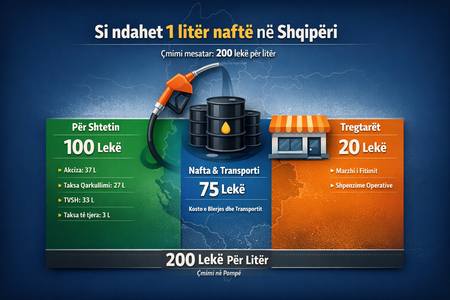
In the Albanian market, the fuel sold at the pump includes a series of taxes accumulated on top of each other. In addition to the basic import price and transportation costs, the fuel is subject to excise duty, circulation tax, carbon tax, fuel marking fee and finally VAT. These taxes usually make up over half of the final price. In practice, this means that when citizens pay for a liter of fuel, a very large part of that amount goes directly to the state budget.
In this context, Albania is often among the countries with the highest fuel prices in the region, despite the fact that the purchasing power of citizens is among the lowest in Europe. This economic paradox is related to the fact that fiscal policy has treated fuel as one of the main sources of budget revenues. In recent years, fuel taxes have been an important component of public budget financing, bringing significant revenues to the state. This creates a situation where any reduction in fuel taxes would have a direct impact on fiscal revenues, which makes intervention politically difficult.
When the price of oil on international exchanges increases, the effect in Albania becomes even more noticeable precisely because of this fiscal structure. If the price of oil on global markets exceeds $100 per barrel, the price at the pump in Albania usually rises to the range of over 220–230 lek per liter. If global markets were to head towards $120 per barrel, then in the Albanian market the price could approach or exceed 250 lek per liter. In more extreme scenarios, where geopolitical tensions drive oil to very high levels, the price in Albania could also approach the psychological threshold of 300 lek per liter.
This situation has a direct impact on the entire economy. Albania is an economy where road transport dominates almost all sectors. Goods, food, construction materials and services depend heavily on transportation by trucks and vehicles that use diesel. For this reason, any increase in fuel prices translates into increased costs for businesses and subsequently into increased prices for consumers. The domino effect affects the supply chain, affecting inflation and the purchasing power of citizens.
On the other hand, the structure of the fuel market in Albania has often been the subject of public debate. The market is relatively small and dominated by a few major operators, while competition mechanisms have not always been strong. In some periods, there have been suspicions that prices have not immediately reflected decreases in international stock markets, while increases have been reflected very quickly. This has created the perception that the market operates with a one-sided elasticity, where consumers immediately feel the increase, but do not always benefit from the decreases.
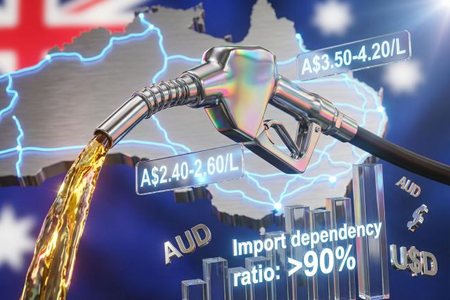
In this context, any global energy crisis finds Albania in a vulnerable position. The country does not have a large active refining capacity and is dependent on the import of refined petroleum products from international markets. This dependence makes the Albanian economy highly vulnerable to any geopolitical tensions affecting global energy supplies.
If tensions in the Middle East continue and oil prices on world markets remain high for a long period, Albania will face a double pressure: on the one hand, the real cost of energy that is increasing globally, and on the other hand, the fiscal structure that amplifies this increase in the final price. In such a situation, the price of oil at the pump could become not only an economic problem, but also a social and political issue, as its impact directly affects the daily lives of citizens and the functioning of the entire economy./ Pamphlet



Si nuk pashe nje politikan qe te organizoje nje proteste specifike per naften. Ama te fokusuar vetem per cmimin e naftes me argumenta se paguajme shume shtrenjte dhe leket qe mblidhen shperdorohen brutalisht ne tendera te mbyllur me rruge e ura qe rrezohen pa u hapur akoma. Sot nje 1 liter nafte ne Maqedoni kushton 1140 leke, ne kosove 1330 leke. Ne tirane 1840 leke. pse ????? Kush kontrollon energjine kontrollon zhvillimin ekonomik te nje vendi - prandaj po behet lufte kudo- per energji.
Ne Londer e tere Britanine cmimi i benzines 125 Pound - 138 Pound dhe Diesel 132 - 150 Pound. Kursi i Pound - Lek eshte 1 Pound - 110 Lek. Dmth, ju plehra ne Shqiperi ia shisni karburantin popullit me dyfishin e Europes. Turp! Te gjithe kombet e shtetet jane pushtuar e nuk kane bere ze per disa vite e dekada por populli yne qurrash nuk eshte ndier me shekujt. Dhe me cfare te drejte i themi vehtes trima e te mencur!?
Vlerat jane: benzina 1.25 Pound - 1.38 Pound, nafta (diezel) 1.32 - 1.50 Pound. Ishte harruar pika dhjetore.
NJE POPULL DELE QË VOTON RREGULLISHT KETE PUSHTET TË KORUPTUAR, NJË KRYEKARIDHATO QË AS JA NDJEN PER KETE SHTRESE TE VARFER MOS PRISNI QË NAFTA TE ULET.....