


 Shkruar nga Pamfleti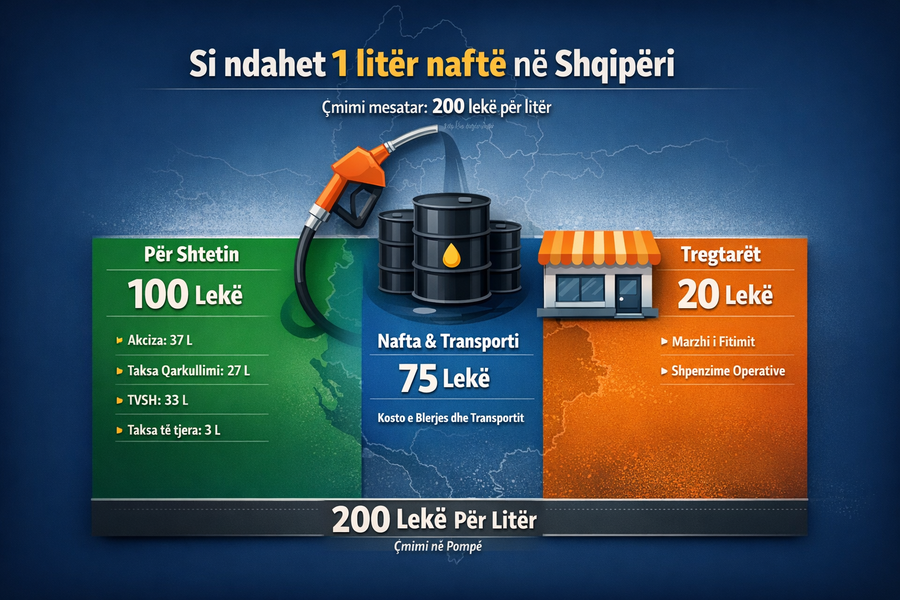
The Balkans facing rising fuel prices: why Albania pays more than its neighbors...
Tensions in the Middle East and volatility in global energy markets are raising fears of a new cycle of fuel price hikes. In the Balkans, governments are facing a difficult choice: protect the state budget or the pockets of citizens. Serbia is considering cutting excise taxes to cushion the market blow. Albania, meanwhile, remains the country where the state takes the lion's share of every liter of fuel.
International oil markets are entering a new phase of uncertainty. Conflicts and tensions in the Middle East, rising global energy demand and supply volatility have raised fears of a new surge in oil prices in the coming months. In this context, governments in the Balkans are facing a double pressure: on the one hand, rising global costs, and on the other, social discontent caused by rising fuel prices.
In Serbia, the debate has been opened publicly. Authorities have signaled the possibility of intervening in fiscal policy by reducing excise duties, an instrument often used in times of crisis to mitigate price increases at the pump. Currently, according to economic analyses in Serbian media, more than half of the price of fuel in Serbia consists of state taxes.
Economists in Serbia argue that there is room for fiscal intervention. A cut in excise duties by about 20% would significantly reduce the fiscal burden and reduce inflationary pressure. In an economy where transport and industry are heavily dependent on energy prices, this is seen as a stabilizing move.
But there is one country in the region where the fiscal burden on fuel is even heavier.
That country is Albania.
In Albania, the fuel price structure is among the most expensive in the Balkans. Each liter of diesel includes several taxes at the same time, which significantly increase the final price paid by the consumer.
Fuel tax structure in Albania
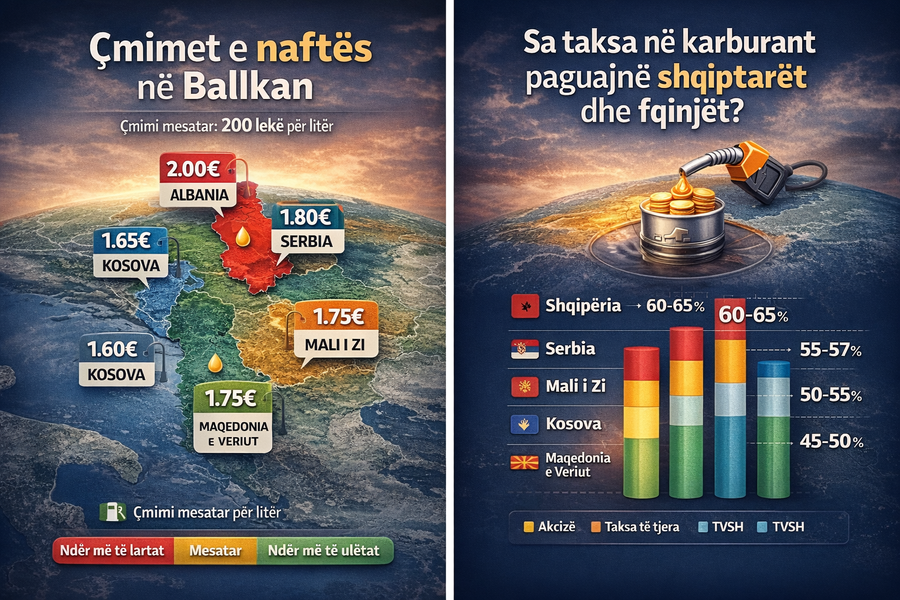
In total, energy market estimates show that 60–65% of the final fuel price in Albania consists of state taxes and fees.
This is why Albania often results in the highest oil price in the Balkans, despite being one of the lowest-income economies in the region.
In most countries in the region, temporary reductions in excise duties have been used as an instrument to stabilize the market during energy crises. North Macedonia and Montenegro have intervened several times in fuel taxes during periods of global price increases.
In Albania, this has never happened.
The reason is structural. Fuels constitute one of the most reliable sources of revenue for the state budget. Excise taxes on energy are among the most stable contributors to public finances, so any reduction in them directly affects fiscal revenues.
But this strategy also has a significant economic cost.
The price of fuel is a key factor in the entire economic chain. It directly affects transportation, agriculture, food production, and the logistics costs of businesses. When oil prices rise, the domino effect spreads throughout the economy and increases inflationary pressure.
For this reason, many countries use excise tax reductions as a "safety valve" to cushion shocks from international markets.
Serbia seems to be considering precisely this instrument.
Albania, meanwhile, has much more limited room for intervention. When more than 60% of a product's price consists of taxes, any fiscal cuts will have a direct impact on the state's coffers.
However, if global oil prices continue to rise through 2026, social and economic pressures are expected to increase significantly. In a region where average incomes remain low and economies are vulnerable to inflation, fuel could quickly become a hot political issue.
In the end, the dilemma for governments is the same throughout the Balkans: protect fiscal stability or the purchasing power of citizens.
Albania, for the moment, remains the country where the state earns the most from every liter of diesel that enters the car depot.
How many lek from a liter of diesel goes to the state in Albania (illustrative example)
???? Albania often results in one of the most expensive fuel markets in the Balkans, even though its economy is smaller than some of its neighboring countries./ Pamphlet


Lini një Përgjigje