


 Shkruar nga Giuseppe Gagliano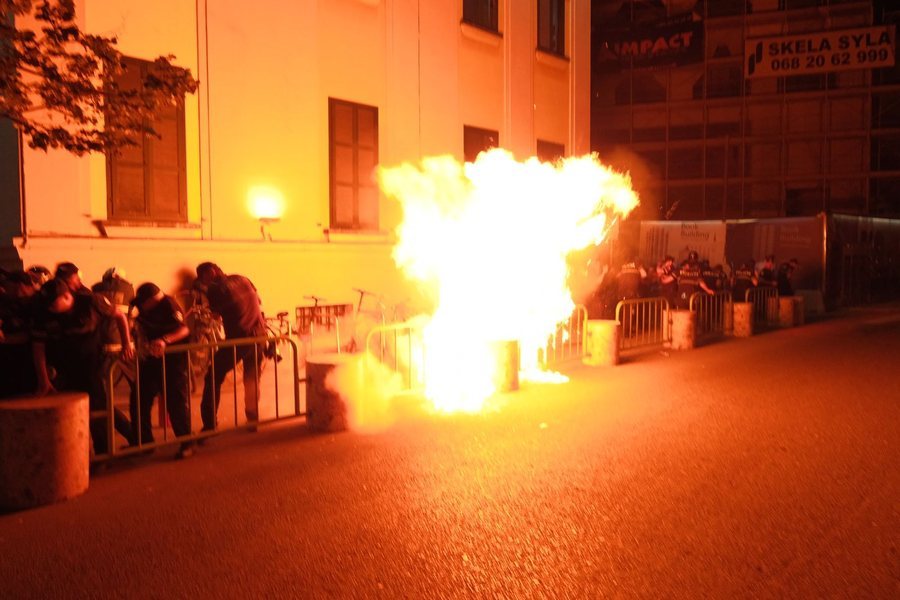
When politics stops producing solutions and starts generating anger, the line between fragile democracy and open crisis becomes increasingly thin. Internal instability, allegations of systemic corruption, and open conflict between state powers are weakening this narrative of EU membership, and opening the door to external influences, ready to exploit any cracks...
Protest that disrupts the balance
In Tirana, politics has shifted from a purely verbal conflict to a physical confrontation. The throwing of a Molotov cocktail towards Prime Minister Edi Rama's office, in the midst of an anti-corruption demonstration, is the clearest sign of a deepening rift.
for weeks. Thousands of people in the streets, arrests, injuries and a protester accidentally setting himself on fire: the scene is that of a country where political tension has crossed the threshold of safety.
The "Balluku" node and institutional paralysis
At the center of the crisis is Deputy Prime Minister Belinda Balluku, accused by the Special Prosecution Office (SPAK) of interfering in giant tenders related to infrastructure projects. The issue is not only the investigation, but also the parliamentary immunity that has so far prevented any arrest.
The majority of the Socialist Party has blocked the vote to dismiss her, taking refuge in the Constitutional Court. Formally, this is compliance with the rules; politically, it looks like a wall erected to protect power.
Balluku denies all charges and promises cooperation, but the damage is now systemic: when a key infrastructure minister is implicated in allegations affecting the country's major projects, the impact is not limited to the courtroom.
Opposition, streets and delegitimization
The protest is led by Sali Berisha, a controversial figure but still capable of mobilizing the streets. His message is clear: the government is no longer legitimate. The narrative is that of a state captured by a network of power that plunders public resources and manipulates the democratic process.
In this context, the Molotov cocktail is not just a violent act, but a symbol of radical delegitimization. The danger is clear: when political struggle moves from parliament to the streets, the distinction between protest and destabilization becomes blurred. Albania, with its still fragile institutions, does not have the luxury of becoming a “gray zone.”
SPAK and the conflict over justice
Rama's response opens another front. The Prime Minister defends Balluk and accuses SPAK of abusing preventive arrests, describing them as "arrests without trial," incompatible with European standards.
This is a delicate step: justice reform and the independence of SPAK have been the cornerstone of Albania's European journey. To question the methods of this institution is to attack a symbol, not just a law enforcement body.
Here the crisis becomes structural: on the one hand, a judiciary that demands autonomy; on the other, a government that fears losing control of the political landscape.
Geopolitical and European consequences
Albania is not an island. The protests and political violence come at a time when Tirana is struggling to present itself as a reliable partner for the European Union and NATO in the Balkans. Internal instability, accusations of systemic corruption, and open conflict between state powers are weakening this narrative and opening the door to external influences, ready to exploit any cracks.
A dangerous threshold
Prime Minister Rama speaks of “desperate fellow citizens,” while Berisha speaks of an illegitimate government. In the midst of this, the state risks sliding into a spiral of distrust. The question is not simply whether Balluku is guilty or innocent, but whether Albanian institutions can withstand the shock without succumbing to the logic of perpetual conflict.
The Molotov cocktail in Tirana is not an isolated incident. It is a warning. When politics stops producing solutions and starts generating anger, the dividing line between fragile democracy and open crisis becomes exceedingly thin.





Lini një Përgjigje