


 Shkruar nga Gjergj Zefi
When the language of the world's most powerful president slips from diplomacy to rhetorical barbarity, the alarm goes off not only for America's opponents, but for the very political civilization it claims to defend...
There are leaders who go down in history for their vision. There are others who are remembered for their substance. And then there is that noisier, more exposed, but intellectually poorer category: leaders who remember that the strength of a state is measured by the brutality of their vocabulary. It is here that the modern tragicomedy of what could be called, without fear of exaggeration, the presidency of the Stone Age begins.
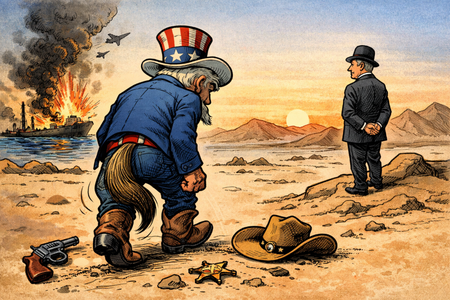
When the head of a superpower threatens to return a country to the “Stone Age,” the problem is not just the moral vulgarity of the expression. The problem is deeper: that sentence is not just a verbal slip, but a philosophy of governance. A philosophy that sees diplomacy as weakness, complexity as an annoyance, and civilization as unnecessary decorum in the face of the naked instinct of destruction.
In theory, the presidency should be the pinnacle of state reason. There, language is weighed, nuanced, and carefully constructed, because every word the president utters is not simply an opinion, but a strategic signal.
In the new populist practice, words no longer serve to avoid war, but to make conflict more marketable. Instead of prudence comes the slogan. Instead of strategy, the pose. Instead of thought, the television instinct.
The threat to return a nation to the “Stone Age” is not just an ugly rhetorical figure; it is a political self-denunciation. It shows the world that the speaker, despite the power he holds, remains a prisoner of a primitive imagination about international relations.
In this mentally impoverished world, global order is not built with alliances, agreements, balances, and communication channels, but with war drums, muscular gestures, and the banal illusion that fear is the highest form of respect.
But the history of diplomacy teaches us otherwise. Fear produces temporary obedience, not lasting order. Humiliation produces reaction, not peace. And the leader who speaks like a tribal chief in a nuclear age is not necessarily strong; he is often simply incapable of conceiving the world outside the categories of violence and spectacle.
Herein lies the greatest irony. America, the country that for decades has tried to present itself as the architect of the liberal international order, risks being represented time and again by a man who speaks as the enemy of that order itself. In a single sentence, he manages to undo centuries of Western political philosophy and summarize relations between nations in the logic of the stick, the threat, and total destruction. It is, in essence, the triumph of barbarity in presidential garb.
Of course, supporters of this language will call it “sincerity,” “determination,” even “realism.” But realism is not about shouting louder than others. Realism is about understanding that the true power of a great state lies not only in the ability to strike, but especially in the ability to restrain oneself. Civilization begins precisely where force ceases to be instinct and becomes an instrument controlled by reason. When reason is absent, only noise remains. And noise is not strategy.
In the end, the "stone age" is not the threat made to the other. It is the mental state of the one who thinks this is presidential speech. It is the conceptual poverty of a politics that remembers that the world is governed as a 'reality show' arena. It is the failure of the elite that, instead of producing statesmen, produces aggressive performers with primitive codes and imperial ambitions.
Therefore the real title is not just a metaphor.
The Stone Age President is not simply one who threatens destruction. He is one who, in the century of complex diplomacy, terrifying technology, and fragile balances, continues to believe that the highest language of the state is that of huns and stones.
Because sometimes, man cannot turn the world back to the Stone Age. But he can discover, before the whole world, that he himself never left it./ Pamphlet


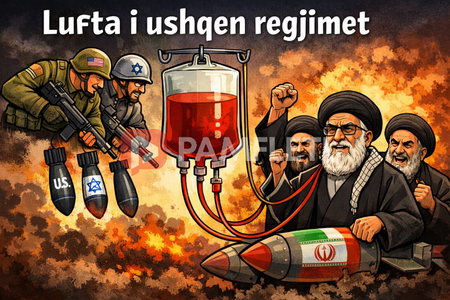

Mire e ke mor djale, por kush te degjon.
, President ì Gurit, ky është termi më i përshtatur, zbathur me poplën në shpinë, me lëkurë kafshësh, me një fjalor fshsaxijeshTràmpi është padyshim më vulgari dhe ordineri i presidentëve të tërë kohërave dhe jo vetëm amerikànë dhe jo vetëm tashti. Por kjo është një linjë degradimi mentaë që nis me Bushin e Irakut, Obamën e Pranverës Àrabe dhe Bidenin që furnizoiIźraelin me armatime kur po kryente genocidin e Gazës. Bertold Brehti i tha gjermanëve pas luftës ll ka dhe përgjegjësi kolektive të një populli.
Kjo është më se e vërtetë.Ai njeri s'ka dalë akoma nga epoka e gurit por çudia qëndron në faktin se shteti më i fuqishëm i planetit, s'paska ligj që të ndalojë njerëzit e çmendur, që ngjiten në majë të shtetit, njëlloj si para 80 vjetësh me z.Adolf..????
Po kete e ka zene frika tani! Mos e peson si JFK, nqs ju rreshqet cifuteve! Nuk te lene ata. Nqs ky terhiqet nga Irani, cifutet nuk do e lene te gjalle!
Cifutet ia hapen letrat dhe e detyruan të beje zullume me urdherin, o bej zullume, o të nxorra bojen e të hysh ne burg.