


 Shkruar nga Diplomatico | Pamfleti.net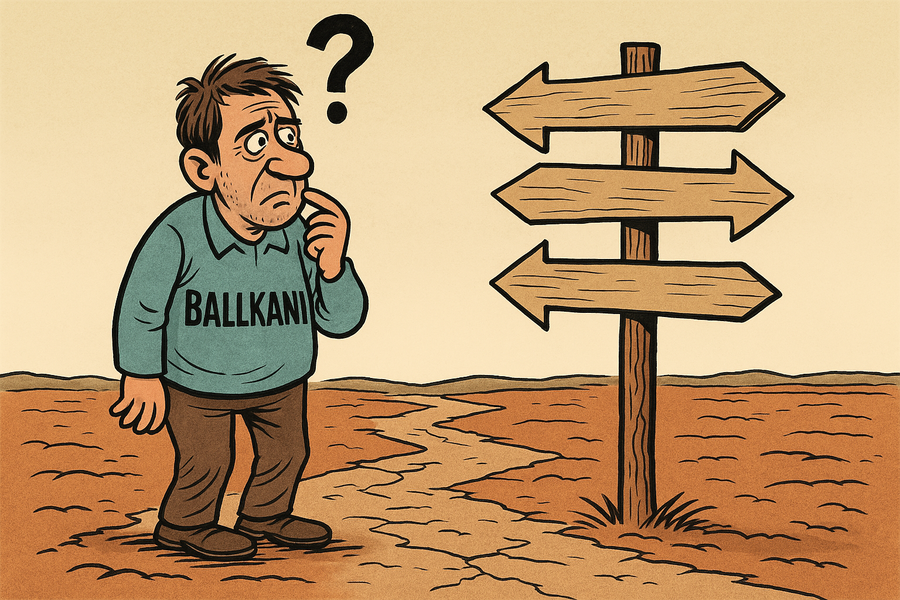
International reports show that the region has lost political and administrative orientation, while citizens report a sharp decline in trust in the state...
Public services in the Balkans are functioning at an uncertain pace. Citizens in Albania, Kosovo, North Macedonia, Serbia, Montenegro and Bosnia report a steady decline in trust in state institutions. The Balkan Barometer '2024 shows that only 7 percent of citizens in the region express a lot of trust in parliaments.
UNDP's 2023 Albania Survey reports that 59 percent of citizens perceive governance as non-transparent, while 62.7 percent say it lacks accountability. These numbers show that the political system does not create sustainable expectations.
Citizens demand clear rules and a service that works without daily improvisations. Institutions change rules frequently and produce decisions that are not based on analysis or governance standards. In some cases, political parties directly influence the administration. This practice creates uncertainty. Citizens do not know what is valid today and what may change tomorrow. In this climate, spontaneous reactions take the place of long-term policies.
Geopolitical pressures add to this uncertainty. The region faces increasing Russian, Chinese and Turkish influence. The European Union retains a leading role, but integration processes are slow. The FEPS report for 2024 emphasizes that institutional capture and the lack of rule of law remain the main obstacles to democratic stability in the Balkans. Governments often follow the Western orientation in declarations, but do not back it up with sustainable reforms.
Albania is experiencing the same situation. Institutional reforms created expectations for new standards, but citizens still report a lack of transparency and uncertainty in decision-making. Opinion polls show that SPAK enjoys a higher level of trust than other institutions, but this does not translate into overall trust in the state apparatus. The system produces success stories, but it does not guarantee that these cases will become the rule.
This panorama shows that the region does not move with a clear compass. Governments make decisions according to the interests of the day. The oppositions remain fragmented and do not present viable plans. Technical institutions do not serve as an axis of stability, but as extensions of the political cycle. In this situation, the citizen loses orientation. He sees a state that functions according to circumstances and not according to the rule.
The Balkans need a return to basic principles of governance. Decision-making should be based on evidence, not improvisation. The administration should function with clear and measurable standards. Parliament should monitor governments and demand accountability. These elements create the missing compass. Without them, countries in the region move in an unclear direction and often only react to crises./ Pamphlet








Lini një Përgjigje