


 Shkruar nga Pamfleti
For a leader once considered Trump's closest ally in Europe, the situation presents a clear paradox: to maintain the support of Italian voters, Meloni may be forced to disappoint the White House.
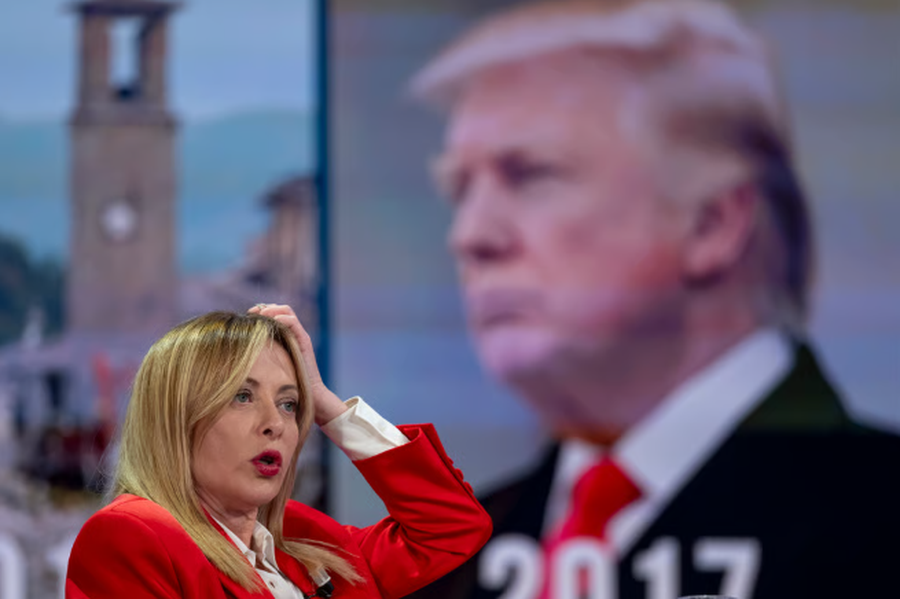
Italian Prime Minister Giorgia Meloni is facing an increasingly difficult political and economic challenge, which is forcing her to gradually move away from the closeness she had built with US President Donald Trump.
According to an analysis published by POLITICO, Meloni, who during the first year of Trump's second presidency was positioned as a bridge between Europe and the MAGA political movement, is now facing the economic and political consequences of this relationship.
In 2025, Trump publicly praised Meloni as a “highly respected” and “friendly” leader. However, the war in Iran and its economic fallout have significantly changed the political climate in Italy. Many Italian families blame US policies for rising energy costs, while Washington’s demands for increased military spending are facing growing opposition.
In recent months, Meloni has become more critical of Trump. She has publicly expressed disagreements with the US president and has restricted the use of an Italian air base by US aircraft. This shift also reflects public opinion in Italy. An Ipsos poll in May showed that 77 percent of Italians have a negative opinion of Trump.
One of the most sensitive issues remains defense. Italy currently spends about 2 percent of its GDP on defense, while Trump is demanding that NATO member states increase this level to 5 percent by 2035. Meloni has supported the target, but the Italian economy is struggling and the opposition argues that the country has more urgent priorities than increasing the military budget.
Antonio Misiani, a senator from the Democratic Party and former deputy finance minister, described the NATO objective as unattainable for Italy. According to him, the claim that Meloni could serve as a bridge between Europe and Trump has not worked.
Even within the ruling coalition, there are critical voices. Senator Claudio Borghi from the League party stated that it is difficult to explain to citizens why the tanks should be financed while families are facing high energy bills.
Meloni, for her part, argues that Italy cannot abandon its security commitments. In a speech to Italy's main business federation, she said that a country that is unable to defend itself loses its autonomy and the ability to defend national interests. According to her, defense spending is "the price of freedom."
Meanwhile, economic challenges are becoming increasingly apparent. The nearly 200 billion euro post-pandemic recovery program is nearing completion, productivity remains weak, and public finances are under closer scrutiny by the European Union. This situation is weakening Meloni's political position, while the opposition sees real opportunities to challenge the government in the 2027 elections.
The Italian government had planned to use 15 billion euros in loans from the European SAFE program to increase defense spending to 2.5 percent of GDP by 2030. However, the high level of the budget deficit is making it difficult to obtain these funds. Political sources cited by POLITICO say that Rome is considering the possibility of requesting only about 5 billion euros from the initially planned fund.
Experts warn that this could force the review of dozens of defense industry projects that are planned in collaboration with the Italian Ministry of Defense.
Former Italian ambassador to NATO, Stefano Stefanini, believes that the high level of debt and deficit does not leave Meloni much room to accelerate military spending. He believes that Italy may face criticism from Washington, but not necessarily a full-blown clash with the White House.
According to analyst Beniamino Irdi of the German Marshall Fund, the debate in Italy is not between armament and disarmament, but between maintaining strategic credibility and domestic political stability. He adds that the Trump administration assesses the loyalty of allies mainly through numbers and not political arguments.
However, some analysts believe that a clash with Trump may not necessarily be detrimental to Meloni. Given that the US president remains unpopular in Italy, potential criticism from Washington could strengthen her position with the Italian electorate.
For a leader once considered Trump's closest ally in Europe, the situation presents a clear paradox: to maintain the support of Italian voters, Meloni may be forced to disappoint the White House.



Lini një Përgjigje