


 Shkruar nga Pamfleti
Diplomats and officials are reacting with indignation to new details of the US peace plan, warning that it could derail their efforts to help Ukraine survive the war...
Donald Trump has caused a shock in one of the most sensitive negotiations currently underway in Europe, potentially derailing efforts to help fund Ukraine to stay in the fight against Russia.
For months, European Union officials have tried and failed to find a way to use some 140 billion euros of frozen Russian state assets, held mostly in Belgium, to support Kiev's war effort.
The money is urgently needed, as Ukraine risks running out of money early next year.
Talks in Brussels are at an extremely delicate stage, diplomats said, as senior officials try to draft a legal text that would allow frozen funds to be used for a loan to the Ukrainian government.
But the United States' new 28-point plan for a ceasefire includes a rival idea of using the same assets for American-led reconstruction efforts once a ceasefire is reached. The US would receive "50 percent" of the profits from that activity, the document said.
Ukrainian President Volodymyr Zelensky warned that Trump's new plan faced his country with one of the most difficult moments in its history: a potential choice between losing "dignity" and losing "a key partner."
Many EU diplomats and officials said they feared the proposals, from Trump's envoy, Steve Witkoff, would destroy their chances of getting the loan proposal approved by the 27 EU governments. European leaders had hoped to finalize the so-called "reparations loan" deal at a crucial summit next month.
A former French official, who has been granted anonymity like others to discuss sensitive issues, said Witkoff's idea "is, of course, scandalous."
“The Europeans are getting tired of trying to find a sustainable solution to use the assets to benefit the Ukrainians, and Trump wants to take advantage of them,” the former official said, adding that “this proposal is likely to be rejected by everyone.”
Get a psychologist.
A senior EU official in Brussels scoffed at the idea, noting that whatever he wants, Trump has no power to unfreeze assets held in Europe. An official from an EU government used harsh words to express their displeasure, while a senior EU politician said: "Witkoff needs to see a psychiatrist."
The issue of how to use Russia's frozen assets has been one of the most difficult for Ukraine's allies to resolve, amid concerns over the potential legal, political, security and economic consequences. The most acute issue is that the assets are largely held in a structure in Belgium called Euroclear, which leaves the Belgians disproportionately exposed to the risks of Russian retaliation.
The EU's idea is to use the assets to facilitate a loan to Ukraine, which would only have to be repaid if Russia agrees to pay Kiev war reparations once a peace agreement is signed.
But Belgium has been reluctant to approve the plan because it is concerned it could be held financially liable if Russia tries to recover the funds. This has put Belgium at odds with other EU members who are calling for faster action to support Ukraine.
On Friday, diplomats and EU officials said they feared Trump's new proposal would make it even harder to persuade Belgium to agree. An EU government official said the US plan was an argument against moving forward with the reparations loan, as the EU would face pressure from Trump to unlock assets under a post-war agreement, leaving European taxpayers responsible for paying debts to Russia.
One diplomat added that the idea that America seeks to benefit from assets held in Europe sounded like "classic Trump."
The details of the US plan are far from clear. However, the full text of the 28-point plan makes it clear that the Trump administration has plans for frozen funds, with $100 billion “to be invested in US-led efforts for reconstruction and investment in Ukraine,” the document says. “The United States will receive 50% of the proceeds from this activity. Europe will add another $100 billion to increase the total investment available for Ukraine’s recovery. Frozen Russian funds held by Europe will be unblocked.”
The rest of the frozen Russian assets will be invested in "a special US-Russia investment vehicle, which will be used for joint US-Russian investment projects in sectors that strengthen global stability and mutual economic interests."
The 28-point plan has sparked widespread concern in European capitals this week that Trump is preparing to try to force Ukraine to accept an unequal peace deal that would benefit Vladimir Putin.
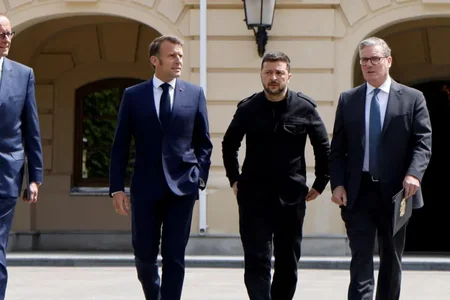
Zelensky held telephone talks with the leaders of Germany, France and the United Kingdom on Friday in an effort to coordinate their next steps.
The Europeans assured Zelensky that they remained committed to a “just” peace, according to a statement issued after the call. “They agreed that any agreement affecting European states, the European Union or NATO requires the approval of European partners or a consensus among allies,” the statement said. /Adapted from Politico/





Lini një Përgjigje