


 Shkruar nga Alberto Simoni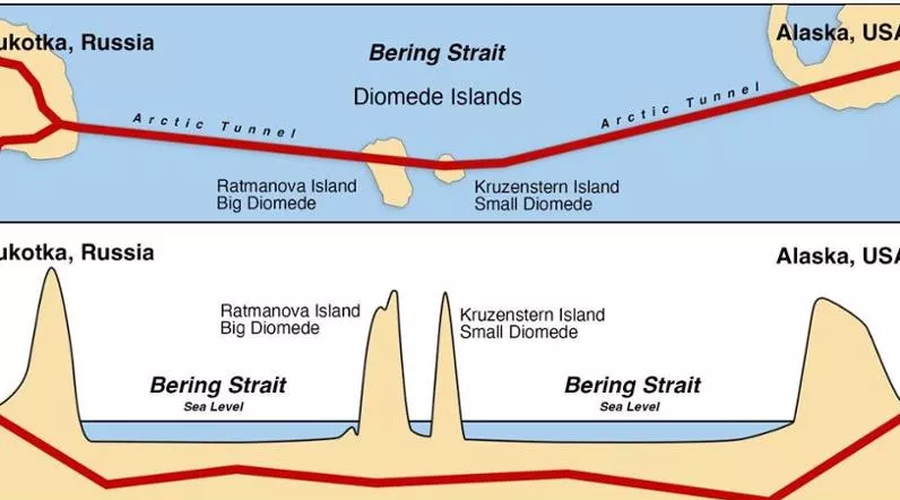
As the Russian military's position on the Ukrainian front worsens, Moscow is drawing attention to a project for a railway tunnel under the Bering Strait, called the "Bridge of Peace," to more closely connect the two historically rival countries. Russia says it is ready to sign an agreement with a private American company, while the US has not officially confirmed...
"A very interesting idea!" was Donald Trump's response to the journalist who, in October 2025, asked him about the proposal that Kirill Dmitriev - head of the Russian sovereign wealth fund (RDIF) and negotiator on the Ukraine issue - had presented to Vladimir Putin a few days earlier:
“Let's build a tunnel under the Bering Strait to connect the US with Russia.” Volodymyr Zelensky, who was in the White House next to Trump when this question was asked, reacted emphatically: “I don't like this idea…” The conversation ended there, but contacts between the US and Russia about the Arctic tunnel and the joint exploration of the seabed - in search of natural resources to be exploited and shared - continued.
According to Dmitriev's announcement, the railway project is expected to be signed today. But Washington itself has not confirmed any agreement. What exactly will be signed - and if it will be signed - by a private American company and the Russian side remains unclear.
Now let's get to the numbers. The Bering Strait is about 82 kilometers wide. The railway tunnel would pass through the two Diomede Islands - one under Russian sovereignty and the other American - and the underground segment would reach 112 kilometers, at least according to the plan presented in October last year.
It is said that the cost will be around 8 billion dollars, not 65 billion as previously mentioned, thanks to the possibility that the contract will be entrusted to the Boring Company, founded by Elon Musk. At that time, Dmitriev had published on the X platform his proposal to Musk. However, the plan that is expected to be presented today seems more modest. It is about an agreement with an American consulting company for the development of parks. According to Dmitriev, the agreement will be signed with this company and not with representatives of the American administration.
The estimated time frame for the project is eight years. The so-called “Trump-Putin tunnel” sounds ambitious, but the idea is not new in Russia. As early as 1904, the possibility of a railway connecting Siberia with Alaska was mentioned.
Dmitriev himself envisions a rail network that would connect the US, Canada, Russia and China. The days seem distant when Sarah Palin, John McCain's vice-presidential candidate in 2008, declared as governor of Alaska that she had experience in foreign policy because she could see Russia from the shores of her state.
If the project is realized, after 8 years she can cross the Strait by train and shake hands with those she once called "enemies" or people who should not be trusted.
Meanwhile, against the backdrop of this project, contacts between the Russians and the Americans have not ceased. The exchanges of messages between Witkoff and Dmitriev - a former banker with excellent English - have continued, despite the 73 missiles launched by Russia over Kiev, the counter-attacks and the escalation of the fighting.
Dmitriev confirmed that he had a phone conversation with Witkoff and Jared Kushner, the president's son-in-law and involved - albeit without an official position - in the negotiations on Ukraine and Iran on June 3. A new contact is expected soon.
Miami, the city where Witkoff holds his most important meetings, has also recently been visited by Ukrainian representatives. On February 18, 2025, the American diplomacy - represented by Marco Rubio - met in Riyadh with the Russian delegation led by Sergei Lavrov. The meeting produced few concrete results for Ukraine and Zelensky, but both sides emphasized that relations between the United States and Russia are not limited to the Ukrainian issue.
Restoring relations and resuming trade exchanges and joint projects were presented as strategic objectives. Fifteen months later, peace in Ukraine remains elusive, but Moscow-Washington bilateral relations appear more stable than expected.
According to Politico, the Pentagon has even considered canceling a contract to sell missiles to Germany, fearing Moscow's reaction. Signs of rapprochement are also being seen in sports. On July 1, a hockey match between the two countries' national teams is expected to take place, the first in 7 years, and with the support of Trump himself.
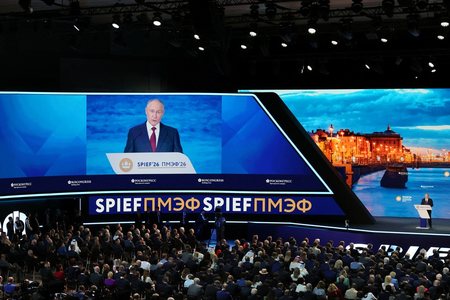
Meanwhile, an American delegation participated in the St. Petersburg Business Forum, led by Rosney Mims Cook, designer and since January president of the US Commission on Fine Arts.
Among his most notable decisions is the approval of the Grand Ballroom in the White House. Meanwhile, Kurt Volker, former US ambassador to NATO during Trump's first term, highlighted in an interview with "La Stampa" the close connection between Witkoff and Dmitriev.
He has advised the European Union to build its own dialogue channel with Russia - "not necessarily for negotiations", as he specifies - because according to him "when they sit down to discuss, the US and Moscow do not think about European interests"./ Pamphlet from "La Stampa"




Lini një Përgjigje