


 Shkruar nga Pamfleti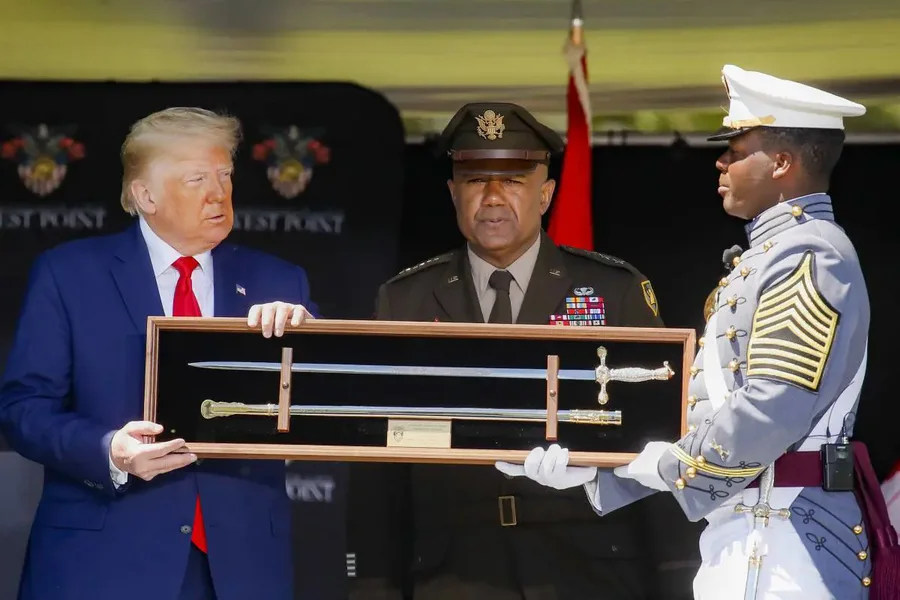
From symbolic putters to luxury objects, items exchanged between leaders demonstrate alliances, strategies, and global narratives, but rarely do they actually shift balances.
In the context of international relations, symbolic gestures can carry equal, if not greater, weight than official statements. Gifts exchanged between world leaders are never casual: they reflect personal relationships, diplomatic strategies, and political messages intended for a global audience. During and after Donald Trump’s first term, several episodes demonstrated how these objects can become powerful narrative tools, capable of summarizing alliances, conflicts, and shared values.
But they can also cause criticism and bureaucratic hassles. Democrats on the House Oversight Committee have alleged that the first Trump administration failed to properly record some foreign gifts, as required by the Foreign Gifts and Decorations Act, though this could simply be the result of mismanagement of accounting.
Personal connection with Shinzo Abe
The gifts Trump has received during his second term reflect a certain attention to personalization in relationships between leaders. His well-known passion for golf has been a source of inspiration. In May 2025, South African President Cyril Ramaphosa arrived at the White House with a book on South African golf courses and accompanied by two famous golfers, Ernie Els and Retief Goosen.
One of the most significant examples involves an object that belonged to the late Shinzo Abe, Japan's prime minister during Trump's first term. During a tour of East Asia, Japanese Prime Minister Sanae Takaichi gave Trump a putter that had belonged to Abe, with whom Trump had developed a particularly close relationship.
The two leaders had a very friendly relationship, often highlighted by informal meetings and gestures of mutual appreciation. The gift associated with Abe represented not only a personal memento, but also a symbol of a strong political relationship between the United States and Japan at a time of important geopolitical balances.
Zelensky's gift and the message of resistance
Another symbolic episode occurred last August, when Ukrainian President Volodymyr Zelensky visited the White House. On that occasion, Zelensky presented Trump with an object of strong significance: another putter that had belonged to Ukrainian soldier Kostiantyn Kartavtsev, who lost a leg fighting against Russian forces in the early months of the war.
After his injury, Kartavtsev used golf as part of his rehabilitation process, turning the sport into a means of physical and psychological recovery. The putter was engraved with the phrase: “Let's put peace together!”, a message that symbolically united sport with the aspiration for peace.
Between symbolism and political communication
In both cases, the gifts Trump received show how contemporary diplomacy uses concrete objects and individual stories to construct broader messages. Whether to strengthen a historic alliance or draw attention to a developing conflict, these gestures prove that even details can have a significant impact on the international stage.
The United States Constitution includes the so-called “Emoluments Clause,” which requires Congressional approval for the acceptance of gifts from foreign countries. This norm is enforced today through the “Foreign Gifts and Decorations Act” of 1966: officials can only keep gifts of minimal value, while the rest are archived by the state. Many countries implement similar restrictions to reduce the risk of corruption, turning gifts into diplomatic signals. However, there are exceptions: such as the much-discussed case of the Boeing 747-8 offered by the Qatari royal family.
However, personalized gifts can also take on a transactional dimension. Javier Milei presented Trump with a nomination letter for the Nobel Peace Prize, housed in a gold frame. María Corina Machado went even further, presenting him with her Nobel medal.
However, there is no evidence that such carefully thought-out gifts produce long-term effects: more than tools of influence, they seem like stage props, useful for opening dialogue but destined to lose their importance once diplomacy gets to the heart of the matter. /Adapted from IlGiornale /




Lini një Përgjigje