


 Shkruar nga Karsten-Dirk Hinzmann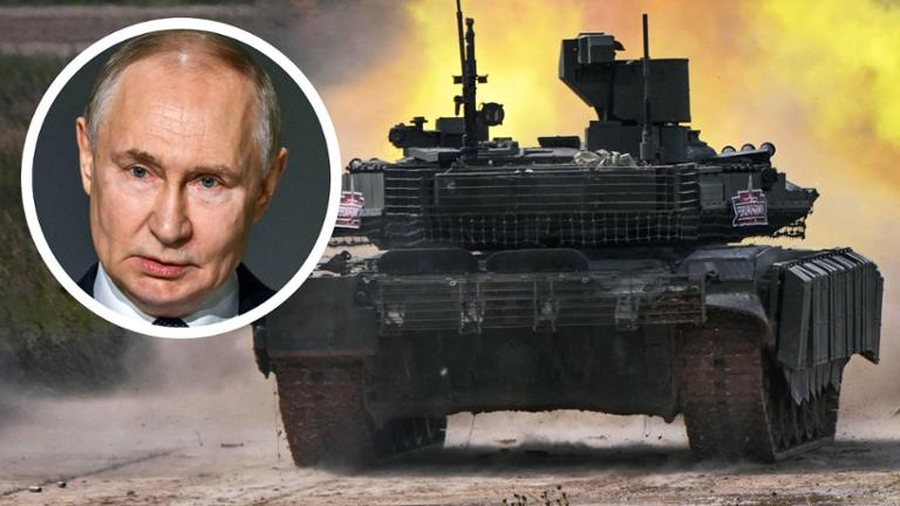
A Russian military success in the "special operation" in Ukraine would cost Europe twice as much as a Ukrainian victory: if Russia wins in Ukraine, the European community would have to invest a total of about 1.8 trillion euros over the next four years, and Europe would also have to expect an influx of 6 to 11 million more refugees from the war zone...
“Instability is growing, Putin’s hybrid warfare in Europe is intensifying, and out of fear of escalation, we have encouraged the global proliferation of nuclear weapons,” writes Timothy Garton Ash.
The analyst had already raised the question in early 2025 of how vulnerable the European Union (EU) would be if Vladimir Putin were to win his war in Ukraine, which he instigated in violation of international law.
In his analysis for the European Council on Foreign Relations, he predicted “the shadow of a dark year 2025.” That shadow has deepened considerably since then, with Europe set to suffer financial losses from the war in Ukraine more than previously thought; however, financing a Ukrainian victory now seems like a good deal compared to leaving the field in Russia’s hands.
A study suggests that if Russia wins the war in Ukraine, the EU will face collapse.
Timothy Garton Ash initially assumes that a Russian victory would be a diplomatic disaster and collateral damage in Donald Trump's new foreign policy direction. Ash points out that Putin has spoken of a new "global majority" and "the creation of a completely new world order," including territorial shifts in Russia's favor. According to the analyst, Putin would use any means necessary to achieve this: the land grab currently being pursued in Ukraine, presented as an allegedly legitimate political instrument, is on a par with "poisoning, sabotage, disinformation, and election interference" for Putin, Garton Ash argues.
“A Russian victory in Ukraine would encourage China to increase pressure on Taiwan, and North Korea would intensify its provocations against South Korea,” he writes, to the extent that US President Trump is wrong to keep the US militarily out of the Ukraine war in order to focus on the conflict with China. Which he can hardly do anyway, because a Russian victory in Ukraine would bring it, along with NATO and the European Union, to the brink of financial ruin, at least that is what Norwegian scholars are sure of.
In a recently published study by the think tanks "Corisk" and the "Norwegian Institute of International Affairs", they reach a shocking conclusion.
A Russian military success in the “special operation” in Ukraine would cost Europe twice as much as a Ukrainian victory: if Russia wins in Ukraine, the European community would have to invest a total of about 1.8 trillion euros over the next four years, and Europe would also have to expect an influx of another 6 to 11 million refugees from the war zone. Moreover, the Russians would have gained so much combat experience in Ukraine that they would be morally far superior to any NATO army, regardless of its composition or equipment.
For NATO, a Russian victory would mean that it could be forced to rush into action against an adversary who, for years, has been tactically trained and morally prepared, marching toward a "continuous war."
"War means a continuous cycle of learning, innovation and adaptation; and this happens at a very high speed. In the next war, this cycle will be even faster than now," says Martin Winkler.
However, the human factor remains the decisive difference, both at the command level with its demands for leadership, and within the ranks with its demands for morale and camaraderie, explained the lieutenant colonel and head of the "Assessment" section at the Army Command in the "Nachgefragt" podcast.
Russia, as a winner, would also be able to repair its military equipment much faster than the losers. According to Legal Tribune Online, the European Union currently holds 210 billion euros in assets frozen by the Russian central bank. Russia could potentially face a total bill three times that amount after a loss in Ukraine, the World Bank published in early 2025. It estimated that “the total cost of reconstruction and recovery in Ukraine will reach 524 billion US dollars (506 billion euros) over the next decade as of December 31, 2024.” And the Norwegian analysts did not even include these costs in their calculations.
Their analysis refers to the costs of continued support for Ukraine, care for refugees, and military buildup in anticipation of a Russian attack on the Baltic states, whenever that happens.
In total, 1.205 trillion euros distributed over the next 4 years. This assumes that Russia achieves victory in Ukraine. Conversely, defense costs will be reduced and costs for refugees will be redirected from securing them as asylum seekers to their return to their countries of origin. However, until this status is achieved, military spending will remain high. And these costs will occur now anyway, according to the Kyiv Independent.
"To achieve victory, Ukraine would need a rapid influx of military equipment. This includes 1,500 to 2,500 main battle tanks and 2,000 to 3,000 artillery systems within one to two years. (...) Ukraine would also need up to 8 million drones of all types, air defense systems and strategic missile systems," the media quoted the study as saying.
This is a sum that Europe may have to bear on its own if Donald Trump intends to continue his policy of denial, if the Europeans were willing and able. “Ukraine could continue to fight, but the war would immediately enter a much more vulnerable and unpredictable phase,” Chris Sunday and Veronika Melkozerova recently wrote.
It will take Germany and Europe as a whole decades to keep pace with current Russian weapons production.
They point to the capabilities of Ukraine's military economy. "Ukraine currently has one of the largest arms industries in Europe and produces its own drones, medium- and long-range missiles, artillery systems, and ammunition," according to the authors of Politico magazine.
However, this economic power also applies to the European economy, which, however, can only provide this strength collectively. Individual national solutions, as has been the case so far, help a lot, but are far from sufficient. Europe can hardly meet its demand for battle tanks alone. Up to 2,000 new battle tanks are currently on order, writes Martin Rosenkranz. The author of the Austrian magazine Militär Aktuell estimates the current inventory of battle tanks in Europe at around 6,500.
Most of them are barely functional. This is something that will change only slightly in the future, as the British Economist predicted in mid-2025. According to the newspaper, tank production is sluggish: “Europe has only one active production line for main battle tanks: the Leopard 2 line, operated by the German part of the KNDS. During the Cold War, 300 tanks were produced there a year. Today, it is about 50,” the newspaper reported. The British, for example, are also trying to improve their armored forces. Instead of increasing their Challenger fleet with the third generation, the existing Challenger 2 is being re-equipped.
On the other hand, Russia is repairing its old Soviet tanks and continuing its rapid production. However, the prospect of 2,500 (new) tanks for Ukraine is quite unrealistic. This is also the assertion of the Belgian organization "Bruegel", as its authors Guntram B. Wolff, Alexandr Burilkov, Katelyn Bushnell and Ivan Kharitonov explain.
"Germany and Europe as a whole will need decades to keep pace with current Russian weapons production." /Adapted from Fr.de/



Lini një Përgjigje