


 Shkruar nga Pamfleti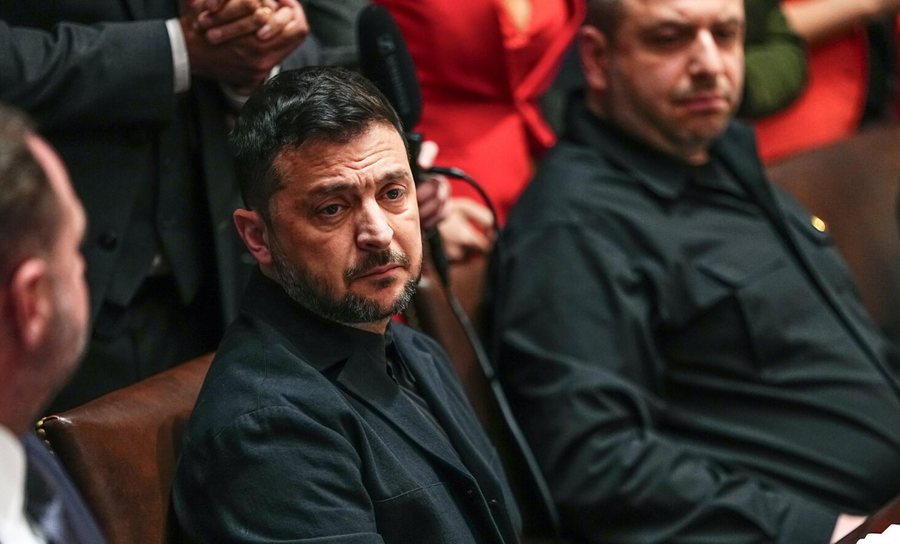
Zelensky under fire: Corruption affects his inner circle
After the massive summer protests that rocked the streets of Kiev, the issue of corruption has returned strongly to the public and political debate in Ukraine.
In July, thousands of citizens protested against a draft law that would have placed the country’s main anti-corruption agencies, NABU (National Anti-Corruption Bureau) and SAPO (Special Anti-Corruption Prosecutor’s Office), under the jurisdiction of the Prosecutor General, a figure appointed by parliament and directly influenced by the government. President Zelensky initially signed the law, but a strong public backlash and pressure from the European Union forced him to immediately withdraw it.
The German newspaper Berliner Zeitung notes that corruption has now become one of the most talked-about topics in the Ukrainian media. “Journalists denounce that official anti-corruption agencies are not allowed to work effectively,” the newspaper writes. The head of NABU, Semyon Kriwonos, told the Frankfurter Allgemeine Zeitung on September 24 that for any investigation of deputies “we need permission from the Prosecutor General. Our employees are threatened by the state, our work is sabotaged, often by illegal means.”
Tensions have been particularly high over investigations into President Zelensky's inner circle. Former Deputy Prime Minister Oleksiy Tschernyschow is under investigation for alleged manipulation of state land sales. Timur Minditsch, a personal friend of Zelensky and former manager of his entertainment company "Kvartal 95", is also accused of involvement in the mismanagement of funds for military fortifications in the energy sector, where he has strong influence.
German journalist Konrad Schuller, in an article for the Frankfurter Allgemeine Sonntagszeitung, raises a delicate question: "How can a clean president be compatible with tolerating corruption?"
This is a concern that is spreading beyond Ukraine's borders. The Berliner Zeitung writes that "in this context, German citizens and taxpayers can rightly ask: are their aid to the Ukrainian people going into a bottomless pit?"
Transparency International's latest data for 2024 confirms this alarming trend: after a modest improvement in 2023, Ukraine has fallen again in the Corruption Perceptions Index, taking 105th place in the ranking. According to Andrii Borovyk, executive director of Transparency International Ukraine, this is a clear signal of the stagnation of reforms, which are being implemented only formally or are even being deliberately hindered.
Ukrainian public opinion also seems to be moving away from the idealism of the beginning of the war. A recent Gallup poll shows that, for the citizens questioned, the biggest problem in the country is not the war, but corruption. 50.5% of respondents state that high-level corruption is the most negative factor in the current situation. Then come the damages from the Russian invasion and the decline in living standards. At 27.9%, “aggressive methods of military mobilization” also rank as a major concern.
In a country facing occupation, poverty and immense international pressure, an internal crisis of trust and corruption can be as dangerous a weapon as bombs. And as the front against Russia continues, Ukraine must face another front: that of cleansing its institutions. / Adapted from “Pamphlet” by “Inside Over”


Lini një Përgjigje